How to Choose a Forex Broker: 7 Checks Before You Deposit
Short answer: Choose a broker in this order: legal entity and regulator, protections such as negative balance protection, total trading cost, minimum deposit and withdrawal rules, then leverage. A brand can run several companies, and the one that holds your account decides what protection you get.
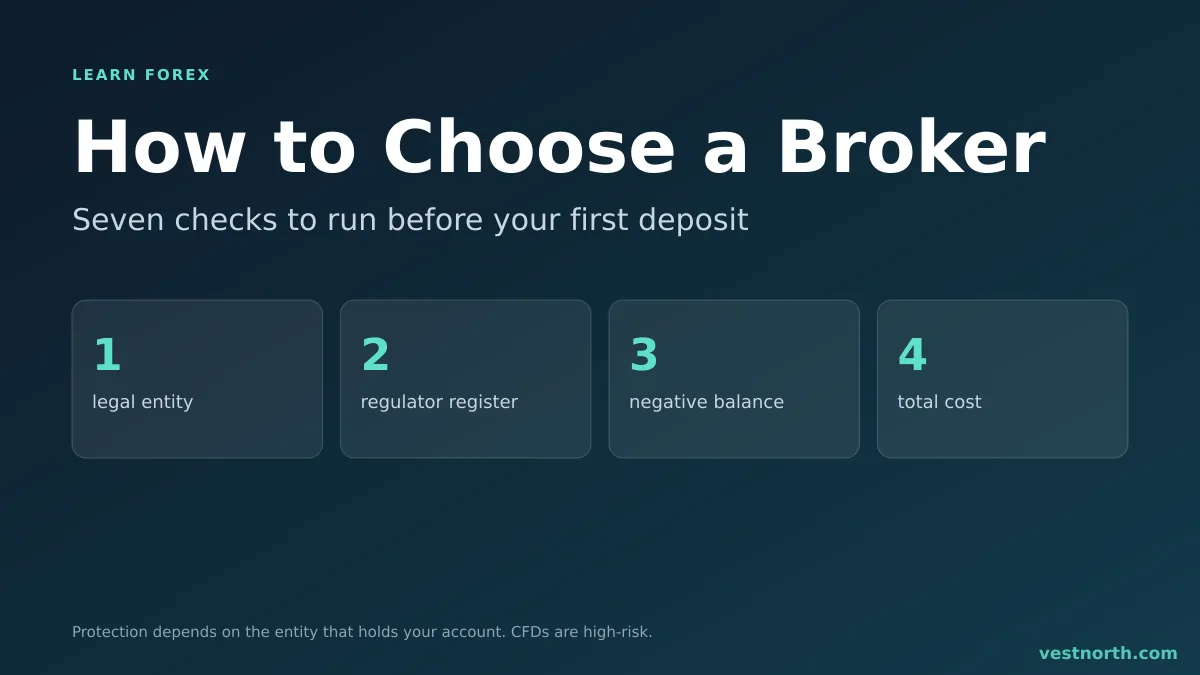
Seven checks to run before a first deposit. Examples come from the VestNorth broker reviews, October 2026.
1. Find the legal entity that holds your account
If you are not sure what a broker does for you, start with what a forex broker is. Then open the client agreement for your country and read the first clause. It names the company you contract with.
This matters because one brand often runs several companies. The Axi review shows the split clearly: Axi has ASIC, FCA and CySEC licences, but international clients on its global site sign with AxiTrader LLC in St Vincent and the Grenadines. By its own Client Agreement that entity is not licensed to issue CFDs there. Our Axi review has the entity table.
VT Markets works the same way. Its Client Agreement says you contract with VT Markets Limited in Mauritius and not with any other VT Markets company, according to our VT Markets review.
2. Check the regulator, and what it does not give you
Look the entity up on the regulator’s own register. Compare the licence number and the company name letter for letter. Our EBC legitimacy check shows this step for a brand that runs several entities.
Then read what the entity does not give you. The Vantage review reports that clients of its global site sit under an offshore entity and do not get FCA leverage limits, the FSCS, the Financial Ombudsman Service or FCA client-asset protection. A licence from a regulator in one country gives you nothing if your account sits in another company.
Also search for regulator warnings. Our VT Markets legitimacy check lists warnings from the FCA, CONSOB, CNMV, the Danish FSA and Canadian regulators.
3. Compare negative balance protection
Negative balance protection means you cannot lose more than your account balance. Brokers differ, and the wording matters.
| Broker (per our reviews) | What the review reports |
|---|---|
| Exness | Stated: you cannot lose more than your balance |
| FBS | Stated for all accounts, but FBS keeps the right to claim a debt after actions it considers intentional |
| AvaTrade | Retail accounts only |
| Axi | None for clients of the St Vincent entity |
| Vantage | Not guaranteed at the international entities |
| VT Markets | Discretionary under the Client Agreement |
Read the clause itself. “Discretionary” and “except intentional actions” are conditions, not guarantees.
4. Add up the total cost
A low headline spread can hide a commission, and a zero commission can hide a wider spread. Work out the cost of one standard lot on the pair you plan to trade.
Our ECN vs STP guide shows the sums with real figures: VT Markets lists $6 per lot round turn on RAW ECN, which equals 0.6 pips on a USD-quoted pair. RAW ECN only wins if its spread is more than 0.6 pips tighter than the commission-free account. The pip calculator turns pips into money.
Then check the costs that sit outside the spread:
- Swaps on positions held overnight, see what a swap is.
- Inactivity fees. The AvaTrade review reports a 50 inactivity fee after 3 months.
- Deposit, withdrawal and currency conversion fees. The Vantage review lists a $20 international wire withdrawal fee.
5. Read the minimum deposit and the withdrawal rules
A minimum deposit is the smallest amount the broker accepts, not the amount you should start with. FBS lists $5 overall and Axi gives $100 as a recommended minimum, while its help centre recommends “at least USD 200” so the balance can cover margin, according to our reviews.
When a broker’s own pages disagree, that is information too. The VT Markets review found different minimum deposit, leverage and stop-out figures across its pages.
Before depositing, find the withdrawal rules: fees, processing time, and whether a bonus locks your funds. A bonus with volume conditions can stop you withdrawing. You can always decline one. Our Exness withdrawal, Titan FX withdrawal and EBC withdrawal guides show how these rules look in practice.
6. Treat leverage as a risk setting
Leverage of 1:500 or 1:3000 sounds generous. It only lowers the margin required per trade, so a small price move can wipe out the account faster. Read what leverage is and how margin calls and stop outs work.
Check two things in the agreement. First, the stop-out level: the FBS review reports a 40% margin call and a 20% stop out. Second, whether the broker can change leverage on open positions. The FBS review says it can do so without notice.
Exness shows another pattern. “Unlimited” leverage is not on by default. The help centre lists conditions, including equity under $5,000, according to our Exness review.
7. Check where the facts come from
Broker websites are marketing. A useful review links each figure to the broker’s own page, legal document or a register, and says plainly whether the reviewer traded real money.
VestNorth reviews are based on documents, help centres and registers. We say so at the top of each review, and the weights we use are on the methodology page. A review that gives a star score without saying how it was built deserves less trust.
How to verify a regulator, step by step
A licence claim on a broker’s website is marketing until you find it on the regulator’s own register.
- Open the client agreement for your country and copy the exact company name, address and licence or reference number.
- Search the regulator’s register for that name. Useful starting points: the FCA’s Firm Checker and Financial Services Register, ASIC’s professional registers and CySEC’s list of Cypriot investment firms.
- Check the status: the FCA says a firm marked “No longer authorised” or “Revoked” has had its authorisation cancelled.
- Match the contact details. The FCA describes clone firms as fraudsters who copy the name, address or reference number of a genuine firm, and says to compare the contact details on its register with the ones you were given (source).
- Search the regulator’s warning list. The FCA notes that a firm missing from its Warning List may still be unauthorised, so this step never replaces step 2.
- Save the register page with the date.
Clones are real. On 12 December 2024 the Central Bank of Ireland warned that an unauthorised firm was seeking to pass itself off as Ava Trade EU Limited (C53877) (source). A correct licence number on a page does not show the website belongs to the licensee.
Being on a register is not enough on its own. Checks 2 and 3 in the seven-check list cover what protection the entity gives.
Forex broker checklist
Copy this list and tick each line from the broker’s documents, not from its homepage.
- Company name and licence number found on the regulator’s register
- Entity named in my client agreement matches the register entry
- No regulator warning for the brand or the company
- Negative balance protection stated, and its conditions read
- Compensation scheme named, or confirmed absent
- Cost per lot worked out for my pair and account type
- Minimum deposit, deposit and withdrawal fees and times found
- Margin call and stop out levels found for my account
- Leverage limit and whether it can change without notice
- Bonus terms read, or bonus declined
- Demo account tried on the platform I will use
- First deposit small enough to lose
Red flags
- A guarantee or promise of profit.
- A person who contacts you first and asks you to deposit.
- Licence numbers that do not appear on the register, or appear under a different name.
- Withdrawal terms you cannot find in writing.
- A request to pay to an account in a different company name.
Forex broker trading conditions comparison (October 2026)
The seven checks are easier to run side by side. This table puts the main trading conditions of the brokers we review in one place, for clients on each broker’s global website. Every figure comes from the linked review, where each one is sourced to the broker’s own documents. Conditions change, and some differ by country, so open the review and the broker’s page before you decide.
| Broker | Entity for global clients | Minimum deposit | Maximum leverage | Stop out | Negative balance protection |
|---|---|---|---|---|---|
| Exness | Offshore entity (FSA Seychelles, FSC BVI or CBCS Curaçao) | Standard: low, by payment method · Pro, Raw, Zero: from $200 | “Unlimited” on eligible accounts, conditions apply | 0% (exceptions apply) | Yes |
| Vantage | Vantage Global Limited, VFSC Vanuatu | 50 in account currency (Standard STP, Raw ECN) | 100:1 to 500:1 per help centre, up to 1000:1 in eligible countries per website | 20% | Not guaranteed at international entities |
| VT Markets | VT Markets Limited, FSC Mauritius | $100 on account pages, 50 units in help centre | 500:1 default, up to 2000:1 in eligible countries | 20% (agreement: may close from 50%) | Discretionary |
| FBS | FBS Markets Inc., FSC Belize | $5, varies by payment method | Up to 1:3000, falling with equity | 20% | Yes, except intentional actions |
| AvaTrade | Ava Trade Markets Ltd, British Virgin Islands | 100 in account currency | 30:1 on major FX for EU retail; non-EU FX level not confirmed | 50% retail | Retail accounts only |
| Axi | AxiTrader LLC, St Vincent and the Grenadines (no CFD licence) | $100 recommended | Up to 1000:1 | 20% (MT4/MT5) | No |
| Titan FX | Titan FX Limited, Vanuatu | 200 USD per help centre (pages differ) | 1000:1, 2000:1 on Micro for eligible clients | 20% | Discretionary |
| EBC | EBC Financial Group (SVG) LLC | No account minimum found, method minimums from USD 10 | 500:1, Ultra Leverage in some countries | 30% | Partial, on application, up to USD 1,000 |
How to read it:
- Every global entity in the table is offshore. None of these entities gives you FCA, ASIC or EU retail protection. That is the first line to read, not the leverage column.
- A lower stop out is not “better”. A 0% or 20% stop out lets losses run further before the platform acts. The margin call and stop out guide lists each broker’s levels with sources.
- Where a broker’s pages disagree (VT Markets, Titan FX, Vantage), plan for the stricter figure and keep a copy of the page.
- Costs are not in this table because they depend on account type and instrument. Compare them per lot in each review or in guides such as Vantage account types and VT Markets fees, or start with AvaTrade vs Vantage.
A short worked comparison
Say you want to start with $200 and trade 0.1 lot on EUR/USD.
- Entity: write down which company the agreement names for your country.
- Protection: note whether negative balance protection is stated without conditions.
- Cost: 0.1 lot is a tenth of a standard lot, so the commission and spread cost are a tenth of the per-lot figures. Use the lot size calculator to confirm the position size.
- Margin: 0.1 lot is 10,000 units of the base currency, roughly $10,000 on EUR/USD. At 1:100 leverage that needs about $100 of margin, half your account, and a stop out can arrive before the other $100 is gone.
Two brokers with the same spread can fail steps 1 and 2 and look identical on a comparison table.
Other broker reviews with a different entity setup: Genesis FX (Saint Lucia company), FXNX (licence shown as suspended) and Kama Capital (three entities, no segregation).
Bottom line
Start with the company that holds your account and the protections it gives, then compare total cost per lot, deposit and withdrawal rules, and leverage. Use the broker’s own client agreement and the regulator’s register as your sources. Only deposit money you can afford to lose. CFDs are complex, high-risk instruments.
New to trading? Our forex trading for beginners guide puts these basics together in one place.
Frequently asked questions
What is the first thing to check when choosing a forex broker?
The legal entity that will hold your account and the regulator behind that entity. One brand can run several companies with very different protections, so the licence of the brand is not enough.
Does a regulated broker mean my money is safe?
No. Regulation lowers some risks, but protection depends on the entity and the regulator. Our Axi review reports that international clients sign with AxiTrader LLC, which by its own Client Agreement is not licensed to issue CFDs in St Vincent and the Grenadines.
Is negative balance protection the same everywhere?
No. Exness and FBS state it, with FBS keeping a right to claim a debt after intentional actions. Axi says there is none for clients of its St Vincent entity, and VT Markets treats it as discretionary under its Client Agreement.
Should I pick the broker with the lowest minimum deposit?
Not on that basis alone. FBS lists $5 overall and VT Markets lists $100 on account pages, but a small deposit also means a small margin buffer and a quick stop out.
Is higher leverage a reason to choose a broker?
No. Leverage changes how fast losses reach your account. FBS allows up to 1:3000 and the FBS review shows it can change leverage without notice.
How do I compare forex broker trading conditions?
Put the same items side by side for the entity that would hold your account: regulator, minimum deposit, maximum leverage, stop out level, negative balance protection and cost per lot. Our comparison table covers eight brokers with sources in each review.
Can I trust a broker review site?
Check how the site gets its facts. A good review links each figure to the broker's own page or a regulator register and says whether the reviewer traded real money. Our methodology page lists the weights and sources we use.
What should I look for in a forex broker?
The legal entity and regulator for your country, negative balance protection, total cost per lot, minimum deposit and withdrawal rules, and the leverage and stop out terms in the client agreement.
How do I check if a forex broker is regulated?
Take the company name and licence number from the client agreement and search them on the regulator's own register, for example the FCA Financial Services Register, ASIC's professional registers or CySEC's list of regulated entities. Then compare the website domain and contact details with the register entry.
What are the red flags of a bad forex broker?
A licence number you cannot find on the regulator's register, a company name that differs from your agreement, a regulator warning, pressure to deposit, guaranteed-profit claims, and unclear withdrawal terms.
What is a clone firm?
A fraudster pretending to be a firm the regulator authorises, often copying its name, address or reference number. The FCA says the main defence is to compare the contact details on its register with the ones you were given.
Is a demo account enough to choose a broker?
It helps you test the platform and order types, but demo prices and fills can differ from live trading. Use it alongside the document checks above, not instead of them.
Sources
- FCA: How to check a firm or individual is authorised
- FCA: Clone firms and individuals
- FCA: Warning List of unauthorised firms
- ASIC: Search ASIC's registers
- CySEC: Cypriot investment firms list
- Central Bank of Ireland: Tradervesta warning (12 December 2024)
Sources checked on October 19, 2026. Broker terms change often: confirm the current conditions on the broker's own site before you open an account.