Forex Trading for Beginners: How It Works and What It Costs
Short answer: Forex trading means buying one currency against another, for example EUR/USD. You choose a lot size, the price moves in pips, and you pay the cost through the spread, a possible commission and overnight swaps. Leverage lets a small deposit control a large position, which raises losses as fast as gains.
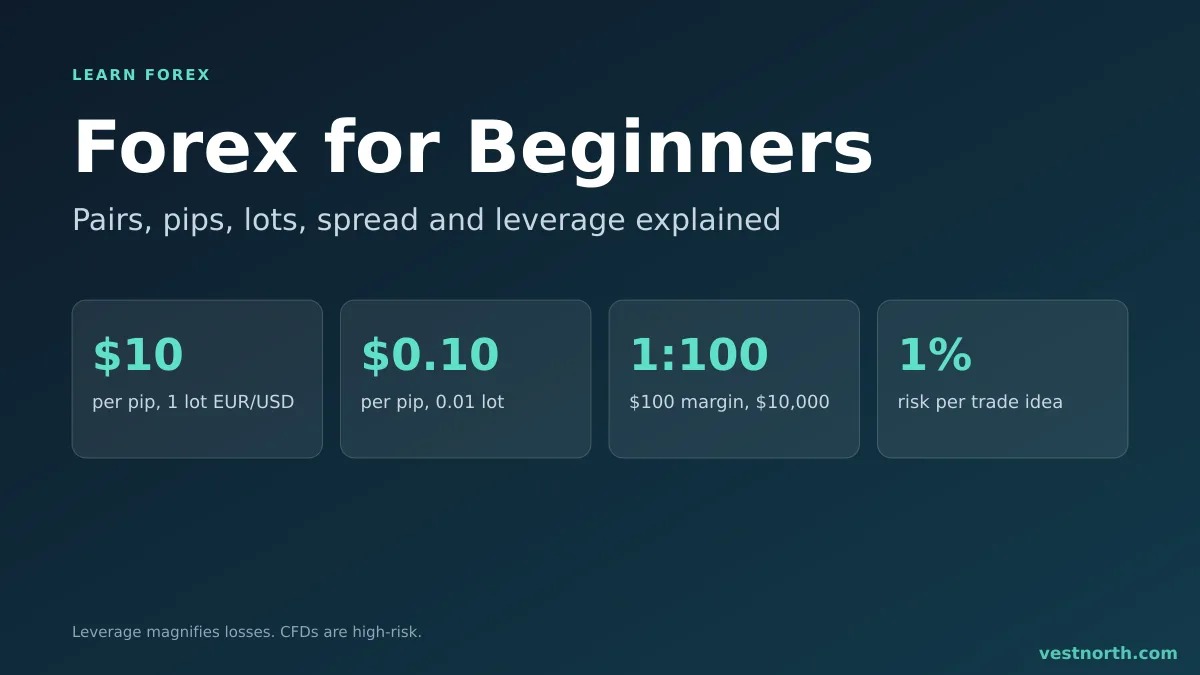
The five basics in one picture. Pip and lot values are for EUR/USD, October 2026.
Is forex trading good for beginners?
Forex is easy to start and hard to do well. Three things make it look friendly: accounts open with small deposits, markets run 24 hours on weekdays, and 0.01-lot trades keep the money per pip small. Three things make it hard: leverage lets a beginner open a position far larger than the account can absorb, costs are paid on every trade whether it wins or loses, and prices react to news in seconds.
When the EU’s markets regulator restricted CFDs in 2018, it cited national regulators’ analyses showing that 74–89% of retail accounts typically lose money on CFDs (source). EU brokers must now show their own figure for the last 12 months in a risk warning. Read it before you open an account.
Forex suits a beginner who will:
- learn the platform on a demo account first;
- trade 0.01 to 0.05 lot until the numbers in this guide feel routine;
- risk a fixed small share of the account per trade, with a stop loss on every one;
- treat the first deposit as money they can afford to lose.
It does not suit anyone who needs the money for bills or expects a steady income from it.
What you actually trade
Forex is the exchange of one currency for another. Prices are quoted in pairs. In EUR/USD, the euro is the base currency and the US dollar is the quote currency. A quote of 1.1000 means one euro costs 1.1000 dollars. Your platform shows two prices, the bid and the ask, and the gap between them is the spread.
- Buy (go long) if you expect the euro to rise against the dollar.
- Sell (go short) if you expect it to fall.
Prices are plotted on a chart. How to read a forex chart explains time frames and trends, and candlestick basics covers the common candle shapes. After that, support and resistance, moving averages and trend trading basics are the usual next steps.
Most retail traders trade CFDs (contracts for difference). You never take delivery of currency. The broker pays or charges you the difference between your opening and closing price.
Pips: how a price move is counted
A pip is the standard step of a price move. On most pairs it is the fourth decimal place, so 1.1000 to 1.1001 is one pip. Read what a pip is for pairs that differ, such as those with the Japanese yen, and forex pip value for what a pip is worth in money.
Lots: how big your trade is
A lot sets the trade size. One standard lot is 100,000 units of the base currency, a mini lot is 10,000 and a micro lot is 1,000.
| Lot size | Units | Value of one pip on EUR/USD |
|---|---|---|
| Standard (1.00) | 100,000 | about $10 |
| Mini (0.10) | 10,000 | about $1 |
| Micro (0.01) | 1,000 | about $0.10 |
A 20-pip move costs you about $200 on a standard lot and about $2 on a micro lot. Details are in what a lot is and lot size for beginners, and the lot size calculator gives the figure for your pair.
Leverage and margin
Margin is the part of your balance the broker sets aside to hold a position open. Leverage is the ratio between the position and that margin. At 1:100 leverage a $10,000 position needs $100 of margin.
The position still moves on the full $10,000. A 1% price move changes the result by $100, which is 100% of that margin. Leverage does not change the odds. It changes how fast a loss reaches your balance. Read what leverage is before you pick a setting.
If losses use up your free margin, the broker first issues a margin call and then closes positions at the stop-out level. Our guide to margin call and stop out shows the sums.
What a trade costs
Every trade has costs, whether or not you win.
- Spread: the gap between the buy and sell price. See what a spread is.
- Commission: charged on some accounts. VT Markets lists $6 per lot round turn on RAW ECN, according to our review.
- Swap: a charge or credit for holding a position overnight. See what a swap is.
Compare the total per lot rather than one number. The ECN vs STP guide walks through the comparison with real figures.
A worked example with the risk set in advance
Say your account holds $500 and you decide to risk 1% on a trade, which is $5.
- You plan to buy EUR/USD with a stop loss 25 pips away.
- The loss at the stop must be $5, so each pip can be worth $0.20.
- A micro lot (0.01) is worth about $0.10 per pip, so you trade 0.02 lots.
- If the stop is hit, you lose about $5 plus costs. If you had traded 0.10 lots instead, the same stop would cost about $25, which is 5% of the account.
This is why trade size should come from the risk you accept, and not from the biggest position the margin allows.
Pick a broker with care
The company that holds your account decides your protection. The Axi review reports that international clients sign with AxiTrader LLC, which by its own Client Agreement is not licensed to issue CFDs in St Vincent and the Grenadines. Our guide on how to choose a forex broker lists the checks to run before you deposit. Read the deposit and withdrawal pages as well: our EBC minimum deposit and EBC withdrawal guides show how minimums and times differ by payment method, and our Exness minimum deposit, Titan FX minimum deposit and Axi minimum deposit guides do the same for those brokers.
Beware of bonuses. They can carry volume conditions that block withdrawals, and you can always decline one.
Habits that limit damage
- Open a demo account first to learn the platform. A demo has no real fills or emotions, so treat it as practice for the buttons.
- Use a stop loss on every trade and decide it before you enter.
- Keep trade size small. Many traders risk 1% of the account or less per trade.
- Do not add money to a losing trade to “get back” a loss.
- Keep a log of each trade, its size and its result.
- Do not trade money you need for rent, bills or emergencies.
None of this guarantees a profit. Nobody can promise returns in forex, and a broker or course that does should be avoided.
Common beginner mistakes
- Using the maximum leverage offered. The FBS review shows leverage of up to 1:3000, which makes a tiny move dangerous.
- Trading a standard lot on a $500 account.
- Ignoring the spread on short-term trades.
- Following a social media signal without knowing the entry, stop and size.
- Choosing a broker by its bonus.
Related reading: interest rates and currencies and market sentiment.
Bottom line
Learn five things before you trade: pairs, pips, lots, spread and leverage. Decide the amount you risk and the stop loss first, then work out the lot size. Choose the company that holds your account as carefully as you choose a trade. Only deposit money you can afford to lose. CFDs are complex, high-risk instruments.
Frequently asked questions
Is forex trading good for beginners?
It is easy to start and hard to do well. Accounts open with small deposits, but leverage, costs and fast prices mean most beginners lose money at first. A demo account, tiny position sizes and a stop loss on every trade limit the damage.
How does forex trading work for a beginner?
You trade a currency pair such as EUR/USD. Buying means you expect the first currency to rise against the second, selling means the opposite. You profit or lose by the number of pips the price moves, multiplied by your lot size.
How much money do I need to start forex trading?
Brokers set their own minimum. FBS lists $5 overall and Vantage lists 50 units of account currency for Standard STP, according to our reviews. A small deposit leaves a small margin buffer, so it supports only micro lot sizes.
What is a pip?
A pip is the usual unit for measuring a price move. On most pairs it is the fourth decimal place, so a move from 1.1000 to 1.1001 is one pip.
What is the safest way to start?
Start on a demo account to learn the platform, then size each trade by the amount you risk on the stop loss, often 1% of the account or less. No method removes the risk of loss.
Is leverage good for beginners?
Leverage lets a small deposit control a larger position, and it magnifies losses by the same amount as gains. Using only a small part of the leverage on offer keeps losses smaller.
Can a beginner lose more than they deposit?
It depends on the broker and entity. Some state negative balance protection and some do not. Read the client agreement of the entity that holds your account.