Interest Rates and Forex: How Central Bank Rates Move Currency Prices
Short answer: Interest rates move currencies because money tends to flow towards higher returns, so a rise in one country’s expected rates can lift its currency against others. What counts is the difference between the two rates in a pair and how the latest decision compares with what the market expected. A rate hike that was fully priced in can leave a currency flat or lower. Rates also reach your account directly through the swap on trades held overnight.
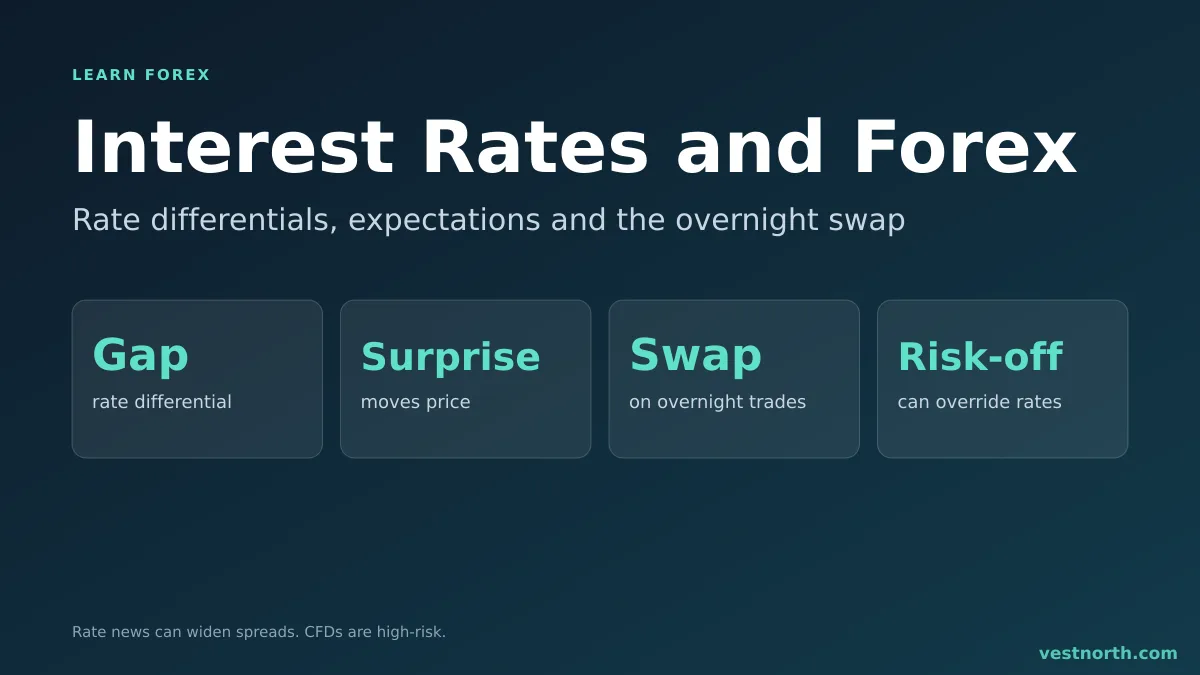
How interest rates connect to currency prices. Illustration, October 2026.
Why rates matter to a currency
A central bank sets a policy rate that anchors borrowing costs in its economy. Investors who hold cash, bonds or deposits in that currency earn a return linked to those rates. If one country offers a noticeably better return than another, some investors move money towards it, and buying that currency to do so supports its price.
Every forex pair involves two currencies, so the question is always relative. EUR/USD does not rise because euro rates are high. It rises when the market expects the euro’s rate path to look better than the dollar’s.
Rate differentials
The rate differential is the gap between the two policy rates in a pair. Here is a made-up example, not current data:
| Currency | Policy rate (illustrative) |
|---|---|
| Currency A | 5.0% |
| Currency B | 1.0% |
| Differential | 4.0 points in favour of A |
A trader looking at A/B sees a wide gap that favours A. If the gap is expected to widen, because the central bank of A is expected to raise rates or the central bank of B is expected to cut, that tends to support A. If the gap is expected to narrow, it tends to weaken A. Direction of change often matters more than the level itself.
The same logic drives the carry trade, where a trader buys the higher-yielding currency and funds it in the lower-yielding one.
Expectations matter more than decisions
Markets look ahead. By the time a central bank meets, traders have already priced in the outcome they think is likely. So what moves price on the day is the surprise:
| Outcome on the day | Versus expectation | Typical reaction |
|---|---|---|
| Hike of 0.25 points, market expected 0.25 | In line | Small move or none |
| Hike of 0.25 points, market expected 0.50 | Less than expected | The currency may fall |
| Hold, market expected a cut | Less dovish than expected | The currency may rise |
| Hold, same as expected, but the statement signals future cuts | Tone more dovish | The currency may fall |
“May” is deliberate here. These are common patterns, not guarantees, and price can react the opposite way, especially in the first few minutes. The words in the statement and the press conference often matter as much as the number. Traders watch for hints about future decisions, a practice usually called forward guidance.
Check meeting dates on each central bank’s own website and add them to your economic calendar. Our news trading guide covers the risks of trading around releases.
Inflation and growth data
Rate decisions rest on data, so the data moves currencies ahead of the meeting. Higher-than-expected inflation can raise the odds of a hike, and weak jobs or growth figures can raise the odds of a cut. A single number can therefore move a pair as much as the decision itself. The reaction depends on what the market currently expects the bank to do, which changes from month to month.
How rates reach your trades: the swap
If you hold a position past the daily rollover time, your broker applies a swap (also called rollover). Its size depends on the interest rates of the two currencies, the direction of your trade and the broker’s own markup. Brokers publish their swap figures in the platform or on their websites.
A short example with invented figures: you buy a pair where the currency you buy has a higher rate than the one you sell. You might receive a small credit each night, minus the broker’s charge. Sell the same pair and you would pay. Do not assume a credit is guaranteed: broker charges can turn a positive carry into a cost. See what a swap is and what rollover is.
Swap is small compared with a large price move. A trade that earns a daily credit can still lose far more through the exchange rate.
Where the link breaks
- Risk sentiment. In a market panic, investors often sell higher-yielding currencies regardless of rates.
- Other drivers. Trade balances, politics, commodity prices and intervention can outweigh the rate story for weeks.
- Already priced in. A trend that has run for months may have little left to give when the event arrives.
- Policy changes direction. A currency that gained from expected hikes can drop fast once the market sees the last hike.
- Wider spreads. Around announcements brokers often widen spreads and slippage rises. See slippage.
A simple way to use rates in your analysis
Rates are context, not a signal. One workable routine is to note which direction the market expects each central bank to move, check whether price already agrees on the chart, and use trend and support and resistance analysis for the actual entry. If the rate story and the chart disagree, treat it as a reason for smaller size, not a larger one. Practise on a demo account first.
Bottom line
Interest rates move currencies through the gap between two countries’ rates and, above all, through changes in what traders expect. A decision that matches expectations often does little, and a surprise can move price fast in either direction. Rates also show up in your account through swaps on overnight positions. Use them as background for a trade plan, keep position sizes small around announcements and only risk money you can afford to lose. CFDs are complex, high-risk instruments.
Frequently asked questions
How do interest rates affect forex?
Higher rates in a country can attract investors who want a better return, which can lift demand for its currency. The effect depends on rates in the other country and on what the market already expected.
Does a rate hike always strengthen a currency?
No. If the market expected a bigger hike, the currency can fall on the news. Price reacts to the surprise relative to expectations, not to the decision alone.
What is a rate differential?
It is the gap between the interest rates of the two currencies in a pair. If the first currency's rate is higher than the second's, the differential favours the first currency.
Who sets interest rates?
Each major currency has a central bank, such as the Federal Reserve for the US dollar, the European Central Bank for the euro and the Bank of England for sterling. Check each bank's own site for its meeting dates.
Do interest rates affect my open trades?
Yes, through the swap. Holding a position past the daily rollover time can cost or earn a swap, which is linked to the interest rates of the two currencies plus the broker's own markup.
Can I trade interest rate announcements?
You can, but spreads often widen and price can jump past your stop. Many traders avoid positions around the announcement or reduce size.