Forex Carry Trade Explained: How Interest Rate Differences Work, and What Can Go Wrong
Short answer: A carry trade buys a currency with a higher interest rate against one with a lower rate, to collect the difference while the position is open. On a broker account that difference arrives as a swap applied at rollover, and it can be positive or negative. The interest gain is usually small beside the price move, so a carry trade can lose money even when the swap is positive.
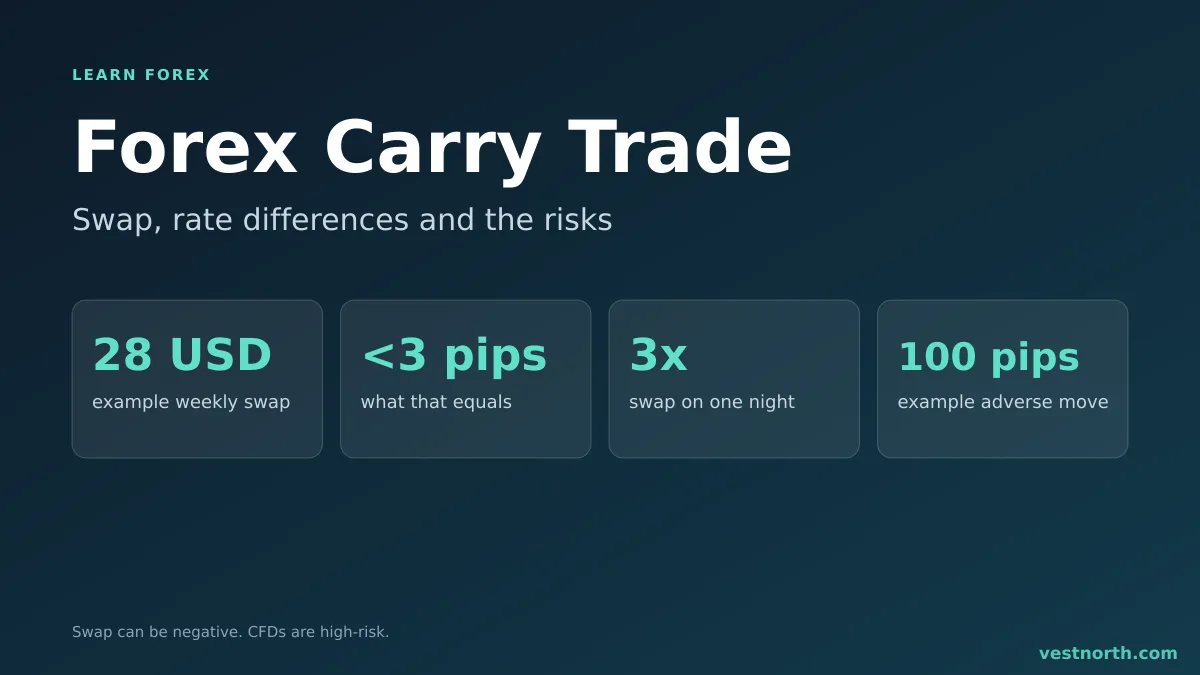
The carry idea in one picture. Illustration, October 2026.
The idea in plain terms
Every currency has an interest rate set by its central bank. If one currency pays more than another, holding the higher one and funding it in the lower one earns the gap. The classic version is “borrow low, hold high”.
In practice, retail traders do not borrow money. They open a CFD position, and the broker credits or debits a swap when the position is held through the daily rollover. The swap is based on interest rate differences, but it also includes the broker’s own markup, so it is not the same number as the central bank rates.
Long and short swap
| Position | What the swap reflects | Possible result |
|---|---|---|
| Long the higher-yielding currency | Interest earned on the higher rate, minus the broker’s charge | Positive or negative |
| Short the higher-yielding currency | Interest paid on the higher rate, plus the broker’s charge | Usually negative |
Both sides can be negative on the same pair after the broker’s markup. Read the swap figures for your instrument in the platform, and look at the units they are shown in (points, money or percent).
A worked example
Invented numbers, not a quote from any broker. Suppose a long position of 1 lot on a pair carries a swap of +4 USD per night, and a triple-swap day applies once a week.
| Item | Amount |
|---|---|
| Normal nights per week | 4 × 4 USD = 16 USD |
| Triple-swap night | 3 × 4 USD = 12 USD |
| Weekly swap | 28 USD |
Now compare it with the price. On 1 lot of a major pair, 1 pip is about 10 USD, so a 28 USD week equals less than 3 pips. A 100-pip move against you is 1,000 USD, which is more than 35 weeks of that swap. That is why the price decides most carry trade results, and why a stop loss and a position size are not optional.
Why carry trades can go wrong
- Sudden reversals. When markets turn risk-averse, high-yielding currencies can fall quickly. Carry positions are often closed all at once, which feeds the move. We have no verified figures on how often this happens, so do not assume it is rare.
- Rate changes. A central bank decision can shrink or reverse the rate gap, and the swap changes with it. Check the economic calendar.
- Broker changes to swap. Swap rates are not fixed. They can change from one day to the next.
- Leverage. A bigger position means a bigger swap and a bigger loss. See leverage and margin vs leverage.
- Spread and costs. The swap has to cover the spread and commission before it is a gain. See trading costs.
- Weekend gaps. Positions held over the weekend can face gaps that jump past a stop.
Questions to ask before using carry
- What is the swap per night for this exact symbol and direction, from my own platform?
- How many pips of adverse move does a year of swap pay for? Divide the yearly swap by the pip value.
- Where is my stop, and what does it cost in money? See risk per trade.
- What is the margin requirement, and how far can price move before a margin call? See margin call and stop out.
- Does the central bank meet while the position is open?
Bottom line
A carry trade is an attempt to earn the interest difference between two currencies. On a CFD account the swap, not the raw rate gap, decides what you receive, and it is often small beside normal price moves. If you try it, read the real swap figures, use a stop loss, keep the size small and expect that a fast reversal can erase months of swap. Only risk money you can afford to lose. CFDs are complex, high-risk instruments.
Frequently asked questions
What is a carry trade in forex?
A carry trade buys a currency with a higher interest rate and sells one with a lower rate, aiming to earn the rate difference while the position is open. The price move still decides most of the result.
How do you earn the carry on a broker account?
On a CFD account, the broker applies a swap when a position is held past the daily rollover. The swap can be positive or negative, and brokers add their own charges, so the figure is not the raw interest rate difference.
Is a carry trade low risk?
No. Price can move against you by more than the interest you earn, and leverage magnifies both. Carry trades have suffered sharp losses when markets turned fast.
Do I always get a positive swap on the higher-yielding currency?
Not always. Broker charges and the way swap is calculated can leave the swap negative on both sides of a pair. Check the swap figures in your platform for the exact instrument.
What is triple swap?
Many brokers charge three days of swap on one weekday to cover the weekend. In MetaTrader that is often Wednesday, but the day can differ, so check your broker's contract specification.
Do carry trades work with leverage?
Leverage lets you hold a larger position, so the swap in money is larger, but so are the price losses. The interest difference is small next to normal price swings.