What Is a Gap in Forex? Weekend Gaps and What They Do to Your Stop
A gap is a place on a chart where price jumps from one level to another and no trades happen in between. The next candle opens well away from where the last one closed, leaving an empty space. In forex, gaps are most common at the weekly open. They matter to beginners for one reason: a stop loss does not protect you from a price that jumps over it.
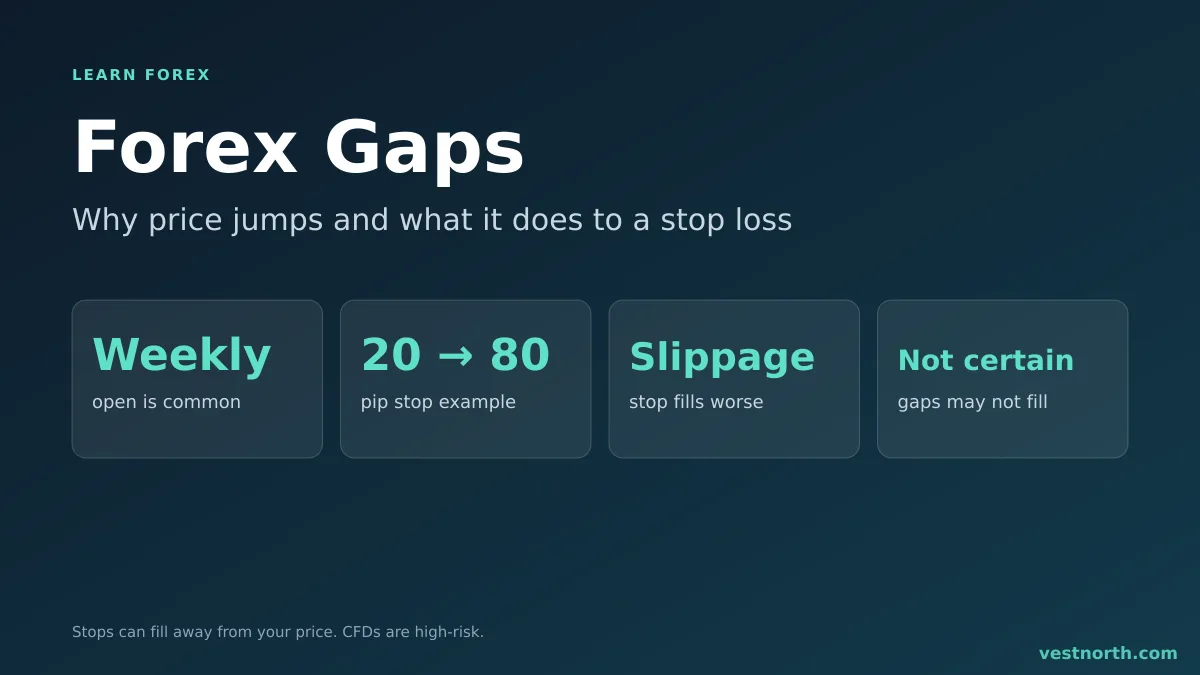
A gap in one picture.
Why forex gaps happen
Forex is open around the clock from the start of the week to Friday evening, so most of the week candles follow each other with no hole. A gap needs a break in trading or a sudden jump with few orders in the way.
- The weekend close. Trading stops on Friday and restarts around Sunday evening in New York. Check your broker’s trading hours, as they publish their own schedule and server time. News, elections or central bank statements can arrive while the market is shut. When it reopens, price moves to its new level at once.
- Thin liquidity. Right after the weekly open, few orders are in the market, so the first quotes can be wide apart.
- Major news. In a few seconds after a surprise release, price can skip a range. See the economic calendar guide.
Most weeks the Sunday open sits close to Friday’s close and the gap is a few pips or none. A big one tends to follow a big event.
Gaps are more visible on instruments that close every day, such as stock CFDs and many index CFDs, because each session opens at a price set by overnight news. Major currency pairs have fewer daily gaps, since the interbank market keeps running in other time zones. Check the trading hours of your own instrument.
Types of gap
Traders use a few names for gaps. These are chart-reading labels, not different mechanisms.
| Name | Where it appears | Common reading |
|---|---|---|
| Weekend gap | Between Friday close and the weekly open | Caused by news during the closure |
| Breakaway gap | Out of a range or chart pattern | Starts a new move |
| Continuation gap | In the middle of a trend | Trend resumes with force |
| Exhaustion gap | After a long move | Sometimes marks the end of that move |
Calling a gap one of these types is done afterwards, once you can see what price did next. At the moment of the gap, you cannot know.
What a gap does to a stop loss
A stop loss is an instruction to close a trade if price reaches a set level. When that level is touched, the order becomes a market order and fills at the next available price. If price jumps past the level, there is nothing to fill at your price, so the order fills at the new, worse one. This is a form of slippage.
A worked example with made-up prices:
- You buy EUR/USD at 1.0900 on Friday with a stop loss at 1.0880. Your planned risk is 20 pips.
- Over the weekend, an unexpected event pushes the euro down. The market reopens at 1.0820.
- Your stop fills at around 1.0820, not 1.0880. The loss is 80 pips, four times the plan.
On a 0.10 lot, where one pip is worth about $1, the plan was a $20 loss and the result is about $80, before spread. On a 1.00 lot the same gap would cost around $800. Position size decides how a gap lands. The forex position sizing guide and the lot size calculator show how to size from your stop distance. A rule that sizes only on the stop distance assumes the stop will fill, and a gap breaks that assumption.
If a gap goes in your favour, a take-profit order also fills at the better price. Gaps cut both ways, but a loss you cannot limit weighs more than a gain.
Gap risk and margin
A large gap can push a leveraged account below the required level in one jump. If equity falls below the stop out level, the broker closes positions, and the account can end up lower than the margin used. Some brokers say they protect retail clients from a negative balance, and others do not. The rule is in the client agreement, so read it before you hold trades over a weekend. The margin call and stop out guide explains the levels.
Do gaps always fill?
A gap is filled when price later returns through the empty zone. You will hear that “all gaps fill”. There is no such law. Some fill within hours, some within weeks, and some never do. Trading on the belief that a gap must close is a way to hold a losing position longer than you should. Treat a fill as one possible outcome.
Ways traders manage gap risk
- Reduce or close before the weekend. A flat position cannot gap against you.
- Use a smaller size on trades held through events such as central bank meetings or elections.
- Check the calendar for scheduled releases before the close of the session.
- Ask whether guaranteed stops exist. Where a broker offers one, the stop fills at the set price even through a gap. It normally comes with a premium or wider spread, and terms vary, so read the broker’s own documents.
- Check the trading hours of each instrument and the trading sessions when liquidity is thin.
None of these removes the risk. They change how much a bad gap costs.
Related chart patterns and levels: supply and demand zones, double tops and bottoms and swing highs and lows.
Bottom line
A gap is a jump in price with no trades in between, most often at the weekly open or after a surprise. A stop loss limits losses only when price trades through your level, so a gap can fill it far away and turn a 20-pip plan into an 80-pip loss. Size positions with that in mind, think before holding trades over the weekend, and risk only money you can afford to lose. CFDs are complex, high-risk instruments.
Frequently asked questions
What is a gap in forex?
A gap is an empty space on the chart where price jumped from one level to another with no trading in between. The next candle opens well away from the previous candle's close.
Why do gaps happen on Monday?
The forex market closes for the weekend, but news and events continue. When trading restarts, prices adjust to everything that happened while it was shut, so the open can differ from Friday's close.
Can a gap skip my stop loss?
Yes. A stop loss becomes a market order once price reaches it, and it fills at the next available price. If price jumps past your stop level, the order fills at the new price, which can be worse than the one you set.
Do gaps always get filled?
No. A gap is 'filled' when price later trades back through the empty zone, but there is no rule that it must. Some gaps fill in hours, some take months, and some never do.
How can I reduce gap risk?
Close or reduce positions before the weekend, trade a smaller size, or avoid holding through major scheduled news. A guaranteed stop, where a broker offers one, covers a stop against gaps but usually costs extra, so read the terms.