Forex Trading Sessions Explained
Short answer: Forex trades 24 hours a day on weekdays, handed from Sydney to Tokyo, London and New York. The busiest period is usually the London and New York overlap, which is roughly four hours a day. Spreads tend to widen when few traders are active, such as around the daily rollover.
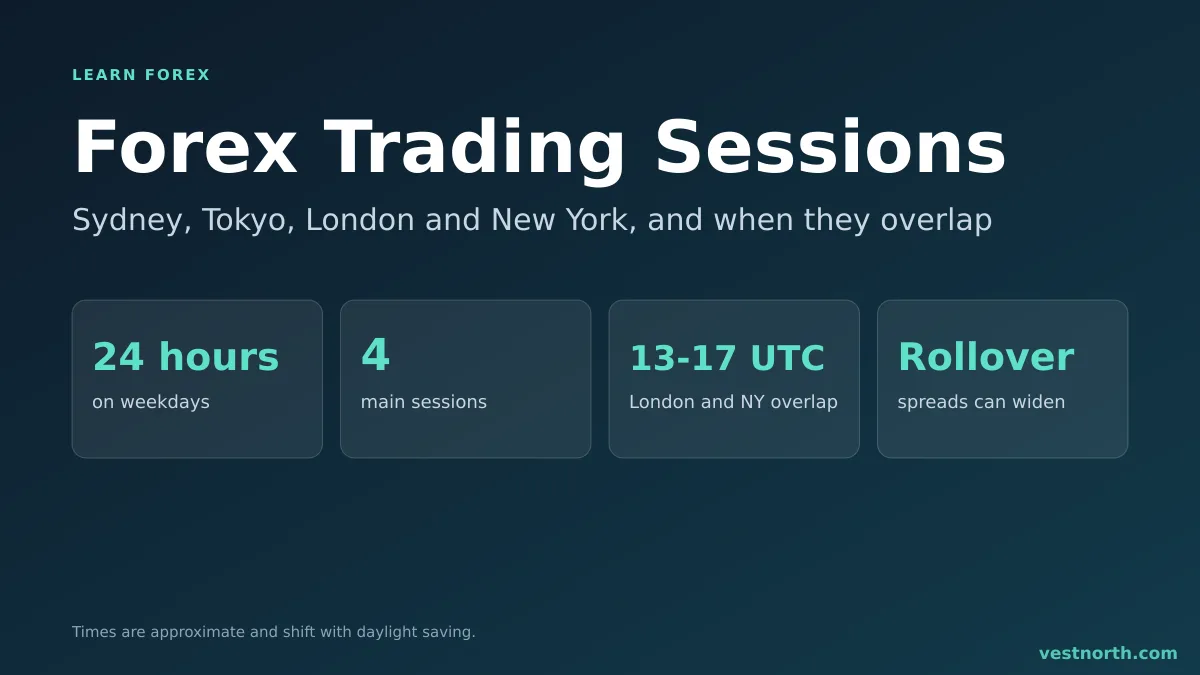
Typical session hours in UTC during northern-hemisphere winter. Approximate, October 2026.
Typical session hours
Forex has no single exchange, so there is no official opening bell. The sessions are named after the main financial centres whose business hours drive activity. The times below are approximate and use UTC with northern-hemisphere standard time. They move by an hour when daylight saving applies.
| Session | Approximate hours (UTC) | Main pairs |
|---|---|---|
| Sydney | 22:00 to 07:00 | AUD, NZD pairs |
| Tokyo | 00:00 to 09:00 | JPY pairs, AUD/JPY |
| London | 08:00 to 17:00 | EUR, GBP, CHF pairs |
| New York | 13:00 to 22:00 | USD pairs, CAD pairs |
These are not rules set by a regulator. They are typical business hours. Your broker publishes the exact times its platform accepts trades, and they can differ by instrument.
Overlaps
When two sessions are open together, more banks and traders are active, so more orders meet each other.
- Tokyo and London: about 08:00 to 09:00 UTC, a short window.
- London and New York: about 13:00 to 17:00 UTC, usually the busiest part of the day.
- Sydney and Tokyo: about 00:00 to 07:00 UTC, quieter but active for AUD and JPY pairs.
Move times to your own time zone before you plan around them. For example, 13:00 UTC is 14:00 in London during winter time and 08:00 in New York during standard time, but the offsets change in spring and autumn.
Why sessions matter to your costs
Costs change with activity. Many brokers show tighter spreads when liquidity is deep and wider spreads when it is thin.
- Rollover: the daily cut-off (see what forex rollover is), often set around the New York close, comes after the New York session ends and before Sydney is fully active. Liquidity is thin and spreads can widen sharply.
- News releases: a major release, listed on an economic calendar, can move price in seconds. Spreads may widen and slippage becomes more likely.
- Sunday open and Friday close: the first and last minutes of the week can be thin.
A worked example: suppose a pair quotes a 1-pip spread in the London and New York overlap and 3 pips at rollover. On 1 lot of EUR/USD, at about $10 per pip, that is a $10 cost against $30 for entering at the wrong time. These figures are an illustration, not a quote from any broker.
Matching pairs to sessions
A pair moves more when the countries behind its currencies are awake. EUR/USD and GBP/USD tend to move most in the London and New York overlap. USD/JPY and AUD/JPY often see more action in the Tokyo session. Quiet pairs in the wrong session can sit in a narrow range, which may leave a tight stop loss in more danger from the spread than from the market itself. Short-term styles feel this most, see scalping vs swing trading. Our guides to what a pip is and how to read a forex chart explain how price moves are counted and shown.
Choosing a session you can follow
The best session is one when you can watch the trade. A plan that needs you awake at 03:00 is hard to follow. Before you place a trade, check the economic calendar for the session, keep risk per trade fixed, and avoid placing market orders seconds before a major release.
Weekends and holidays
Spot forex closes for the weekend. Most brokers stop quoting late on Friday and reopen on Sunday evening in UTC, but the exact minute is set by each broker and can differ for CFDs on indices, metals or crypto. A trade held over the weekend is exposed to a gap: the first quote on Sunday can be far from Friday’s close if news broke while the market was shut. A stop loss does not protect against this, because it is filled at the first available price. Our guide to slippage shows a worked gap example.
Public holidays in a financial centre, such as a bank holiday in London or a US holiday in New York, can thin out that session. Some brokers publish a holiday trading schedule with shortened hours, so check it before holding positions through a holiday.
Daylight saving and your time zone
Sessions follow local business hours. When the US, the UK and Australia change clocks, which happens on different dates, the session times in UTC move. For a few weeks each spring and autumn, the London and New York overlap is an hour shorter or longer than usual, because the two countries switch on different days. Before each clock change, check the hours your broker lists and update your own alarms.
A simple way to avoid mistakes is to keep a clock set to UTC next to your platform’s server time. Many MetaTrader servers use a time zone that follows New York or an offset set by the broker, so the time on a chart may not match your wall clock.
Practical examples
- A EUR/USD trader in London may focus on 08:00 to 17:00 UTC and avoid the thin Asian hours, where the pair often moves in a narrow range.
- A USD/JPY trader in Tokyo may find the pair most active at the Tokyo open, then again when New York opens.
- A part-time trader with only the evening free can pick the New York session, check the economic calendar first, and keep the position small enough to hold without watching.
None of these is a recommendation. They show how the same sessions fit different schedules.
Related indicators: Bollinger Bands.
Bottom line
Forex sessions are the working hours of Sydney, Tokyo, London and New York, and activity is highest when London and New York overlap. Spreads and slippage tend to rise when liquidity is thin, so rollover and news times cost more. Treat the hours here as approximate, check your broker’s trading hours, and only trade with money you can afford to lose. CFDs are complex, high-risk instruments.
Frequently asked questions
What are the 4 forex trading sessions?
The four main sessions are Sydney, Tokyo, London and New York. They overlap in places, so the market is open continuously from the Sunday evening open until the Friday close.
What time does the forex market open and close?
It opens in the Sydney session on Sunday evening in UTC and closes at the end of the New York session on Friday. Exact times depend on your broker and on daylight saving, so check its trading hours.
Which forex session is the busiest?
The London session is usually the busiest, and the London and New York overlap is typically the most active period. Activity also depends on which news is released that day.
Why do spreads widen at rollover?
Around the daily rollover, in the gap between the New York close and the Sydney open, few participants trade, so liquidity is thin and many brokers show wider spreads.
Do sessions change with daylight saving time?
Yes. London and New York shift their clocks on different dates, so session times in UTC move by an hour for part of the year. Recheck the times after each clock change.
Which session is best for beginners?
There is no single best one. Pick sessions when your chosen pairs are active, spreads are lower, and you can watch the trade. Many beginners start with the London session.