Scalping vs Swing Trading in Forex: Which Style Fits You?
Short answer: Scalping means holding trades for seconds to minutes to collect a few pips, many times a day. Swing trading means holding for days to weeks to catch a larger move. Scalpers care most about the spread, speed and focus. Swing traders care more about swaps, overnight gaps and patience. Neither style removes risk.
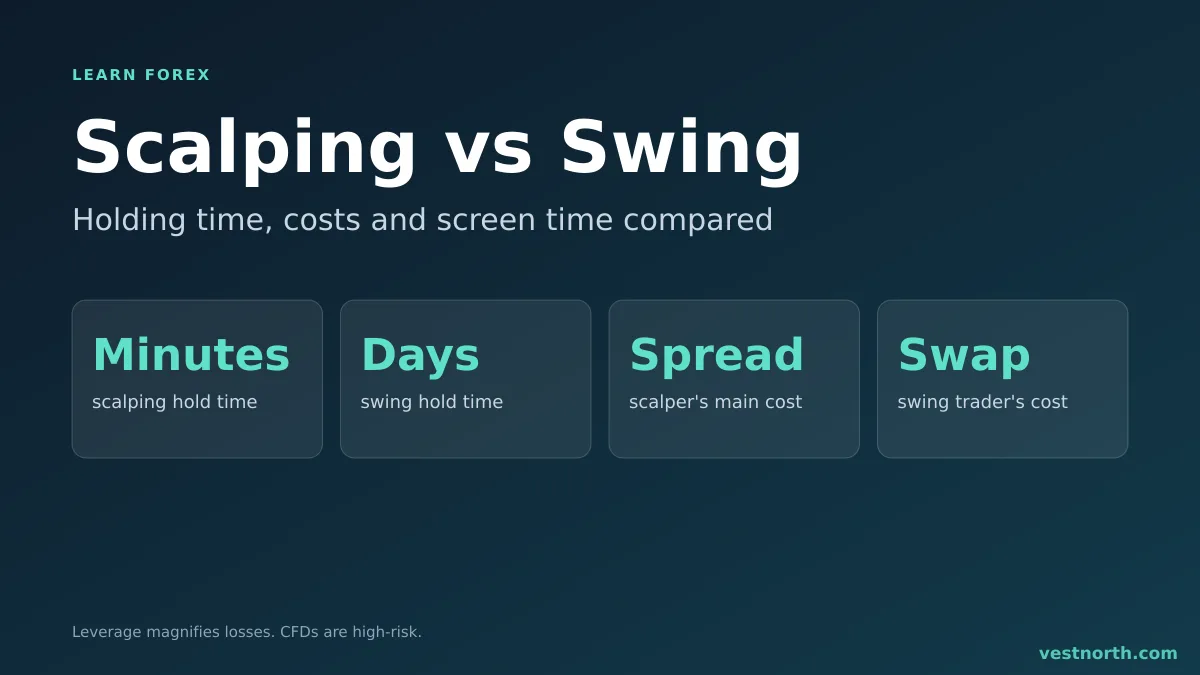
Scalping and swing trading side by side. Illustration, October 2026.
The two styles in one table
| Scalping | Swing trading | |
|---|---|---|
| Holding time | Seconds to minutes | Days to weeks |
| Typical chart | 1-minute to 5-minute | 4-hour to daily |
| Target per trade | A few pips | Dozens to hundreds of pips |
| Trades per day | Many | Often fewer than one |
| Cost that matters most | Spread and commission | Swap and gaps |
| Screen time | High, you must watch | Low, checks a few times a day |
These ranges are general descriptions, not rules. Traders who hold for a few hours are sometimes called day traders, a middle ground between the two.
How scalping works
A scalper enters on a short-term price move and exits quickly, often in a few minutes. The target is small, so the stop loss is small too. A common setup is a stop of a few pips against a target of a few pips.
Because the target is small, the spread takes a large part of it. If a pair has a 1-pip spread and you aim for 5 pips, 20% of the target is gone the moment you open the trade. If there is also a commission per lot, add it to the cost. Spread vs commission shows how to compare the two on one scale.
Scalpers also depend on fast execution. A fill a pip or two away from the price you clicked, called slippage, can erase a whole target. Many scalpers trade during busy hours, when spreads are tighter. See forex trading sessions.
How swing trading works
A swing trader looks for a move that can run for several days, such as a trend leg or a bounce from a level. Chart levels such as support and resistance are common starting points. The stop loss is wider, often dozens of pips, and the target is wider again.
With a wide target, the spread is a small share of the trade. The cost that grows instead is the swap, charged or credited when a position is open at the daily cut-off. What a swap is in forex explains it, and rollover explains the timing. A swing trader also carries the position over weekends, when the price can open at a different level on Monday. A stop loss may not fill at your exact price in that case.
A worked example
These numbers are made up to show the maths, not any broker’s prices.
Scalper: target 5 pips, stop 4 pips, spread 1 pip, 20 trades in a day.
- Spread cost: 20 trades × 1 pip = 20 pips paid to the spread in one day.
- If 11 trades win 5 pips and 9 lose 4 pips, the gross result is 55 − 36 = 19 pips.
- After the spread, the day is −1 pip, even though more than half the trades won.
Swing trader: target 100 pips, stop 50 pips, spread 1 pip, 2 trades in a week.
- Spread cost: 2 pips for the week.
- If one trade wins 100 pips and one loses 50, the gross result is 50 pips, or 48 pips after the spread.
- Swap would be extra. At a made-up −$3 per lot per night, holding 0.1 lot for 4 nights costs 0.1 × $3 × 4 = $1.20.
The point is not that one style wins. The scalper needs a higher win rate or tighter costs to stay ahead, and the swing trader needs patience to sit through losing stretches.
Risk in each style
Both styles use leverage, which magnifies losses as well as gains. Common risks are:
- Scalping: many small losses add up, overtrading after a bad run, and costs rising when spreads widen around news.
- Swing trading: gaps over the weekend, news that moves the market while you sleep, and a large stop loss that makes position size matter more.
The size of each trade should come from the stop distance and the amount you accept to lose, not from how confident you feel. See forex position sizing and risk management, and use the lot size calculator to check the numbers.
Which style fits you?
Ask three questions:
- How much time can you watch the screen? Scalping needs undivided attention. Swing trading can fit around a job.
- How do you handle stress? Scalping gives fast results, good and bad. Swing trading means holding a loss for days without acting.
- What account costs can you get? Scalping is sensitive to spread and commission. Check the terms of the account, including any limits on very short trades.
Write the answers into your trading plan and practise the style on a demo account before using real money.
Related reading: day trading for beginners, interest rates and currencies and market sentiment.
Bottom line
Scalping is about speed and low costs, and swing trading is about patience and wider stops. Costs hit scalpers per trade and swing traders per night, so check the spread, commission and swap on your account before you choose. Pick the style that fits your schedule and temperament, size each trade from your stop loss, and only trade with money you can afford to lose. CFDs are complex, high-risk instruments.
Frequently asked questions
What is the main difference between scalping and swing trading?
Holding time. A scalper opens and closes trades within minutes and aims for a few pips. A swing trader holds for several days or weeks and aims for moves of dozens or hundreds of pips.
Which is better for beginners, scalping or swing trading?
Neither is safe by default. Swing trading needs less screen time and is less sensitive to spreads, so many beginners find it easier to manage. Scalping needs fast decisions and low costs. Practise either on a demo account first.
Do scalpers pay more in costs?
Per trade the cost is the same spread, but a scalper pays it many times a day. Costs take a far bigger share of a 5-pip target than of a 100-pip target.
Do swing traders pay swap?
Yes, if a position is open at the daily rollover the broker adds a swap charge or credit. Over several nights it can add up, so check the swap values for your pair before you hold.
Can I use both styles?
You can, but keep the plan for each separate, with its own position size and loss limit. Mixing rules inside one trade usually leads to unplanned decisions.
Do brokers allow scalping?
Policies differ. Some brokers restrict very short trades or certain strategies on some account types. Read the terms or contract specifications of your account before you rely on scalping.