What Is a Forex Trading Plan?
Short answer: A forex trading plan is a written list of rules you decide before you trade: which pairs and hours you trade, what must happen before you enter, where the stop loss goes, how much you risk per trade and when you stop for the day. It does not predict the market. It stops you making new rules in the middle of a losing trade.
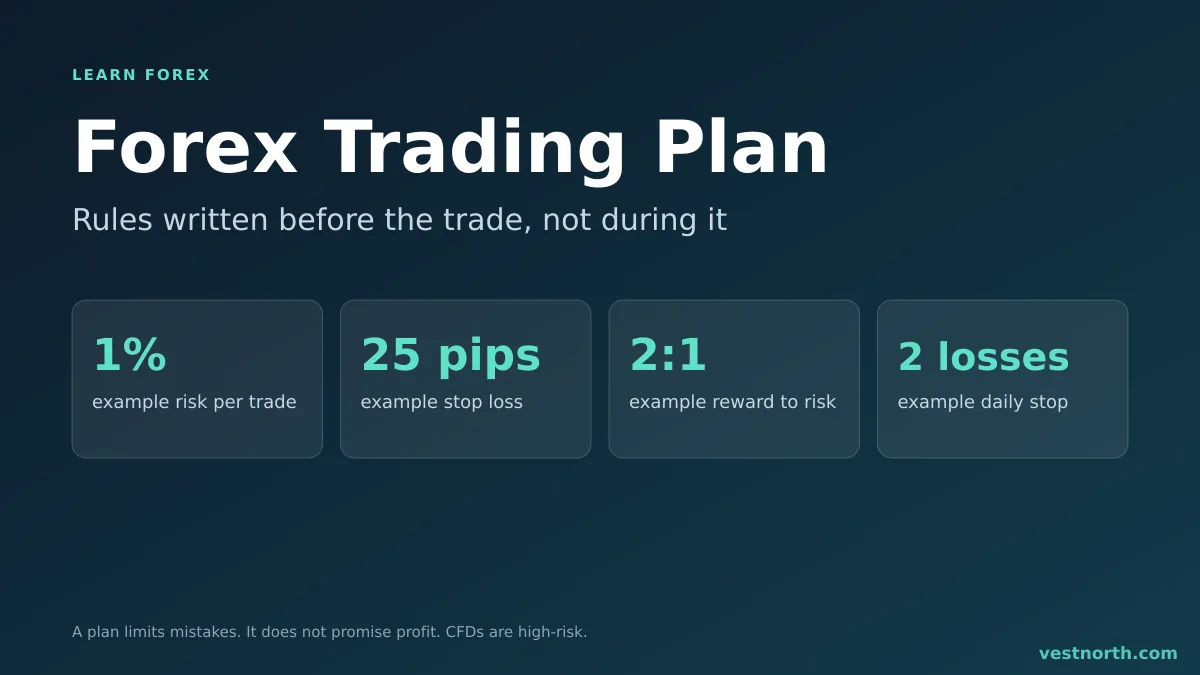
The parts of a trading plan from this article, October 2026. The figures are examples, not recommendations.
Why write it down
Decisions made while a trade is open are shaped by fear and hope. A written plan moves the decision to a calm moment. It also lets you check later whether you followed it, which is the only way to learn from a result.
Two cautions. A plan does not make trades win, and no plan removes the risk of losing money on CFDs. And a plan you cannot follow when a trade is down 20 pips is worse than a simple one you can.
The parts of a plan
1. What and when you trade
Name the pairs and the hours. A beginner might pick EUR/USD and trade only during the London session. Fewer pairs means fewer spreads, pip values and news events to learn. Our page on trading sessions shows how activity changes through the day, and currency pairs explains how quotes work. Your holding time matters too: scalping vs swing trading shows how it changes the weight of spreads and swaps.
2. Entry rule
Write the conditions that must all be true before you click. For example: “Price closes above the 50-period moving average on the 1-hour chart, and no major news is due in the next 30 minutes.” If you cannot write the rule in a sentence or two, it is not specific enough to follow. Our guides to moving averages and candlestick basics cover tools that such rules often use.
3. Stop loss and exit rule
Decide the exit before the entry. The stop loss sets the most you can lose, and the take profit or exit condition sets when you bank a gain. See how a stop loss works and the risk-reward ratio.
4. Risk per trade and position size
Fix the share of the account you will lose if the stop is hit. Then size every trade from it. The formula is:
Lot size = money at risk ÷ (stop loss in pips × pip value per lot)
Our lot size calculator does the sum, and the page on position sizing explains it step by step.
5. Loss limits
Set a daily or weekly limit and stop when you reach it. A common structure is to stop after a fixed number of losing trades in a row or after losing a set percentage in a day. The limit matters most on bad days, when the urge to win it back is strongest.
6. Review routine
Record each trade: pair, entry, stop, exit, result, and whether you followed the plan. Review the log once a week or month. Your risk management rules belong here too.
Worked example
A trader has a $2,000 demo account and writes this plan:
| Item | Rule |
|---|---|
| Pair and hours | EUR/USD, London session only (08:00 to 12:00 UTC) |
| Entry | Buy stop above the high of the last 1-hour candle, only if the candle closed up |
| Stop loss | 25 pips below entry |
| Take profit | 50 pips above entry (2:1) |
| Risk per trade | 1% of the account, $20 |
| Position size | $20 ÷ (25 pips × $10 per pip per lot) = 0.08 lot |
| Daily limit | Stop after 2 losing trades or $40 lost |
| Review | Log every trade, review on Sunday |
Check the arithmetic: 0.08 lot is worth about $0.80 per pip, so 25 pips at risk is $20 and 50 pips of reward is $40. If two trades lose, the day ends at about $40 down, which is 2% of the account. None of this says a trade will win. It says the loss is known before the order is placed. The entry in this example uses a pending order, so the trader does not need to watch the screen.
Testing the plan
Run it on a demo account for enough trades to see how it behaves, and record the rule breaks as well as the wins. Demo results are not a forecast. Real accounts add emotion, slippage and live spreads, so the same plan can look different with real money.
Common mistakes
- Writing a plan with ten indicators nobody can follow in real time.
- Setting risk per trade by gut feeling after a big win or loss.
- Moving the stop loss further away once the trade is losing.
- Changing the plan after every loss instead of after a scheduled review.
- Trading through high-impact news without having decided to.
Bottom line
A trading plan is a one-page set of rules written before the trade: what you trade, when you enter and exit, how much you risk and when you stop for the day. It gives you a record to learn from and caps the damage from your own mistakes. It does not promise profit. Test it on a demo account, keep the risk per trade small, and only deposit money you can afford to lose. CFDs are complex, high-risk instruments.
Frequently asked questions
What is a forex trading plan?
It is a written set of rules covering what you trade, your entry and exit conditions, how much you risk per trade and what you do after losses. You write it before trading so decisions are not made in the moment.
What should a trading plan include?
Markets and trading hours, entry rules, stop loss and take profit rules, risk per trade, a daily or weekly loss limit, and a review routine. Keep it to one page.
How much should I risk per trade in my plan?
There is no single right figure. Many beginners choose a small fixed share of the account, such as 1%, so a run of losses does not cause serious damage. Pick a number you can follow when the trade is going badly.
Does a trading plan guarantee profit?
No. A plan gives structure and limits losses you can control, but trades can still lose and CFD trading is high risk. It does not promise any return.
How do I test a trading plan?
Run it on a demo account and record every trade, including the ones where you broke your own rules. Real-money results can differ because of spreads, slippage and emotion.
How often should I change my plan?
Review it on a schedule, for example monthly, and change it only on the basis of recorded results. Changing rules after every loss defeats the purpose.