What Is a Currency Pair in Forex?
Short answer: A currency pair is the price of one currency in another. In EUR/USD the first currency, the euro, is the base and the second, the dollar, is the quote. A price of 1.0850 means 1 euro costs 1.0850 dollars. Buying the pair means buying the base and selling the quote at the same time.
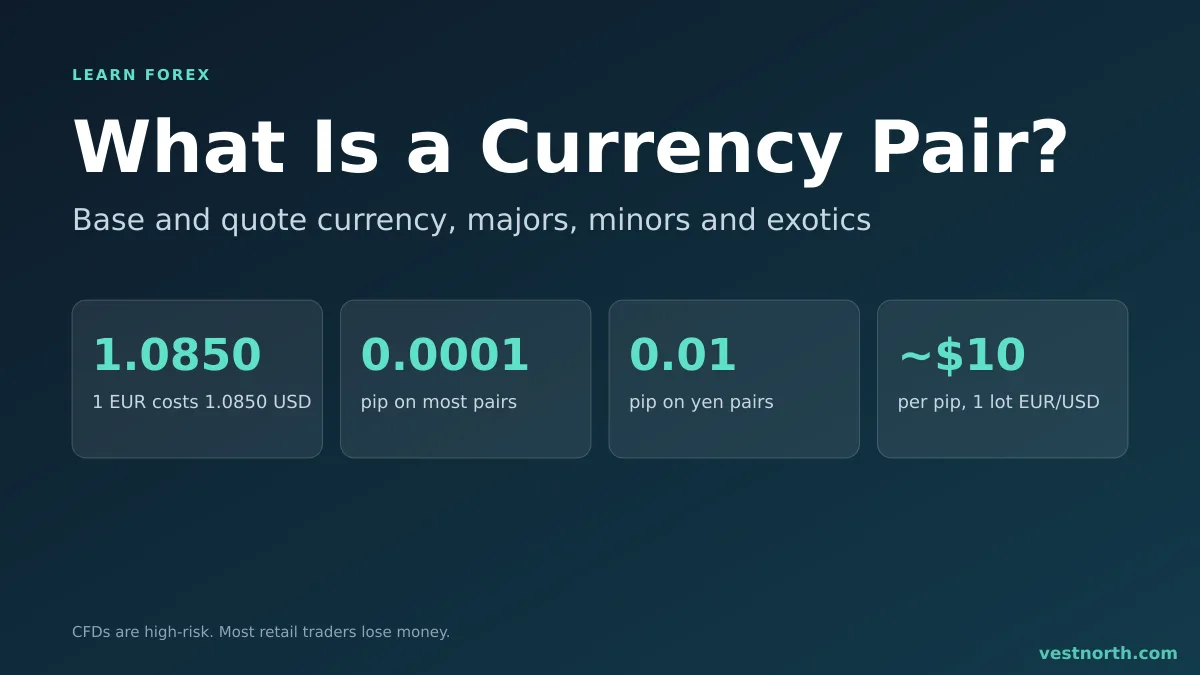
A currency pair quote, EUR/USD at an example price of 1.0850. Illustration, October 2026.
How to read a pair
Forex prices always come as two currencies, because money is always valued against other money. You cannot say a euro is worth “1.0850” without saying what it is worth in.
| Part | In EUR/USD | Meaning |
|---|---|---|
| Base currency | EUR | The currency you buy or sell |
| Quote currency | USD | The currency the price is stated in |
| Price | 1.0850 | 1 EUR = 1.0850 USD |
If the price rises to 1.0900, the euro has become stronger against the dollar. If it falls to 1.0800, the euro has become weaker. The dollar moved in the opposite direction in both cases.
Buying and selling a pair
- Buy (go long): you expect the base currency to rise against the quote currency.
- Sell (go short): you expect the base currency to fall against the quote currency.
Take a buy of 1 standard lot of EUR/USD, which is 100,000 euros, at 1.0850. The price rises to 1.0880, a move of 30 pips. The gain is 30 pips on a lot where one pip is about $10, so about $300. If the price fell to 1.0820 instead, the loss would be the same size, about $300. Brokers also charge a spread and sometimes a commission on top, so the real result is slightly lower.
Major, minor and exotic pairs
Pairs are grouped by how widely they trade.
| Group | What it means | Examples |
|---|---|---|
| Majors | The US dollar against another large currency | EUR/USD, GBP/USD, USD/JPY, USD/CHF, AUD/USD, USD/CAD, NZD/USD |
| Minors (crosses) | Two large currencies, no US dollar | EUR/GBP, EUR/JPY, GBP/JPY |
| Exotics | A major against a smaller or emerging-market currency | USD/TRY, USD/ZAR, USD/MXN |
Majors have the most buyers and sellers, so they usually have the narrowest spreads. Exotics often have wider spreads and larger gaps in price. Each broker sets its own spreads, so check the account page of the broker you use rather than relying on a general rule.
Pip size depends on the pair
A pip is the usual unit for measuring price moves.
- Most pairs are quoted to four decimals, and a pip is 0.0001. EUR/USD moving from 1.0850 to 1.0851 is one pip.
- Pairs with the Japanese yen are quoted to two decimals, and a pip is 0.01. USD/JPY moving from 150.00 to 150.01 is one pip.
The value of a pip depends on the quote currency. For a pair quoted in dollars, one pip on 1 lot is about $10. For USD/JPY, one pip on 1 lot is 1,000 yen. At an example rate of 150 yen per dollar, that is about $6.67. Use the pip calculator to get the value for your pair and size.
Why pairs move together
Two pairs that share a currency can move in a similar way. If the dollar weakens broadly, EUR/USD and GBP/USD often rise at the same time. Holding both is then closer to one large bet on the dollar than two separate trades. Count that when you size positions: our guides to forex position sizing and forex risk management show how.
Choosing a pair as a beginner
- Start with one or two majors, so costs stay low and prices are easy to follow.
- Learn what a pip is worth in your account currency before you place a trade.
- Check trading sessions: each pair is busiest when the markets of both its currencies are open.
- Practise on a demo account first.
Related reading: the US dollar index (DXY), day trading for beginners and the carry trade.
Bottom line
A currency pair is a price of one currency in another, and every trade buys one side while selling the other. Know which currency is the base, how big a pip is for that pair and what a pip is worth on your lot size before you place an order. Only trade with money you can afford to lose. CFDs are complex, high-risk instruments.
Frequently asked questions
What is a currency pair?
A currency pair is the price of one currency expressed in another. In EUR/USD, the euro is the base currency and the US dollar is the quote currency. A price of 1.0850 means 1 euro costs 1.0850 US dollars.
What is the base currency and the quote currency?
The base currency is the first one in the pair and the quote currency is the second. The price tells you how many units of the quote currency one unit of the base currency costs.
What happens when I buy a currency pair?
You buy the base currency and sell the quote currency at the same time. You profit if the base currency gains value against the quote currency, and lose if it falls.
What are the major currency pairs?
The majors are the pairs that include the US dollar and another large currency: EUR/USD, GBP/USD, USD/JPY, USD/CHF, AUD/USD, USD/CAD and NZD/USD. They are usually the most traded and have the tightest spreads.
What is an exotic currency pair?
An exotic pair combines a major currency with the currency of a smaller or emerging economy, such as USD/TRY or USD/ZAR. Spreads are usually wider and prices can move fast.
Is the pip the same in every pair?
No. For most pairs a pip is 0.0001. For pairs quoted in Japanese yen, such as USD/JPY, a pip is 0.01. The value of a pip in your account currency also depends on the pair and the lot size.