What Is a Lot in Forex?
Short answer: A lot is the standard unit of trade size in forex. One standard lot is 100,000 units of the base currency, a mini lot is 10,000 and a micro lot is 1,000. On EUR/USD a standard lot is worth about $10 per pip.
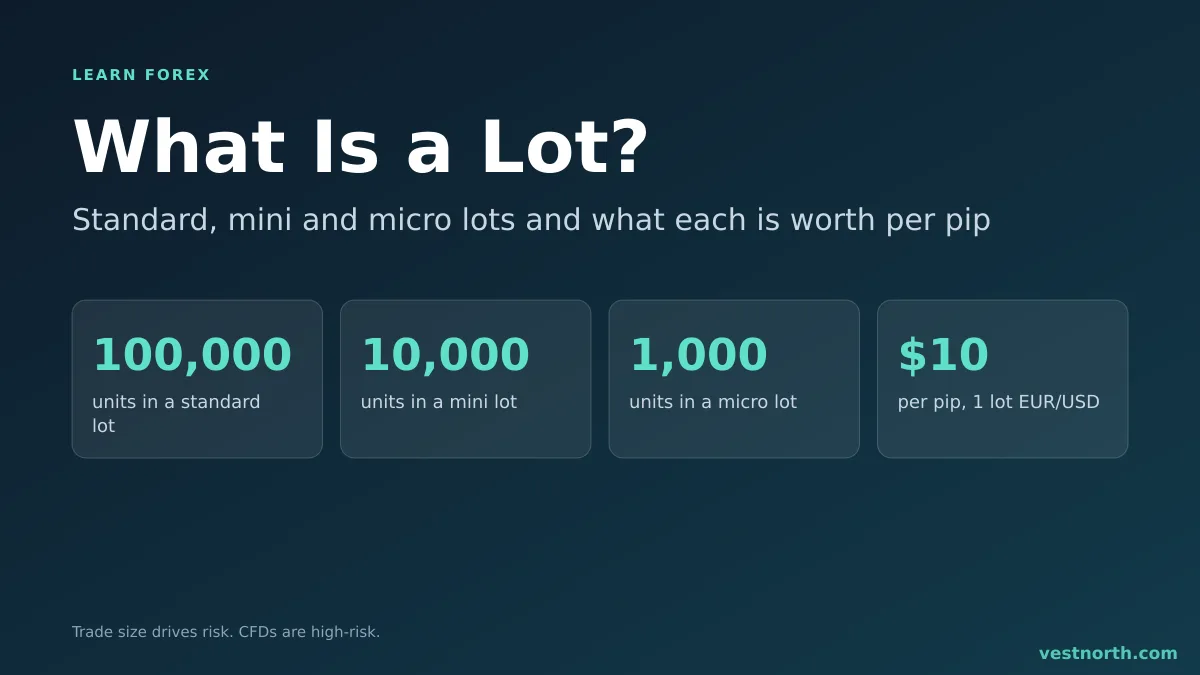
Lot sizes and pip values on EUR/USD, October 2026.
Why forex uses lots
Currency prices move in tiny steps, so trades need to be large for a move to matter. Instead of typing “100,000 euros” every time, the market standardised the size into lots. When your platform asks for “volume”, it is asking for the number of lots.
Lot sizes at a glance
| Name | Lot | Units of base currency | Pip value on EUR/USD |
|---|---|---|---|
| Standard | 1.00 | 100,000 | about $10 |
| Mini | 0.10 | 10,000 | about $1 |
| Micro | 0.01 | 1,000 | about $0.10 |
| Nano | 0.001 | 100 | about $0.01 |
Nano lots are rare. Most brokers set the minimum at 0.01, and some cent accounts use different units. Check the specifications of your own account. The pip values above hold when the US dollar is the second currency in the pair, as in EUR/USD. See what a pip is for how to count pips.
Base currency, not dollars
A lot is measured in the base currency, the first currency in the pair. One lot of EUR/USD is 100,000 euros. One lot of GBP/JPY is 100,000 pounds. One lot of USD/JPY is 100,000 US dollars.
The value of a lot in your account currency changes with the price. If EUR/USD is at 1.10, one lot is worth about $110,000 of exposure.
Lots in gold, indices and other CFDs
The word “lot” is borrowed for other CFDs, but the contract size differs and is set by the broker.
- Gold (XAU/USD): often 100 ounces per lot, but some brokers differ.
- Oil, indices, crypto: each has its own contract size and minimum step.
Never assume. Open the contract specification in your platform and read the line “contract size” before placing a trade. A lot of an index may carry a very different dollar risk than a lot of EUR/USD.
How lot size affects risk and margin
Lot size is the biggest lever you control over how much a trade can lose.
On EUR/USD with a stop loss 30 pips away:
| Lot size | Risk if the stop is hit |
|---|---|
| 0.01 | about $3 |
| 0.10 | about $30 |
| 1.00 | about $300 |
Size also sets the margin needed. A bigger lot ties up more margin, and a given leverage ratio sets how much. See what leverage is. Costs also scale with lots: a spread of 1.2 pips costs about $12 on one standard lot, and about $0.12 on a micro lot. For pairs not quoted in dollars, the forex pip value guide shows the conversion, and forex lot sizes for beginners walks through picking a size.
How to choose a lot size
Do it in this order:
- Decide the risk in money. Many traders keep it to 1% of the account or less. On a $500 account, 1% is $5.
- Choose the stop loss distance in pips. Base it on the chart, not on the lot size you want.
- Divide. Lot size = money at risk ÷ (stop loss in pips × pip value per lot).
Example: $5 risk, 25-pip stop, $10 pip value per standard lot. $5 ÷ (25 × $10) = 0.02 lots.
Our lot size calculator does this for any pair, and the pip calculator shows pip value for your trade.
Account types and minimum lot sizes
Brokers set a minimum lot (often 0.01) and a lot step (the smallest change, often 0.01). Cent accounts show balances in cents, so a “lot” can mean something smaller. Always read your broker’s specification. For a smaller deposit, a micro or cent account lets you learn with real but tiny sizes. See what Exness and Vantage say about their minimum deposits.
Common mistakes
- Typing 1 instead of 0.01 and opening a trade 100 times too big. Check the volume box before you click.
- Using the same lot size on every pair and every stop distance.
- Forgetting that a lot of gold or an index is a different size from a lot of EUR/USD.
- Scaling up after a few wins without checking the risk in money.
Bottom line
A lot is just a unit of size: 100,000 for standard, 10,000 for mini and 1,000 for micro. What matters is the money at risk on your stop loss, so work out the lot size from that number instead of picking a lot size first. Start with micro lots, confirm the contract size of each instrument, and only deposit money you can afford to lose.
New to trading? Our forex trading for beginners guide puts these basics together in one place.
Frequently asked questions
How big is one lot in forex?
One standard lot is 100,000 units of the base currency. A mini lot (0.10) is 10,000 units and a micro lot (0.01) is 1,000 units.
What is a 0.01 lot?
A 0.01 lot is a micro lot, or 1,000 units of the base currency. On EUR/USD each pip is worth about $0.10 on that size.
How much is 1 lot worth per pip?
On pairs quoted in US dollars, such as EUR/USD, one standard lot is worth about $10 per pip. On other pairs the value must be converted and changes with the exchange rate.
What lot size should a beginner use?
Use a size that keeps the loss on your stop loss to a small share of your account, often 1% or less. On a small account that usually means micro lots (0.01).
Are lot sizes the same for gold and indices?
No. A lot for gold, oil or an index CFD is defined by the broker's contract specification. For gold, 1 lot is often 100 ounces, but check your broker.
Do I need to trade a full lot?
No. Most brokers let you trade fractions such as 0.01 or 0.10 lots, and some allow smaller steps. The minimum lot size is in the account specifications.