Forex Lot Sizes for Beginners: How to Pick the Right Size
Short answer: Pick lot size from the amount you accept to lose and the stop loss distance in pips, not from how much margin your account has. The formula is lot size = risk amount ÷ (stop in pips × pip value per lot). With a $10 risk and a 20-pip stop on EUR/USD, that is 0.05 lot.
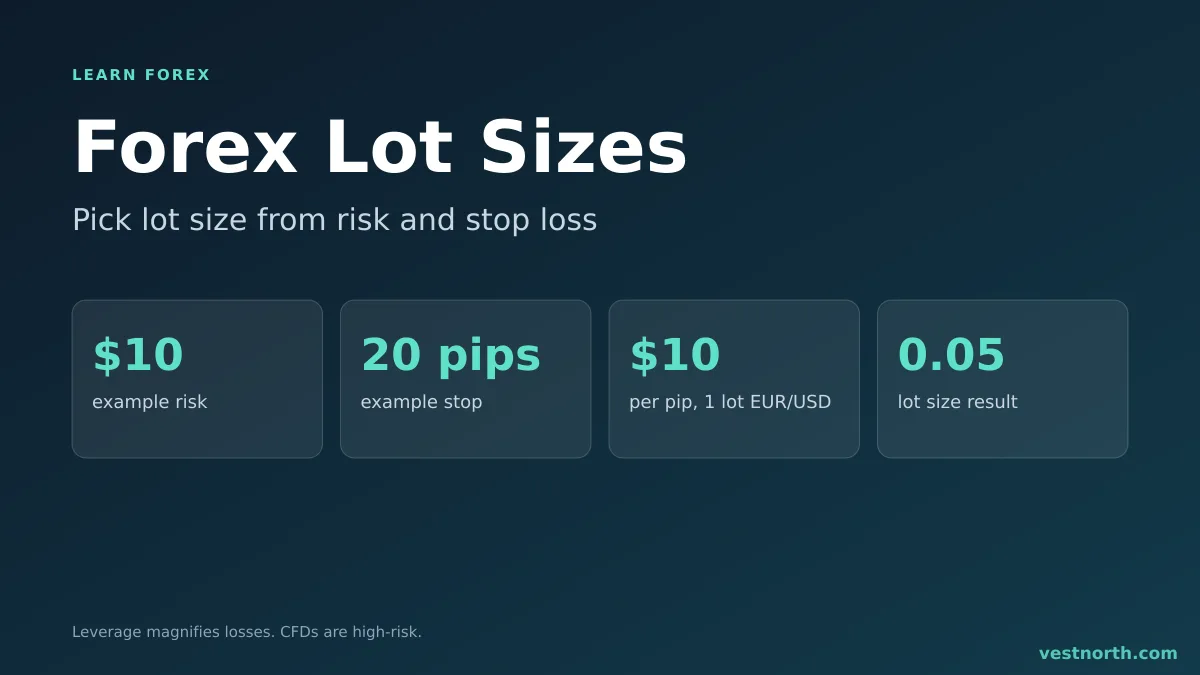
Lot size from risk and stop loss. Illustration, October 2026.
Start with what a lot is
A standard lot is 100,000 units of the base currency, a mini lot is 10,000 and a micro lot is 1,000. On EUR/USD that is about $10, $1 and $0.10 per pip. What a lot is in forex has the full table. This page is about how to choose the number you type into the order window.
The three inputs
- Risk amount: how much money you accept to lose if the stop loss is hit. Many traders set it as a share of the account, such as 1%, but the right figure is the one you can afford to lose repeatedly.
- Stop loss in pips: the distance from your entry to the stop, set by the chart, not by the size you want. See what a stop loss is.
- Pip value per lot: what one pip is worth in your account currency for the pair you trade. What a pip is explains how to count it, and the pip calculator does the conversion.
Then:
Lot size = risk amount ÷ (stop in pips × pip value per lot)
Worked examples
The figures below use the round pip values from the lot guide and are for illustration only. Spreads, commission and slippage are not included.
| Account | Risk | Stop | Pip value per lot | Lot size |
|---|---|---|---|---|
| $500 | 1% = $5 | 25 pips | $10 | 5 ÷ (25 × 10) = 0.02 |
| $1,000 | 1% = $10 | 20 pips | $10 | 10 ÷ (20 × 10) = 0.05 |
| $1,000 | 1% = $10 | 50 pips | $10 | 10 ÷ (50 × 10) = 0.02 |
| $2,000 | 2% = $40 | 40 pips | $10 | 40 ÷ (40 × 10) = 0.10 |
Look at rows 2 and 3. The account and the risk are the same, but the wider stop cuts the lot size from 0.05 to 0.02. A wider stop means a smaller position, not a bigger loss. If the maths gives a size below your broker’s minimum, the trade is too big for your limit and should be skipped or the stop moved only if the chart supports it.
Round down to the lot step your platform allows, never up.
Margin is not a lot size guide
Margin is the deposit the broker holds to keep a position open, and leverage sets how small it can be. Your platform may let you open a 1.00 lot on a $500 account if the leverage is high enough. That does not make it a sensible trade.
A 1.00 lot on EUR/USD is about $10 per pip. A 30-pip move against you is about $300, which is 60% of a $500 account. What leverage is and margin call and stop out show how quickly a large position can close at a loss.
Other pairs and instruments
For pairs where the US dollar is not the second currency, such as EUR/GBP or USD/JPY, the pip value changes with the exchange rate, so use a calculator rather than $10. Gold, indices and oil have their own contract sizes set by the broker, so a lot can mean a very different amount of money. Read the contract specification before you size a trade. The lot size calculator handles these conversions. For the wider method, see forex position sizing.
Common beginner mistakes
- Using the same lot size on every trade regardless of the stop distance.
- Raising the lot size to win back a loss.
- Sizing from the free margin shown on the platform.
- Forgetting that spread and slippage make the real loss a little larger than the planned risk.
- Putting the stop where the size is comfortable instead of where the chart says the idea is wrong.
- Opening several trades in correlated pairs, which multiplies the risk without showing up in one lot figure.
A routine you can repeat
- Decide your maximum loss per trade and write it in your trading plan.
- Find the stop level from the chart.
- Count the pips to the stop.
- Work out the lot size with the formula or the calculator.
- Round down, check that the platform accepts it, and place the stop with the order.
Run the routine on a demo account until it is automatic. See also risk management in forex.
Bottom line
Lot size is an output, not a choice. Decide the loss you accept, measure the stop in pips, divide by the pip value, and round down. When the result is below your broker’s minimum, the trade is too large for your account. Only trade with money you can afford to lose. CFDs are complex, high-risk instruments.
Frequently asked questions
What lot size should a beginner start with?
Start with the smallest size your account allows, often 0.01, and increase only when the loss on your stop loss stays within your limit. The size should come from the maths, not from a fixed number.
How do I calculate lot size?
Divide the amount you accept to lose by the stop loss in pips times the pip value per lot. With a $10 risk, a 20-pip stop and $10 per pip on a standard lot, the size is 10 ÷ (20 × 10) = 0.05 lot.
What percentage of my account should I risk per trade?
Many traders keep it to 1% or less, but there is no correct figure for everyone. Pick a limit you can afford to lose many times in a row and write it in your trading plan.
Can I trade 0.01 lot with $100?
Margin may allow it, but allowed is not the same as sensible. On EUR/USD a 0.01 lot is about $0.10 per pip, so a 20-pip stop risks about $2, which is 2% of $100. Check that against your own limit.
Does more leverage mean a bigger lot size?
Leverage lets you open a bigger position with the same margin, but it does not make a bigger position safer. The lot size should still come from your stop loss and risk limit.
Why is the pip value different on some pairs?
Pip value is quoted in the second currency of the pair and converted to your account currency. On pairs without the US dollar as the second currency, it changes with the exchange rate.