What Is Leverage in Forex?
Short answer: Leverage lets you open a position much larger than the money you put up. At 100:1 leverage, $100 of margin controls a $10,000 position. Leverage magnifies gains and losses by the same amount, so it raises risk, not skill.
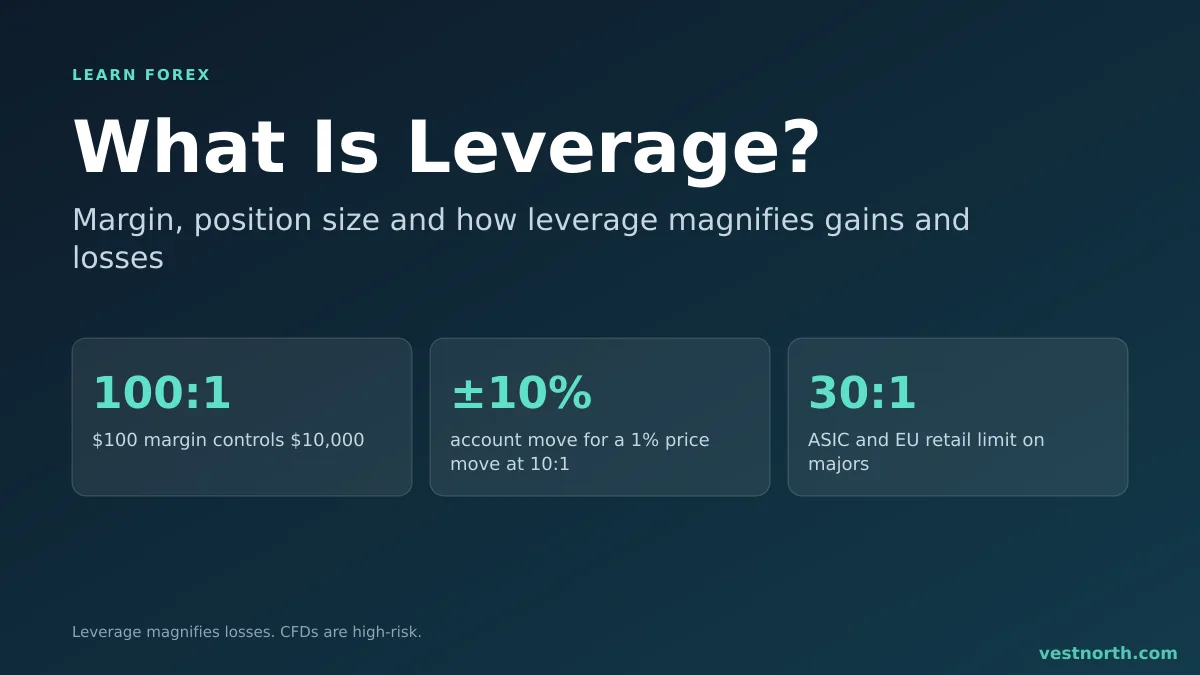
Leverage in numbers. Illustration based on the worked examples in this article, October 2026.
How does leverage work?
When you trade forex or CFDs, you do not pay the full value of the position. You deposit a fraction of it as margin, a good-faith amount the broker holds while the trade is open. Leverage is the ratio between the position size and that margin.
The formula is simple:
Margin = position value ÷ leverage
| Leverage | Position value | Margin needed |
|---|---|---|
| 10:1 | $10,000 | $1,000 |
| 30:1 | $10,000 | $333.33 |
| 100:1 | $10,000 | $100 |
| 500:1 | $10,000 | $20 |
The broker is not giving you free money. The position is a contract for difference or a spot contract, and your profit or loss is calculated on the full position size, not on the margin.
Leverage magnifies both sides
Say you have $1,000 and buy $10,000 of EUR/USD (about 0.1 lot, see what a lot is).
- Price rises 1%: the position gains $100. That is +10% on your $1,000.
- Price falls 1%: the position loses $100. That is −10%.
- Price falls 10%: you lose the whole $1,000, usually long before, because the broker closes trades when margin runs out.
With the same $1,000 and 100:1 leverage you could hold $100,000. Then a 1% fall costs $1,000, which is your entire balance. The market did not move more. Your position was just bigger.
Leverage is not the same as risk per trade
Many beginners think “high leverage” means “high risk” and “low leverage” means “safe”. The risk comes from position size relative to your account, which is something you choose.
You can use 500:1 leverage and still risk 1% of your account per trade, by keeping the lot size small and using a stop loss. You can also blow an account on 30:1 leverage by opening the largest position it allows. The leverage figure is a ceiling on position size. It is not a target.
A better way to work: decide how much money you will risk on the trade (say 1% of the account), find your stop loss distance in pips, then calculate the lot size. The lot size calculator does this. Leverage then only decides whether you have enough margin to open that size.
Leverage and margin level
Brokers watch your margin level, which compares your equity (balance plus floating profit or loss) with the margin used. When it falls to the broker’s margin call level, you get a warning. At the stop out level, the platform starts closing positions automatically.
For example, our Vantage review reports a 50% margin call and a 20% stop out on standard accounts, according to the Vantage Help Centre. Other brokers use different levels, so check your own. Higher leverage means less margin buffer for the same position size, so a smaller move against you can trigger these levels.
Leverage limits differ by country and entity
Regulators in several places cap retail leverage. Examples from the broker materials we reviewed:
- ASIC retail clients are limited to 30:1 on major FX pairs, as noted in our Vantage review.
- EU retail clients get 30:1 on major FX pairs under ESMA rules, and AvaTrade explains that moving to a non-EU entity means giving up leverage caps and other EU retail protections (AvaTrade Support). See the AvaTrade review.
- Offshore entities often advertise much higher ratios, sometimes 500:1 or more. We have seen brokers’ own pages disagree on their maximum, as in our VT Markets review.
Limits also vary by instrument. Majors, minor pairs, gold, indices and crypto CFDs usually have different ceilings. Brokers can also lower your leverage around news events or when your equity grows. Always read the leverage section of your own account’s terms. We could not re-check regulators’ pages directly for this article, so treat the figures above as examples, not as a legal reference.
Higher leverage often comes with weaker protection, because it usually belongs to an offshore entity that does not give the retail safeguards of an EU, UK or Australian licence.
How to use leverage more carefully
- Size by risk, not by margin. Decide the dollar amount you can lose, then work out the lot size.
- Always use a stop loss. It limits a bad trade before the broker’s stop out does it for you.
- Keep free margin. Do not use all your margin on one idea. Spare margin keeps you away from a margin call.
- Start small. A cent or micro account lets you learn how margin moves without large sums.
- Know your entity. Check whether you have negative balance protection and what happens if the account goes below zero.
Common mistakes
- Picking the highest leverage because it “needs less money”.
- Confusing leverage with lot size or pip value. See what a pip is.
- Opening several positions that all lose on the same event, such as a US data release.
- Ignoring spreads and swaps, which are charged on the full position size.
- Moving the stop loss further away when a trade goes wrong.
For a table of common ratios such as 30:1, 100:1 and 500:1 and the margin each one needs, see forex leverage ratios explained.
Bottom line
Leverage is a tool that cuts the margin needed per trade. It does not change the odds of a trade being right, and it magnifies losses as much as gains. Treat the maximum leverage as a limit, choose position size from the money you are willing to lose, and keep a stop loss on every trade. Only deposit money you can afford to lose. CFDs are complex, high-risk instruments.
New to trading? Our forex trading for beginners guide puts these basics together in one place.
Frequently asked questions
What does 1:100 leverage mean?
It means a position can be 100 times the margin you put up. To hold a $10,000 position you need $100 of margin. The position still gains or loses value on the full $10,000.
Is higher leverage better?
No. Higher leverage only lowers the margin needed per trade. It does not improve your odds, and it makes it easier to open positions so large that a small price move wipes out the account.
Does leverage change how much a pip is worth?
No. Pip value depends on lot size and the pair. Leverage changes how much margin is locked up, not what each pip is worth.
Can I lose more than my deposit with leverage?
It depends on your broker and entity. Some provide negative balance protection, others do not. Check the client agreement of the entity that holds your account.
What leverage do regulators allow retail traders?
It varies. For example, ASIC retail clients are limited to 30:1 on major FX pairs, and EU retail clients also get 30:1 on majors under ESMA rules, according to the Vantage and AvaTrade materials we reviewed. Offshore entities often allow much more.
What is a good leverage for beginners?
There is no single right number, but beginners usually do better using only a small part of the leverage on offer. Size each trade by the money you risk on the stop loss, not by the maximum position your margin allows.