Forex Leverage Ratios Explained
Short answer: A leverage ratio shows how large a position can be compared with the margin you put up. At 100:1, $100 of margin supports a $10,000 position. Divide 1 by the ratio to get the margin percentage: 30:1 is 3.33%, 100:1 is 1% and 500:1 is 0.2%.
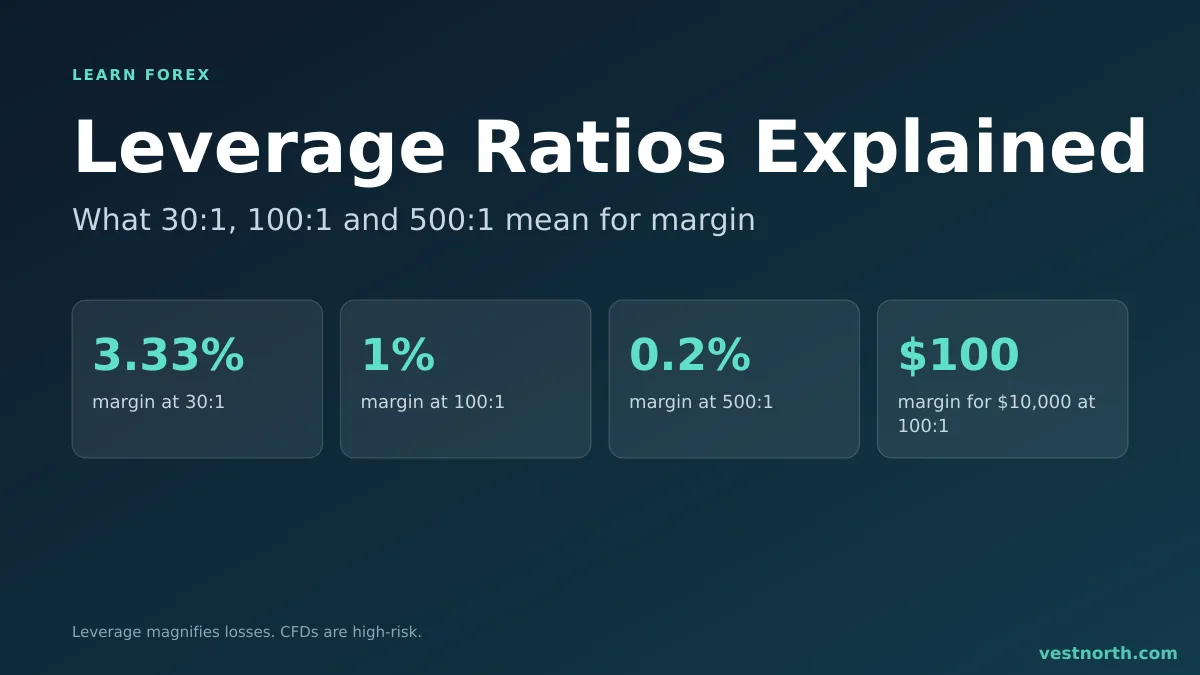
Margin required by ratio, from the worked examples in this article, October 2026.
How to read a ratio
A ratio such as 100:1 compares two sums. The first is the position value. The second is the margin, the part of your balance the broker sets aside while the trade is open. Some brokers write it the other way round, as 1:100. The meaning is the same.
The calculation has two forms:
Margin = position value ÷ ratio, or position value × margin %
Our guide to what leverage is covers the basics. This page is about reading the ratios you will meet on broker pages.
Margin needed at common ratios
For a $10,000 position (about 0.1 lot of EUR/USD, see what a lot is):
| Ratio | Margin % | Margin for $10,000 | Margin for $100,000 |
|---|---|---|---|
| 10:1 | 10% | $1,000 | $10,000 |
| 30:1 | 3.33% | $333.33 | $3,333.33 |
| 50:1 | 2% | $200 | $2,000 |
| 100:1 | 1% | $100 | $1,000 |
| 200:1 | 0.5% | $50 | $500 |
| 500:1 | 0.2% | $20 | $200 |
| 1000:1 | 0.1% | $10 | $100 |
For a small position the dollar gap between rows is modest. It grows with position size, and large positions are where the danger is.
What a price move does at each ratio
The ratio does not change what a pip is worth. Position size does that. What the ratio changes is how large a position your balance can hold, and so how small a move can erase it.
Take a $1,000 account. The table shows the biggest position each ratio allows if you used all the margin, and what a 1% adverse move costs:
| Ratio | Largest position | Loss on a 1% move | Share of account |
|---|---|---|---|
| 30:1 | $30,000 | $300 | 30% |
| 100:1 | $100,000 | $1,000 | 100% |
| 500:1 | $500,000 | $5,000 | 500% (account is gone first) |
At 500:1 the account cannot absorb even a 0.2% move once all the margin is used. In practice the platform closes trades at the stop out level before this, and whether you owe anything beyond the balance depends on your broker’s negative balance protection.
Nobody has to use the maximum. The same $1,000 account on 500:1 can hold a 0.01 lot trade ($1,000 position) and risk a few dollars with a stop loss.
The ratio is a ceiling, not a target
The ratio caps position size. It does not tell you how big to trade. A safer sequence:
- Decide the amount you will lose if the trade fails (for example 1% of the account).
- Measure the stop loss distance in pips.
- Calculate the lot size from those two numbers with the lot size calculator.
- Check that your margin covers it with room to spare.
At that point the leverage ratio only has to be high enough to open the trade. Our pages on position sizing and risk management show worked examples.
Why the ratio differs between brokers
Maximum leverage depends on the entity that holds your account, your country, the instrument and sometimes your equity.
- ASIC retail clients are limited to 30:1 on major FX pairs, as reported in our Vantage review.
- EU retail clients get 30:1 on major FX pairs under ESMA rules, and AvaTrade explains that moving to a non-EU entity means giving up leverage caps and other EU retail protections (AvaTrade Support). See our AvaTrade review.
- Offshore entities often advertise 500:1 or more. Brokers’ own pages can disagree about their maximum, as our Vantage leverage page shows. Our EBC leverage and Titan FX leverage guides show caps that depend on the country and account type, and the EBC review names the EBC entity that serves global clients.
We did not re-check regulators’ pages directly for this article, so treat these as examples and not as a legal reference. Gold, indices and crypto CFDs usually have lower ceilings than major pairs, and brokers can lower leverage before news events.
A higher ratio often comes with weaker protection, because it usually belongs to an offshore entity without the retail safeguards of an EU, UK or Australian licence.
Reading the fine print
- “Up to” leverage. “Up to 1000:1” is a ceiling for eligible accounts. Your own limit may be lower.
- Tiered leverage. Some accounts cut the ratio as equity or position size grows.
- Different ratio per instrument. Check the contract specification, not only the headline.
- Fixed or changing. Brokers may reduce leverage with notice, or without it in volatile markets, depending on their terms.
Bottom line
A leverage ratio converts directly into a margin percentage: divide 1 by the ratio. A higher ratio lets you open a bigger position on the same balance, and it makes a small price move cost more of your account. Choose the lot size from the money you can lose, keep a stop loss on every trade, and treat the broker’s maximum as a limit you rarely need. Only deposit money you can afford to lose. CFDs are complex, high-risk instruments.
Frequently asked questions
How do I read a leverage ratio like 100:1?
The first number is the position size and the second is your margin. At 100:1, $1 of margin supports $100 of position, so a $10,000 position needs $100.
Is 1:100 the same as 100:1?
Yes. Brokers write it both ways. 1:100 and 100:1 both mean the position can be 100 times the margin.
How do I convert leverage into a margin percentage?
Divide 1 by the ratio. 30:1 is 3.33% margin, 100:1 is 1%, 500:1 is 0.2%.
Does 500:1 leverage mean I can make 500 times more?
No. It lowers the margin needed for a position. Profit and loss depend on the position size you choose and the price move, and losses grow as fast as gains.
Which leverage ratio is safest?
No ratio is safe on its own. Risk comes from position size relative to the account and from whether a stop loss is in place. A lower ratio only limits how large a position you can open.
Why do brokers offer different leverage in different countries?
Regulators set limits for retail clients in some places, and offshore entities often have none. For example, ASIC retail clients and EU retail clients are limited to 30:1 on major FX pairs, as reported in our Vantage and AvaTrade reviews.