Forex Risk Management for Beginners
Short answer: Decide the most you can lose before you open a trade. Risk a small fixed share of the account, 1% or less is a common rule, then work out the lot size from your stop loss distance. At 1% on a $1,000 account, one losing trade costs about $10.
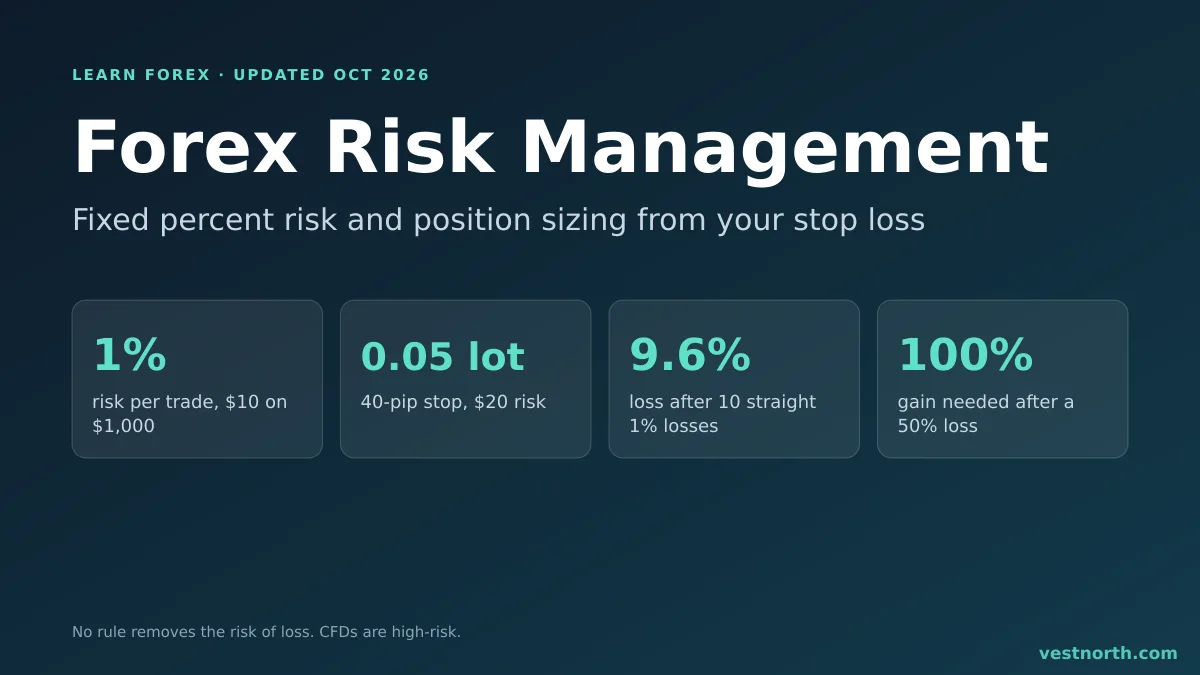
Position sizing in numbers. The examples use EUR/USD at $10 per pip per standard lot and are illustrations, October 2026.
Why risk rules matter more than entries
Most beginner accounts do not fail because of one bad market view. They fail because a few oversized trades in a row leave too little money to recover. A loss of 50% needs a gain of 100% to get back to even, so the deeper the hole, the harder the way out.
| Loss from peak | Gain needed to recover |
|---|---|
| 10% | 11% |
| 25% | 33% |
| 50% | 100% |
| 75% | 300% |
Risk rules are about staying in the game long enough to learn. They cannot make a trade win.
Step 1: risk a fixed percent per trade
Pick a percent of the account you accept to lose if the stop loss is hit. Many traders use 1% or less. On a $1,000 account:
| Risk per trade | Money at risk | After 10 losses in a row |
|---|---|---|
| 1% | $10 | about $904 left |
| 2% | $20 | about $817 left |
| 5% | $50 | about $599 left |
| 10% | $100 | about $349 left |
Each loss is a percent of the shrinking balance, so the totals fall a little slower than a straight line. Ten losses in a row is not rare for a strategy that wins 40% of the time. At 10% per trade it leaves a third of the account.
Step 2: size the position from the stop loss
The sequence matters. Do not pick a lot size first and then see how much it risks. Work backwards:
- Choose the stop loss price from the chart, not from the money, for example beyond a support or resistance level.
- Measure the distance in pips (see what a pip is).
- Divide the money at risk by that distance times the pip value per lot.
Lot size = money at risk ÷ (stop distance in pips × pip value per lot)
Example. Account $1,000, risk 2% = $20. You plan to buy EUR/USD with a 40-pip stop. One standard lot is worth about $10 per pip.
20 ÷ (40 × 10) = 0.05 lot (five micro lots, about $0.50 per pip).
If the stop is hit, you lose 40 × $0.50 = $20. If you widen the stop to 80 pips, the lot size drops to 0.025 to keep the risk the same. Our position sizing guide covers more cases. The lot size calculator does this sum, and the pip calculator gives pip values for other pairs.
Some brokers do not allow lots smaller than 0.01. If your correct size is below the minimum, the trade is too large for the account. Skip it or widen the account, not the risk.
Step 3: put the stop loss on the platform
A stop loss kept “in your head” does not close anything when you are asleep or away. Enter it with the trade. Read our notes on order types to see how stop and limit orders behave.
Two limits to know:
- A stop loss turns into a market order when triggered. After a gap, for example around a news release or the weekly open, the fill can be worse than your level.
- Moving a stop further away after the trade goes against you changes the risk you decided on. Moving it closer to lock in profit is fine.
Step 4: watch total exposure, not just single trades
Three trades risking 1% each are a 3% risk, but only if they are independent. EUR/USD, GBP/USD and AUD/USD often move together against the US dollar. Three long positions on those pairs behave like one trade of about triple the size. Opening an opposite position to offset one you already hold is called hedging: it limits further moves on that exposure, but you pay spread and swap on both sides.
Simple limits that help:
- A cap on open risk, for example 3% to 5% of the account in total.
- A daily loss limit, for example stop trading for the day after losing 3%.
- No new trade right after a loss to “win it back”.
Step 5: know the reward-to-risk ratio you need
Reward-to-risk compares the take profit distance with the stop loss distance. It decides the win rate you need.
| Reward : risk | Win rate needed to break even (before costs) |
|---|---|
| 1 : 1 | 50% |
| 2 : 1 | 33% |
| 3 : 1 | 25% |
Spreads and commissions raise those figures, because every trade starts slightly behind. A tight spread and a wider stop reduce that drag. A high ratio does not help if the target is rarely reached, so base the target on the chart too.
Margin, leverage and risk
Leverage sets how much margin a position needs, not what a pip is worth. High leverage makes it easy to open a position that a normal price move can wipe out. Check what leverage is and how a margin call and stop out work on your broker’s terms. If a position uses most of your balance as margin, the stop out can come before your stop loss does.
A simple pre-trade checklist
- Where is my stop loss, and why there?
- How much money is that, in my account currency?
- Is it 1% of the account or less (or whatever limit I set)?
- What is my total open risk including this trade?
- Is a news release due on this pair within the trade’s lifetime? Check the economic calendar.
Rules only work if you follow them after a run of losses. Our guide to forex trading psychology covers the habits that break risk plans.
Bottom line
Risk management is arithmetic you do before the trade: fix the percent, set the stop from the chart, then calculate the lot size. Keep total open risk and daily losses capped, and expect losing streaks. No rule removes the risk of loss, and a gap can fill a stop at a worse price. Only deposit money you can afford to lose. CFDs are complex, high-risk instruments.
Frequently asked questions
What is risk management in forex?
It is the set of rules that limits how much you can lose on one trade, in one day and in total. The core rules are a stop loss on every trade, a fixed percent of the account at risk per trade, and a cap on open exposure.
How much should I risk per trade?
There is no correct number, but many traders keep it at 1% of the account or less. At 1%, a $1,000 account risks $10 per trade, and ten losses in a row cost about $96, not the whole account.
How do I calculate position size?
Divide the money you will risk by the stop loss distance in pips times the pip value per lot. Risking $20 with a 40-pip stop on EUR/USD ($10 per pip per lot) gives 20 ÷ (40 × 10) = 0.05 lot.
Does a stop loss guarantee my loss is limited?
No. A stop loss becomes a market order when triggered, so a price gap can fill it at a worse level. It limits the loss in normal conditions, not in every condition.
Is high leverage bad for risk management?
Leverage does not change what a pip is worth, but it lets you open a position far larger than your account can survive. Size by the money at risk, not by the largest position your margin allows.
What is a good risk-reward ratio?
It depends on how often your trades win. A 2:1 ratio needs a win rate above about 33% to break even before costs, a 1:1 ratio needs above 50%. Spreads and commissions push both figures up.