How to Read a Forex Economic Calendar
Short answer: A forex economic calendar is a schedule of data releases and central bank events that move currencies. Each line shows the time, the country, a forecast, a previous figure and the actual result. Use it to know when volatility is likely, so you do not open a trade just before a release that can widen the spread and cause slippage.
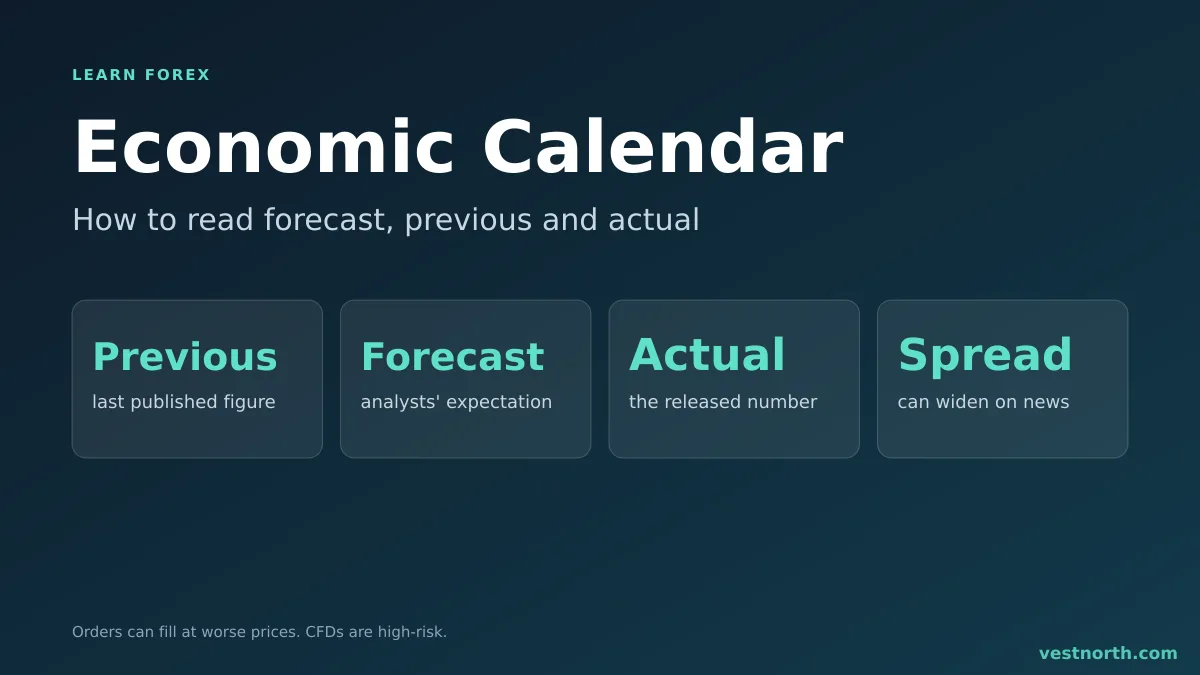
How an economic calendar line is laid out. Illustration, October 2026.
What an economic calendar shows
An economic calendar lists scheduled events in time order. Providers differ in layout, but most lines carry the same columns:
| Column | What it tells you |
|---|---|
| Time | When the release is due, in the zone you selected |
| Currency or country | Which currency the event is most likely to move |
| Event | The name, such as a consumer price index or a rate decision |
| Impact | A low, medium or high rating set by the provider |
| Previous | The figure from the last release |
| Forecast | The average expectation of analysts |
| Actual | The number once it is released |
The impact rating is an opinion of the calendar site, not a measurement. Two sites can rate the same event differently.
The events traders watch
Different releases matter to different degrees. These groups are the ones most often marked as high impact:
- Central bank decisions and statements. A bank raising, cutting or holding its interest rate, and what its officials say about the next move.
- Inflation data. Consumer price reports show how fast prices are rising, which affects rate expectations.
- Employment reports. Jobs and unemployment data, such as the US monthly employment report.
- Growth and activity data. Gross domestic product, retail sales and purchasing managers’ surveys.
Smaller releases and speeches by officials also appear. Events recur on schedules that each statistics office or central bank publishes, so you can read the next dates from the calendar rather than memorise them.
How to read forecast, previous and actual
The price often reacts to the gap between actual and forecast, not to the number alone. A worked example with made-up figures:
- Previous inflation: 3.0%.
- Forecast: 3.2%.
- Actual: 3.5%.
Inflation came in higher than analysts expected. Traders may now expect a central bank to keep rates higher for longer, which can support that currency. The reverse can happen too, and a currency can fall on a good number if the market had already priced in something better. A release that matches the forecast often causes a small move.
No reading of a single number gives you a reliable direction. Treat the calendar as a warning of when movement is likely, not as a signal to buy or sell.
What news does to spread and execution
Around a high-impact release, liquidity thins for a short time. Three things can happen:
- The spread widens, sometimes by several pips, so entering costs more.
- Orders can fill at a worse price. This is slippage.
- A stop loss can be triggered by a brief spike, even if price returns to its earlier level a minute later.
Pending orders placed on both sides of the price ahead of news can fill at poor prices or be triggered by the spike in the wrong direction. Whether your broker widens spreads, limits orders or changes margin around news depends on its own terms, so read them before you trade events.
A simple routine for using the calendar
- Set your time zone on the calendar page and check it again after a clock change.
- Filter for the currencies in the pairs you trade and for high-impact events.
- Note the times of the day’s releases before you open any trade.
- Check your open positions. A trade you plan to hold through a release needs a stop and a size you accept if the price jumps.
- Decide your rule in advance. Some traders close trades before a major release, some reduce size and some stay out until after the move. Put the rule in your trading plan.
For the hours when pairs are most active, see forex trading sessions. News often lands when a major session opens, so the two tools work together.
A short example with pip figures
You hold a buy on 0.2 lot of EUR/USD with a 40-pip stop, which risks about $80 at about $2 per pip (see the pip calculator). A major release is due in ten minutes. If the spread usually runs 1 pip and widens to 6 pips for a short time, your stop can trigger at a worse price than planned, and the trade can close beyond the 40 pips. The planned loss was $80. The real loss can be larger.
That gap between the plan and the result is why many traders either reduce size or close before high-impact news. Sizing a trade so the loss stays within your limit is covered in forex position sizing.
Common mistakes with the calendar
- Reading the time in the wrong zone.
- Trading the release as a guess about direction, with no plan for a wider spread.
- Treating every red-flag event as equal.
- Placing a tight stop just before a release.
- Ignoring events for the other currency in the pair. EUR/USD reacts to euro-area and US data alike.
- Using news as a reason to raise your risk after a loss. See forex trading psychology.
Related reading: the US dollar index (DXY), day trading for beginners and the carry trade.
Bottom line
An economic calendar tells you when scheduled news is due and how the result compares with the forecast. It does not tell you which way price will go. Use it to avoid opening trades into thin, fast markets, to check your stops before a major release and to plan your size. Pick a free calendar, set your time zone and filter it to the currencies you trade. Only trade with money you can afford to lose. CFDs are complex, high-risk instruments.
Frequently asked questions
What is a forex economic calendar?
It is a schedule of upcoming economic releases and events, such as inflation data, jobs reports and central bank decisions, listed by date, time, country and expected impact.
What do forecast, previous and actual mean?
Previous is the last published figure. Forecast is the average expectation of analysts. Actual is the number released. Markets tend to react to the gap between actual and forecast.
Which events move currencies the most?
Central bank interest rate decisions and statements, inflation data and employment reports are usually rated high impact. Impact ratings are set by the calendar provider, so they differ between sites.
What time zone does the calendar use?
It depends on the site, and many let you pick one. Check the zone before you plan around a release, because a one-hour mistake puts you in the trade at the wrong moment.
Should I trade during high-impact news?
It carries more risk. Spreads can widen, orders can fill at worse prices and stops can be hit by a quick spike. Many beginners stay out until the market settles.
Do I need to follow every event on the calendar?
No. Filter for the currencies you trade and for high-impact events, then note their times before you open a position.