Forex Day Trading for Beginners: How It Works, What It Costs and the Main Risks
Forex day trading means opening and closing trades within one trading day, so no position is held overnight. Trades usually last from a few minutes to several hours. Day trading attracts beginners because it looks quick, but it brings the most trades, the most costs and the most decisions, which is a hard combination to manage with little experience.
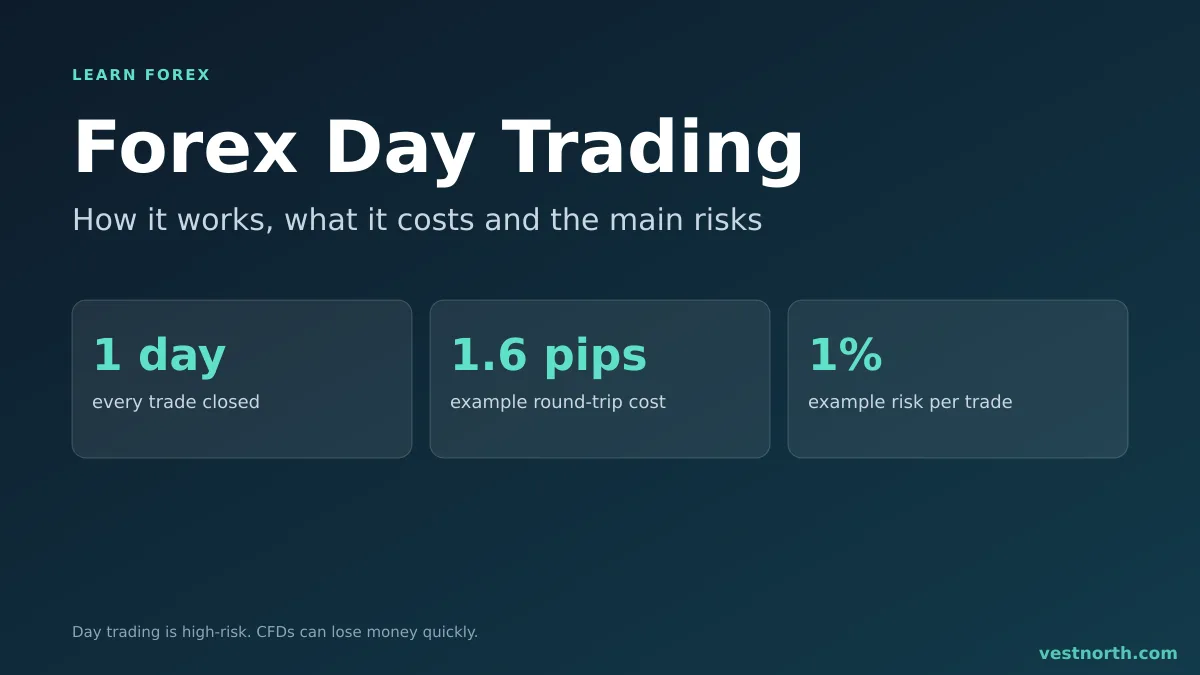
A day trade in one picture.
How day trading differs from other styles
The styles differ mainly in how long a trade is held. The scalping vs swing trading guide covers the two ends. Day trading sits between them.
| Style | Typical holding time | Trades | Swap paid |
|---|---|---|---|
| Scalping | Seconds to minutes | Many per day | No |
| Day trading | Minutes to hours, closed the same day | A few per day | No, if closed before rollover |
| Swing trading | Days to weeks | A few per week | Yes |
Holding times are rules of thumb, and traders do not agree on exact boundaries.
How a day trade works
- Pick a pair and a time window. Many day traders trade one or two major pairs during the busiest hours. The trading sessions guide shows when London and New York overlap.
- Read the chart on a short time frame. Common choices are the 5-minute to 1-hour charts, with a higher time frame for context. See how to read a forex chart.
- Set the stop loss and target before entering. The distance between entry and stop sets the position size. See position sizing and risk reward ratio.
- Manage the trade and close it. If the trade is still open near the end of your window, close it. That is what makes it a day trade.
Why costs matter more
Every trade pays the spread, and some account types add a commission. A day trader makes more trades than a swing trader, so these costs repeat. The spread vs commission guide explains the two models.
An example with made-up figures:
- Spread of 1.0 pip and a commission equal to 0.6 pip per trade, so a round trip costs about 1.6 pips.
- Five trades a day is 8 pips of cost.
- Over 20 trading days that is 160 pips, which has to be earned before the account is even.
A strategy with a target of 10 pips per trade gives up 16% of each winner to costs. A strategy aiming at 50 pips gives up about 3%. The shorter the target, the more costs weigh. Check the live spread on your own account, since it widens around news and at rollover.
Risk rules to settle first
- Fix the risk per trade. Many traders pick a small fraction of the balance, such as 1%, and size every trade from that. The risk management guide covers this.
- Set a daily loss limit. Decide in advance how much loss ends the day. Without one, a bad morning tends to become a worse afternoon. The trading psychology guide explains why.
- Watch leverage. Leverage magnifies both gains and losses and can bring a margin call quickly. See margin call and stop out.
- Avoid news and spikes unless planned. Releases cause spikes and slippage, and the economic calendar shows when.
A worked example of sizing: on a 2,000 account with 1% risk, the most you plan to lose on a trade is 20. With a stop 10 pips away, that is 2 per pip, which is about a 0.20 lot on a pair where a standard lot is worth 10 per pip. The pip value guide and the lot size calculator do this arithmetic for your pair and account currency.
Do you need a plan?
Yes. Day trading without written rules invites trades made out of boredom or to win back a loss. A trading plan lists the pair, hours, setup, stop, target and daily limit. Practise it on a demo account first. A demo has no real fear and often fills orders at better prices than a live account, so results there are only a rough guide.
What the numbers say
Regulators in some regions require brokers to show the percentage of retail CFD accounts that lose money. These figures are commonly above half. Day trading is not exempt, and the added trade count makes costs a larger drag. Read the figure on your own broker’s risk warning, and treat the activity as high-risk.
Bottom line
Forex day trading means closing every trade within the day, which avoids swap but means paying spread and commission many times. Decide risk per trade and a daily loss limit before you place the first order, write a plan, and practise on a demo account. Start with small sizes and risk only money you can afford to lose. CFDs are complex, high-risk instruments.
Frequently asked questions
What is forex day trading?
Day trading means opening and closing positions within the same trading day, so nothing is held overnight. Trades usually last from several minutes to several hours.
Is day trading different from scalping?
Scalping is a faster style with trades lasting seconds to minutes and many trades per day. A day trader makes fewer trades and holds each for longer, aiming at larger moves.
Do day traders avoid swap?
A position closed before the daily rollover does not pay or earn swap. Day traders still pay the spread and any commission on every trade.
How much money do I need to day trade forex?
There is no fixed answer. Broker minimum deposits differ, and a small account limits position size, since the risk per trade should stay a small fraction of the balance. Never trade with money you cannot afford to lose.
Do most day traders lose money?
Regulators require brokers to publish the share of retail CFD accounts that lose money, and the figure is commonly above half. Check the risk warning on your own broker's website for its current number.