Forex Risk Reward Ratio Explained
Short answer: The risk reward ratio is the distance to your target divided by the distance to your stop. Risk 20 pips to aim for 40 pips and the ratio is 1:2. At 1:2 you break even at roughly a 33% win rate before costs, and a little higher once spread is counted.
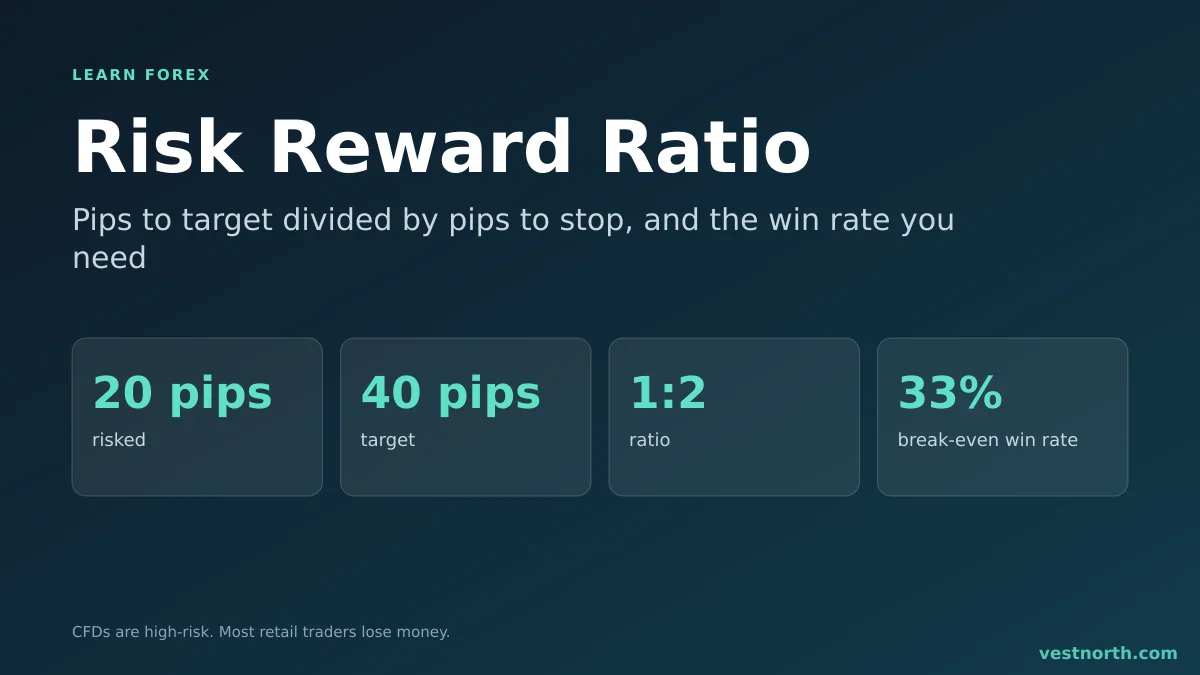
Risk reward ratio on a EUR/USD long, break-even win rate before costs. Illustration, October 2026.
The formula
Risk reward ratio = pips to take profit ÷ pips to stop loss.
Take a EUR/USD buy at 1.1000:
- Stop loss at 1.0980, so the risk is 20 pips.
- Take profit at 1.1040, so the reward is 40 pips.
- Ratio: 40 ÷ 20 = 2, written 1:2.
In money, size the trade first. With a 1% risk on a $2,000 account, you risk $20. At 20 pips of stop that is 0.1 lot at about $1 per pip on a 0.1 lot, so the target is worth about $40. Our position sizing guide and the pip calculator do the same arithmetic.
Break-even win rate
The ratio only means something with a win rate. The break-even rate before costs is:
Break-even win rate = 1 ÷ (1 + reward ratio)
| Ratio | Break-even win rate |
|---|---|
| 1:0.5 | 66.7% |
| 1:1 | 50% |
| 1:1.5 | 40% |
| 1:2 | 33.3% |
| 1:3 | 25% |
Example at 1:2 over 30 trades, risking $20 each: 10 winners earn $400 and 20 losers cost $400, so the result is zero. An 11th winner would put you $40 ahead.
Costs raise the bar
The table ignores spread, commission and slippage. If the spread is 1 pip, your 20-pip stop is effectively about 21 pips of loss and your 40-pip target about 39 pips of gain on a buy, because you enter at the ask and exit at the bid. The real ratio is 39 ÷ 21, about 1:1.86, and the break-even win rate rises to roughly 35%.
The smaller the stop, the more the spread matters. A 5-pip stop with a 1-pip spread loses a fifth of its width before the market moves.
A high ratio is not the same as a good trade
A 1:5 target looks attractive, but price must travel five times as far as the stop. If it gets there only 12% of the time, you lose money, because the break-even rate at 1:5 is 16.7%.
Use the ratio to reject trades, not to justify them:
- Place the stop where the trade idea is wrong, such as beyond a recent swing low.
- Place the target at a level price has reason to reach, such as a prior high.
- Work out the ratio from those two levels. If it is too low for your win rate, skip the trade.
Do not shift the stop tighter just to improve the number. A stop loss that sits inside normal price noise gets hit often.
Using the ratio with a plan
Track your own results. After 50 trades, count the win rate and the average pips won and lost. If you win 45% of the time with an average ratio of 1:1.5, you are above the 40% break-even rate. If the figures do not hold up, change the plan, not the maths. The ratio sits alongside the other rules in forex risk management. Trend-following setups, covered in trend trading basics, often accept a lower win rate in exchange for a larger ratio.
Two traders, same risk, different ratios
Ratio alone does not rank strategies. Compare two traders who each risk $20 per trade over 40 trades, before costs:
| Trader A | Trader B | |
|---|---|---|
| Ratio | 1:1 | 1:3 |
| Win rate | 55% | 30% |
| Winners | 22 x $20 = $440 | 12 x $60 = $720 |
| Losers | 18 x $20 = $360 | 28 x $20 = $560 |
| Net | +$80 | +$160 |
Trader B wins less than a third of the time and still comes out ahead, because each winner pays three times the loss. Change Trader B’s win rate to 22% and the result flips: 9 winners earn $540 and 31 losers cost $620, a net of minus $80. The break-even rate at 1:3 is 25%, so anything below it loses.
Common mistakes
- Changing the target after entry. Pulling the take profit closer when a trade is in profit lowers the average ratio without changing the average loss.
- Moving the stop further away. This makes the trade look smaller on the ratio and larger in dollars. If the stop moves, the position size must shrink.
- Using one ratio for every setup. A trade against a nearby support level may offer 1:1 while a breakout may offer 1:3. Calculate each one.
- Ignoring streaks. Even with a 40% win rate, six or seven losses in a row happen. The ratio does not remove a losing streak, so keep the risk per trade small enough to survive one.
Checking the ratio before you enter
A short routine keeps the number honest:
- Mark the stop level from the chart, not from the ratio you want.
- Mark the nearest target that price has a reason to reach.
- Add the spread to the risk and subtract it from the reward.
- Compare the result with your break-even win rate and your recent record.
- If the trade fails the check, skip it. Missing a trade costs nothing.
Related risk topics: moving a stop to break-even.
Bottom line
The risk reward ratio compares the pips to your target with the pips to your stop, and the break-even win rate follows from it: 1 divided by 1 plus the ratio. Spread and slippage make the real break-even rate higher than the table. Judge a ratio against how often your targets are really hit. Only trade with money you can afford to lose. CFDs are complex, high-risk instruments.
Frequently asked questions
What is the risk reward ratio in forex?
It compares the potential loss on a trade with the potential gain. If you risk 20 pips to aim for 40 pips, the ratio is 1:2, meaning you aim to gain two units for every one you risk.
How do you calculate the risk reward ratio?
Divide the pips between entry and take profit by the pips between entry and stop loss. Entry 1.1000, stop 1.0980 and target 1.1040 gives 40 / 20 = 2, written 1:2.
What is a good risk reward ratio?
There is no universal figure. A higher ratio needs a lower win rate to break even, but targets that are far away are hit less often. Test the ratio against your own results.
What win rate do I need at 1:2?
Before costs, you break even at about 33.3%. With spread and commission added, you need a little more. The formula is 1 / (1 + reward ratio).
Does a high risk reward ratio guarantee profit?
No. If the target is rarely reached, the win rate falls and the ratio does not help. Costs such as spread and slippage also reduce the real ratio.
Where do I place the stop loss for the ratio?
Place it where your trade idea is proven wrong, then see if a sensible target gives an acceptable ratio. Do not move the stop closer just to improve the number.