What Is a Spread in Forex?
Short answer: The spread is the gap between the bid (sell) price and the ask (buy) price. It is the main cost of most forex trades. On EUR/USD, a 1.2-pip spread on one standard lot costs about $12 to open the trade.
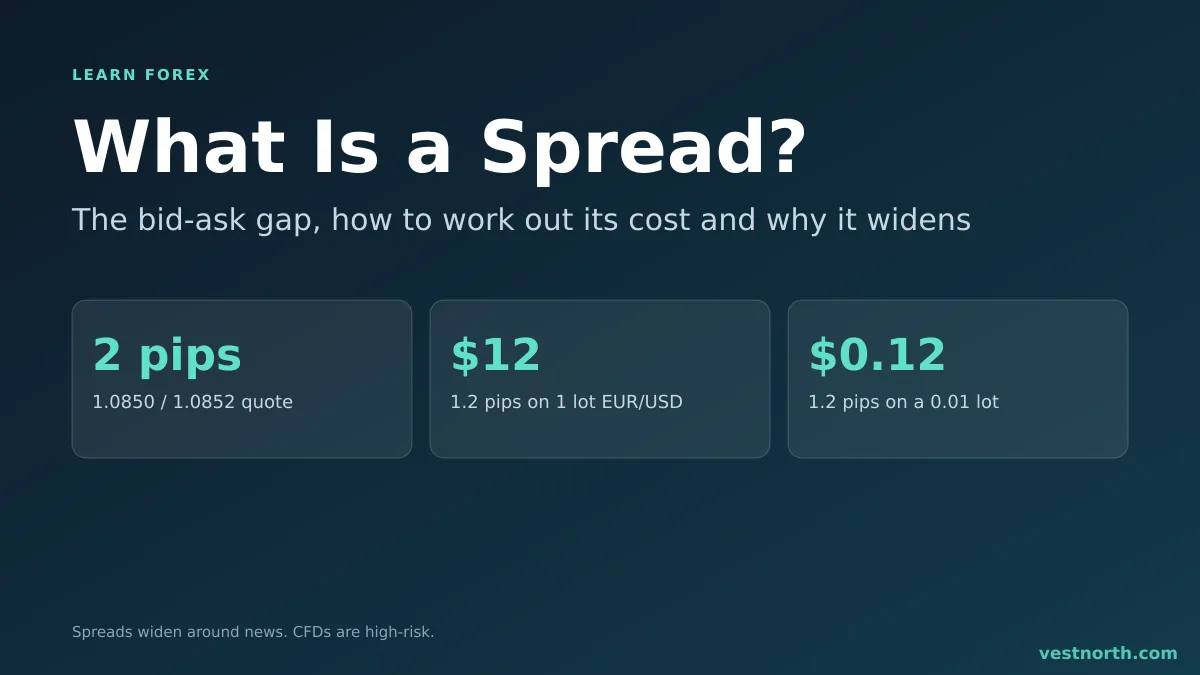
A spread explained with a sample quote, October 2026. Figures are illustrations, not a broker’s prices.
Bid, ask and spread
Every forex quote has two prices (more in bid and ask price):
- Bid: the price at which you can sell.
- Ask: the price at which you can buy.
The ask is always higher than the bid. The difference is the spread. If EUR/USD shows 1.0850 / 1.0852, the spread is 0.0002, which is 2 pips. (If your platform shows five decimals, it can also be shown in points: 10 points are 1 pip. See what a pip is.)
If you buy at 1.0852 and close at once, you sell at 1.0850. You have lost the spread. The price has to move in your favour by that amount before you break even.
How to work out the cost of a spread
Spread cost = spread in pips × pip value × lots
| Spread | Lot size | Pip value (EUR/USD) | Cost to open |
|---|---|---|---|
| 1.2 pips | 1.00 | $10 | $12 |
| 1.2 pips | 0.10 | $1 | $1.20 |
| 1.2 pips | 0.01 | $0.10 | $0.12 |
| 0.1 pips + commission | 1.00 | $10 | $1 + commission |
You pay it on every trade, win or lose. Our pip calculator shows pip value for other pairs, and the lot size calculator helps pick the size. For lot sizes see what a lot is.
Fixed and variable spreads
Fixed spreads stay the same under normal conditions. They are easy to predict, though a fixed spread is often wider than the average variable spread, and brokers can still change it in extreme markets.
Variable (floating) spreads change with liquidity. They can be very tight during the London and New York overlap and widen sharply during news, at rollover and at the weekend gap.
Most retail brokers offer variable spreads on at least some accounts. Check the account terms to see which type applies.
Spread-only accounts vs raw spread plus commission
Many brokers offer two cost models:
- Standard (spread-only): the broker’s fee is built into a wider spread. No separate commission.
- Raw spread (ECN-style) plus commission: a tighter spread plus a fixed commission per lot, often charged per side.
Neither is better by default. For a trader who places few trades, spread-only is simple. For a frequent trader, the raw model can be cheaper once you add up spread and commission per round trip. Compare the total cost per lot on the pairs you trade. For an example of how brokers label accounts, see Vantage’s review and Exness’s review. We have not traded real money with these brokers, so we compare the published terms only.
Why spreads widen
- News releases. Interest rate decisions and jobs data can widen spreads for seconds or minutes.
- Low liquidity. Market open, late Friday and rollover hours have fewer participants.
- Exotic pairs and CFDs. Less traded instruments cost more.
- Volatility. Fast markets make dealers quote wider prices to protect themselves.
If you plan to trade the news, expect higher costs and slippage, and consider whether the trade is worth it.
Other costs that sit beside the spread
The spread is not your only cost:
- Commission on raw accounts.
- Swap (overnight financing) for positions held past rollover.
- Withdrawal and deposit fees, which some brokers charge for certain methods.
- Inactivity fees that a few brokers apply.
Add up the costs for the way you really trade. A broker with an eye-catching spread can still be expensive overall. See also our Exness review for how an overnight admin fee on swap-free accounts works.
How to keep spread costs down
- Trade pairs with deep liquidity, such as EUR/USD, during busy sessions.
- Avoid opening trades right before major news if you are not prepared for wider spreads.
- Make fewer, better planned trades, because each one costs the spread.
- Compare account types on total cost, not on the headline number.
- Use the broker’s published specifications and a live account view to confirm the real spread you receive. Published “from” spreads are minimums, not guarantees.
Bottom line
The spread is the gap between bid and ask, and you pay it each time you open a trade. Work out the cost in money with the formula above, compare accounts using the all-in cost per lot, and remember that spreads widen when markets are thin or busy with news. Only deposit money you can afford to lose.
New to trading? Our forex trading for beginners guide puts these basics together in one place.
Frequently asked questions
What is a spread in simple terms?
The spread is the difference between the price you can sell at (bid) and the price you can buy at (ask). You pay it when you open a trade, so every position starts slightly in the red.
How do I calculate the spread cost?
Multiply the spread in pips by the pip value and the number of lots. A 1.2-pip spread on one standard lot of EUR/USD (about $10 per pip) costs about $12.
What is a good spread?
It depends on the pair and the account. Major pairs such as EUR/USD usually have the tightest spreads. Compare the total cost, including commission, not only the spread.
Why do spreads widen?
Spreads often widen when liquidity drops, such as around major news releases, at market open and close, over weekends and rollover time.
What is the difference between a fixed and a floating spread?
A fixed spread stays the same under normal conditions. A floating (variable) spread changes with market liquidity. Brokers with raw spread accounts typically charge a commission on top.
Is a zero-spread account really free?
Not necessarily. Accounts advertised with zero or very low spreads usually charge a commission per lot or have other conditions. Read the account terms and add up all the costs.