Forex Lot Size Calculator
Tell the calculator how much you have, how much of it you are prepared to lose on this trade, and where your stop loss is. It returns the largest lot size that keeps the loss within that amount.
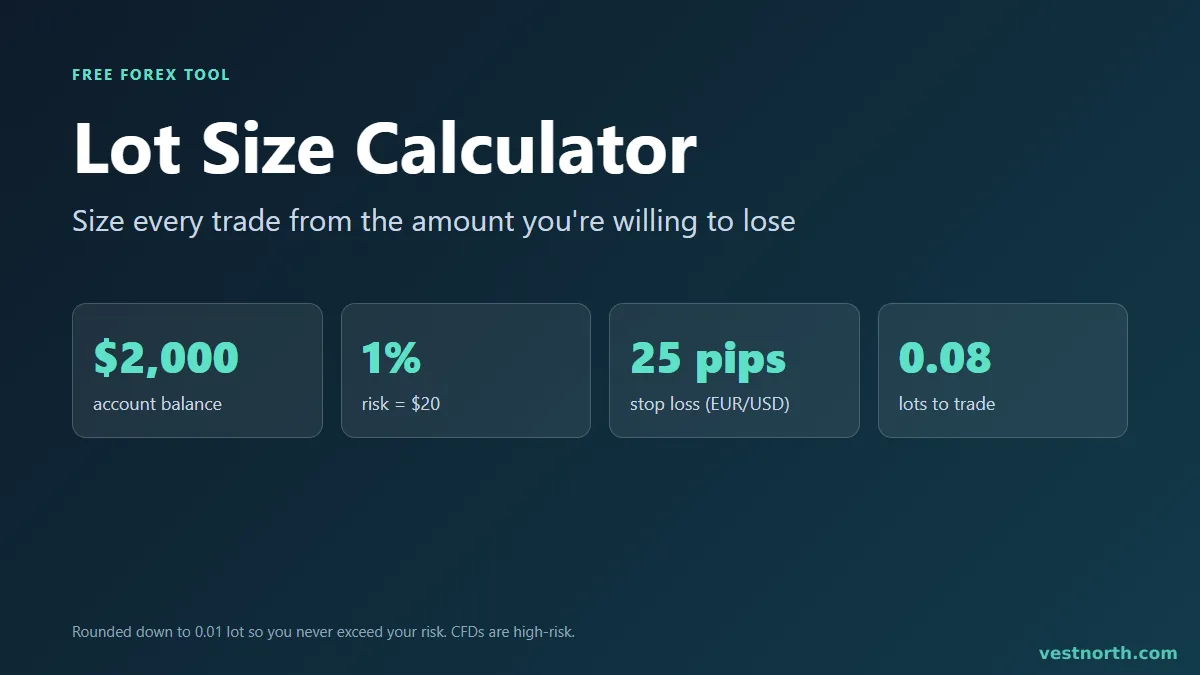
The worked example below, in four numbers.
The formula
Lot size = (account balance × risk %) ÷ (stop loss in pips × pip value per lot)
Example: a $2,000 account risking 1% ($20) with a 25-pip stop on EUR/USD, where one pip on one lot is worth $10:
$20 ÷ (25 × $10) = 0.08 lots.
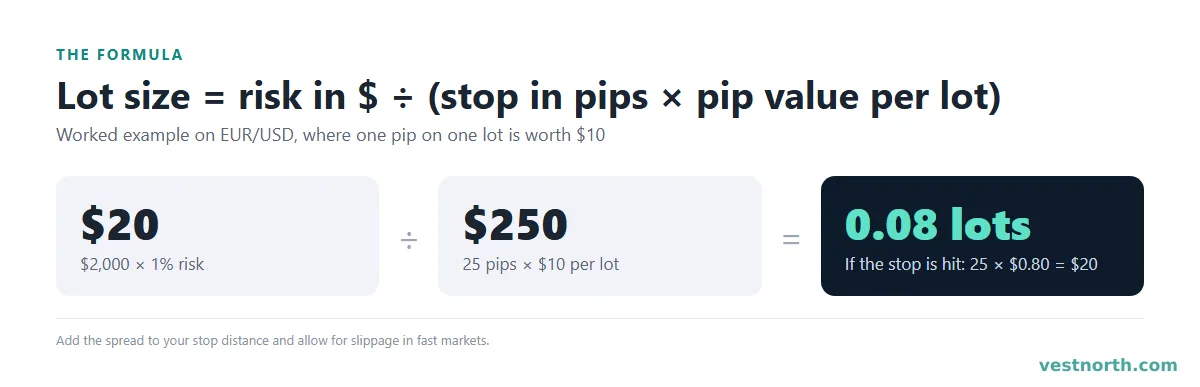
If the stop is hit, the loss is 25 pips × $0.80 = $20, exactly the amount you chose to risk. The calculator rounds down to the nearest 0.01 lot, because most brokers don’t accept smaller increments, and rounding up would push you over your risk limit.
How much is 0.01 lot in dollars?
A lot size describes units of the base currency, so its dollar size depends on the pair. On EUR/USD:
| Lot size | Units | Position value at 1.0850 | Value of 1 pip | 20-pip move |
|---|---|---|---|---|
| 1 | 100,000 | about $108,500 | $10 | $200 |
| 0.1 | 10,000 | about $10,850 | $1 | $20 |
| 0.01 | 1,000 | about $1,085 | $0.10 | $2 |
“1 lot is equal to” 100,000 units of the base currency, and 0.01 lot is equal to 1,000 units. The position value is not what you pay. You put up margin, a fraction of it set by your leverage, and your profit or loss follows the pip value. See what a lot is and lot sizes for beginners.
Lot size in dollars: 0.01 to 100 lots
Quick lookup for pairs quoted in USD (EUR/USD, GBP/USD) and for gold with a 100-ounce contract and a 0.1 pip. Dollars per pip is simply lots × $10.
| Lots | Units (forex) | Ounces (gold) | Dollars per pip | 50 pips |
|---|---|---|---|---|
| 0.01 | 1,000 | 1 | $0.10 | $5 |
| 0.03 | 3,000 | 3 | $0.30 | $15 |
| 0.05 | 5,000 | 5 | $0.50 | $25 |
| 0.1 | 10,000 | 10 | $1 | $50 |
| 0.3 | 30,000 | 30 | $3 | $150 |
| 0.5 | 50,000 | 50 | $5 | $250 |
| 1 | 100,000 | 100 | $10 | $500 |
| 10 | 1,000,000 | 1,000 | $100 | $5,000 |
| 100 | 10,000,000 | 10,000 | $1,000 | $50,000 |
A 100-lot position is an institutional size. Figures are arithmetic, not a forecast, and a loss at these sizes scales the same way as a gain.
What 0.01, 0.1 and 1 lot are worth in dollars per pip
One lot is 100,000 units of the base currency, so 1 lot equals 100,000 euros on EUR/USD and 100 ounces on gold. The table shows the dollar value of one pip at each size, using the usual pip definitions (0.0001 on EUR/USD, 0.1 on gold with a 100-ounce contract).
| Lot size | EUR/USD per pip | XAU/USD per pip | 100 pips EUR/USD | 100 pips XAU/USD |
|---|---|---|---|---|
| 1 | $10 | $10 | $1,000 | $1,000 |
| 0.1 | $1 | $1 | $100 | $100 |
| 0.01 | $0.10 | $0.10 | $10 | $10 |
Other sizes scale the same way. Per pip, 0.04 lot is $0.40, 0.08 lot is $0.80 and 0.3 lot is $3. A 1,000-pip move on 0.01 lot is $100 on EUR/USD. On gold, 1,000 pips of 0.1 is a $100 price move, which is also $100 on 0.01 lot (one ounce). If your platform counts 0.01 as a gold pip, 1,000 pips is only a $10 price move and $10 on 0.01 lot. Check the symbol specification before you rely on a pip count.
Lot size for gold and indices
The formula does not change. Only the value of one pip or point per lot does.
Gold (XAU/USD). With a 100-ounce contract, 1 lot moves $10 for every 0.1 move ($1.00 in price is $100 per lot). Example: a $1,000 account risking 2% ($20) with a stop $5.00 away (50 pips of 0.1): $20 ÷ (50 × $10) = 0.04 lot. Some platforms quote gold pips as 0.01, which changes the pip count but not the dollar result.
US30 and other index CFDs. Brokers set a different value per point per lot. Find it in the contract specification, then use: lot size = risk in dollars ÷ (stop in points × value per point per lot). If the specification says $1 per point per lot and you risk $30 with a 100-point stop, the size is $30 ÷ (100 × $1) = 0.3 lot. With a $10-per-point contract the same risk allows 0.03 lot.
MT4 and MT5 users. The calculator works with any platform. Use the pip value from your symbol’s specification if your broker’s contract size differs from the standard 100,000 units.
Why size positions by risk?
Most traders who blow up an account don’t do it with a bad strategy. They do it with position sizes that are too large for the stop they’re using. Sizing from risk flips the process:
- Decide where the trade is wrong, which is where your stop loss goes.
- Decide how much you can lose if it is wrong.
- Let the lot size follow from those two numbers.
A wider stop means a smaller position. A tighter stop allows a larger one. The dollar risk stays the same.
How much should you risk per trade?
There is no single right number, but common guidelines are:
| Risk per trade | Losing streak to lose 20% of the account |
|---|---|
| 0.5% | about 45 trades |
| 1% | about 22 trades |
| 2% | about 11 trades |
| 5% | about 5 trades |
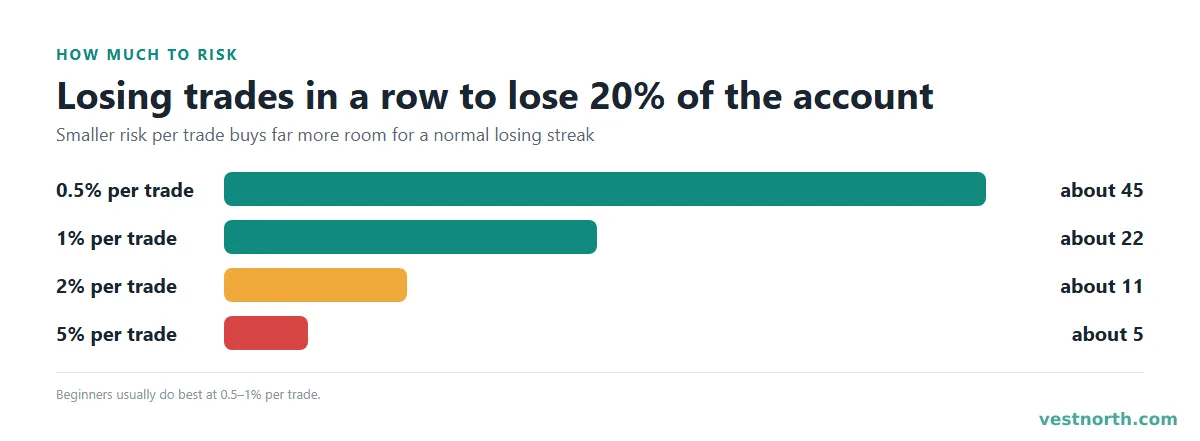
Even a strategy that wins often will hit losing streaks. Beginners usually do best at 0.5–1%.
Small accounts and the 0.01 lot minimum
Most brokers’ smallest trade is 0.01 lot (a micro lot), worth about $0.10 per pip on EUR/USD. With $100 and a 1% risk rule, you can afford a stop of only 10 pips at that size. That’s why cent accounts exist: they let you trade 1/100th of a micro lot, so small balances can still follow sensible risk rules. See how this works on the Exness Standard Cent account.
Using the calculator with an Exness account
The calculator uses standard lots, which is what Exness Standard, Pro, Raw Spread and Zero accounts trade. Exness lists a forex lot as 100,000 units of the base currency and an XAUUSD lot as 100 troy ounces, with a minimum of 0.01 lot. So the result above can be typed straight into the order window on those accounts.
The Standard Cent account is different. Exness defines 1 cent lot = 0.01 standard lot (1,000 USD), its symbols carry a “c” suffix (EURUSDc, XAUUSDc), and the balance is shown in US cents (USC). To convert:
| Calculator result (standard lots) | Exness Standard, Pro, Raw, Zero | Exness Standard Cent |
|---|---|---|
| 0.50 | 0.50 lot | 50 cent lots |
| 0.05 | 0.05 lot | 5 cent lots |
| 0.01 | 0.01 lot | 1 cent lot |
| 0.003 | not possible (below 0.01) | 0.30 cent lot |
Enter your balance in dollars, not cents: 10,000 USC is $100. One cent lot on EURUSDc is worth about $0.10 per pip, which the platform shows as 10 USC. On XAUUSDc, 1 cent lot is 1 ounce, so a $1 move in gold is $1 (100 USC).
Example: a $100 Standard Cent account risking 1% ($1) with a 20-pip stop on EURUSDc. The calculator gives 0.005 lot, which is 0.5 cent lot. On a Standard account that trade is impossible at 1% risk, because 0.01 lot would risk $2. Exness changes its conditions from time to time, so open the symbol specification in your terminal before trading. More detail is in our Exness review and Exness minimum deposit guide. For gold specifically, see the gold pip calculator.
Before you place the trade
- Check the spread. It is paid when the trade opens, so a 2-pip spread makes a 20-pip stop effectively 22 pips.
- Check margin. Make sure you have enough free margin for the position with the margin calculator.
- Remember slippage. In fast markets a stop can fill beyond its level, so the real loss may be larger than planned.
Want the value of a single pip instead? Use the pip calculator.
Frequently asked questions
What lot size should I use with $100?
It depends on your stop loss. Risking 1% of $100 means $1. With a 20-pip stop on EUR/USD (about $0.10 per pip per micro lot), the exact size would be 0.005 lot. Most brokers' minimum trade is 0.01 lot, which would risk $2 (2%), so a small account needs either a tighter stop, a higher risk percentage or a cent account.
What is the 1% rule in forex?
It is a common risk-management guideline: never lose more than 1% of your account on a single trade. It keeps a losing streak from wiping out your account, but it is a guideline, not a guarantee against losses.
How much is 0.01 lot in dollars?
0.01 lot is 1,000 units of the base currency. On EUR/USD that is a position of 1,000 euros, and each pip is worth about $0.10, so a 20-pip move is about $2.
How do I calculate lot size for gold?
Use the same formula with gold's pip value. With a 100-ounce contract and a 0.1 pip, 1 lot is $10 per pip. Risking $20 with a 50-pip ($5) stop gives $20 ÷ (50 × $10) = 0.04 lot.
Is lot size the same as position size?
Yes. Position size is the amount you trade. In forex it is usually expressed in lots (1 lot = 100,000 units), so lot size and position size describe the same thing in different units.
Does leverage change the lot size I should trade?
No. Leverage only changes how much margin the broker holds. Your risk is set by lot size and stop-loss distance. High leverage just makes it possible to open positions that are far too big for your account.
Does this lot size calculator work for Exness?
Yes for Standard, Pro, Raw Spread and Zero accounts, which use standard lots (100,000 units on forex, 100 ounces on gold). On a Standard Cent account, 1 cent lot equals 0.01 standard lot, so multiply the calculator's result by 100 to get cent lots.
Sources
- Exness Help Center: Standard Cent account
- Exness Help Center: Commodities (XAUUSD contract size)
- Exness Help Center: Trading volume calculation
Sources checked on November 2, 2026. Broker terms change often: confirm the current conditions on the broker's own site before you open an account.