What Are the Bid and Ask Price in Forex?
Short answer: Every forex quote has two prices. The bid is the price at which you can sell, and the ask is the price at which you can buy. The ask is always higher. On a quote of 1.0850 / 1.0852 for EUR/USD, you sell at 1.0850, you buy at 1.0852, and the 2-pip gap is the spread you pay to trade.
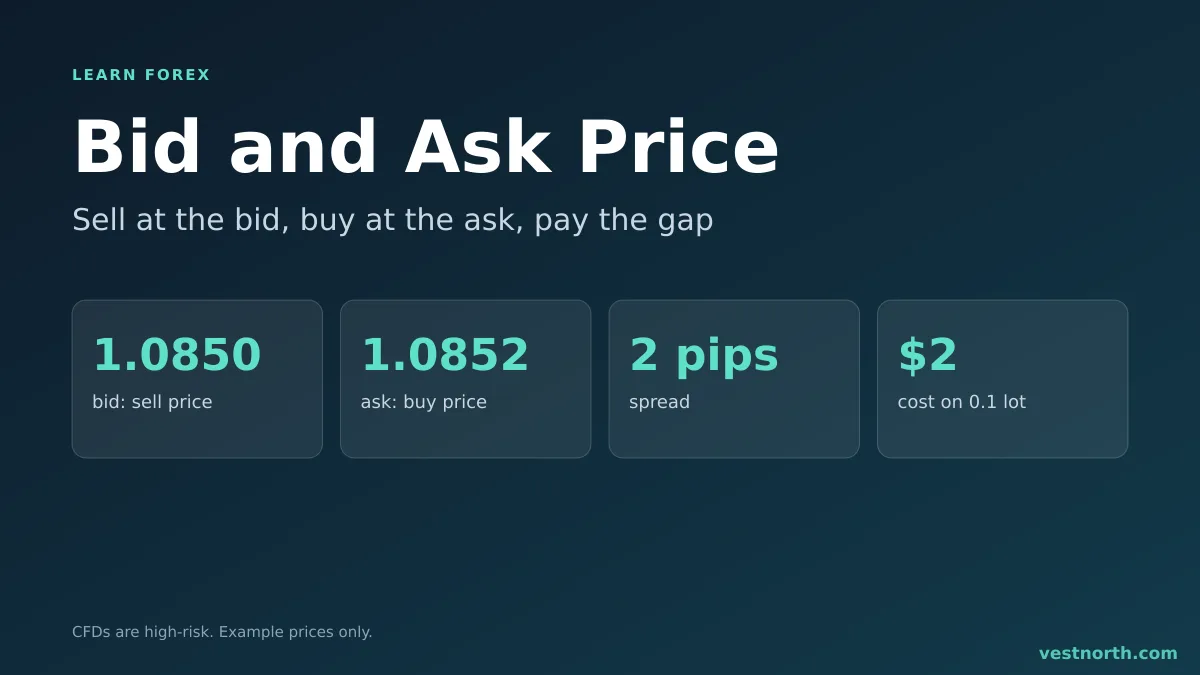
How to read a bid and ask quote. Illustration with example prices, October 2026.
How to read a forex quote
A quote shows the price of one currency in terms of another. In EUR/USD, EUR is the base currency and USD is the quote currency. A price of 1.0850 means 1 euro costs 1.0850 US dollars.
Your platform shows two numbers for the pair:
| Bid | Ask | |
|---|---|---|
| Also called | Sell price | Buy price, offer |
| Which side of the quote | Lower | Higher |
| You use it to | Sell the base currency | Buy the base currency |
| Example, EUR/USD | 1.0850 | 1.0852 |
A simple way to remember it: the broker is on the other side of your trade. It buys from you at the bid and sells to you at the ask. The broker is on the better side of the gap, which is why the prices are never reversed.
Which price do you pay when you open and close?
Opening and closing a position uses both prices, one at each end.
- Buy trade: you open at the ask and close at the bid.
- Sell trade: you open at the bid and close at the ask.
That is the reason a new trade starts slightly in the red. If you buy EUR/USD at 1.0852 and the quote does not move, the only price you could close at is the bid, 1.0850. You would lose the 2 pips of spread.
A worked example in pips and money
Take the quote 1.0850 / 1.0852 and a position of 0.1 lot (10,000 units of EUR). On EUR/USD with a USD account, one pip on 0.1 lot is about $1. See what a pip is and the pip calculator for the formula.
- You buy at the ask, 1.0852.
- Price moves up and the quote becomes 1.0880 / 1.0882.
- To close the buy, you sell at the bid, 1.0880.
- The move is 1.0880 − 1.0852 = 0.0028, which is 28 pips, about $28 before any commission or swap.
Compare that with the “mid” price. From 1.0851 (halfway between the first bid and ask) to 1.0881, the move looks like 30 pips. The 2 pips that disappear are the spread. On the opposite trade, a sell opened at the bid 1.0850 and closed at the ask 1.0882 would be a loss of 32 pips.
The spread is the gap
The spread is the ask minus the bid. With 1.0850 / 1.0852 it is 0.0002, or 2 pips. If your platform shows five decimals, such as 1.08503 / 1.08521, the last digit is a point, and 10 points make 1 pip. The cost in money is:
spread in pips × pip value per lot × lots
For 2 pips on 0.1 lot of EUR/USD that is 2 × $10 × 0.1 = $2. The full treatment, including how raw spreads plus commission compare with wider spreads and no commission, is in what the spread is and spread vs commission.
Why the gap changes
The bid and ask are not fixed. They come from the prices of the broker’s liquidity providers and from the broker’s own pricing, and they update many times a second. The gap tends to:
- Widen when few participants trade, for example around the daily rollover or on a bank holiday. See forex trading sessions.
- Widen around major news, because dealers quote cautiously when prices can jump.
- Narrow in busy sessions on liquid pairs such as EUR/USD.
Exotic pairs generally have wider gaps than majors. Your broker’s contract specifications show whether its spread is fixed or floating on each account type.
Bid and ask on your chart and your orders
Most platforms, including MetaTrader 4 and MetaTrader 5, draw the chart from the bid price by default. This matters for orders.
- A buy trade closes at the bid, so its stop loss and take profit are triggered when the bid touches them.
- A sell trade closes at the ask, so its stop loss and take profit are triggered when the ask touches them. The chart line may not have reached the level yet, because the chart shows the bid and the ask sits higher.
That explains the common complaint that “price never touched my stop but I was stopped out”: on a sell, the ask did. A wide spread makes the difference bigger. Many platforms can display an ask line on the chart, so you can see both.
The same logic applies to pending orders. A buy limit or buy stop is compared with the ask, and a sell limit or sell stop with the bid.
Quotes versus fills
The prices you see are a quote. The price you get is a fill. In fast markets, or when you place a market order of large size, the fill can differ from the quote you clicked on. See slippage in forex for how that works. Your broker’s execution policy explains how it fills orders.
Common beginner mistakes
- Reading only the bid and assuming a buy is filled there.
- Forgetting that a buy and a sell on the same pair at the same moment lose the spread.
- Setting a very tight stop that a normal spread, or a spread that widens at rollover, can hit.
- Comparing the spread on a quiet weekend quote with the spread during a busy session.
- Opening a position just before major news, when the gap is likely to be at its widest.
Practise reading both prices on a demo account before risking money.
Bottom line
The bid is where you sell and the ask is where you buy, and the gap between them is the spread. Every trade crosses that gap once when it opens and once when it closes at the other price, so check both numbers before you enter. Remember that a buy is stopped out by the bid and a sell by the ask. Only trade with money you can afford to lose. CFDs are complex, high-risk instruments.
Frequently asked questions
What is the bid price in forex?
The bid is the price at which you can sell the base currency of a pair. It is the lower of the two prices in a quote.
What is the ask price in forex?
The ask, also called the offer, is the price at which you can buy the base currency. It is the higher of the two prices in a quote.
Do I buy at the bid or the ask?
You buy at the ask and sell at the bid. A buy order opens at the ask price and closes at the bid price, while a sell order does the reverse.
Why is the ask always higher than the bid?
The difference is the spread, which is how most brokers and liquidity providers are paid. If the two prices were equal there would be no spread to charge.
Which price does a chart show?
Most MetaTrader charts draw the bid price. A buy trade closes at the bid but opens at the ask, so a buy's stop loss or take profit is triggered by the bid, and a sell's by the ask.
Can the bid and ask change between clicking and filling?
Yes. Prices update many times a second, so the fill can differ from the quote you saw. That difference is slippage, and it is most likely in fast markets.