Spread vs Commission in Forex: How to Compare the Real Cost
Short answer: A broker is paid through the spread, a commission, or both. To compare accounts, turn everything into one number: the round-trip cost per lot. At $6 per lot round turn, a commission equals 0.6 pips on a USD-quoted pair, so a raw-spread account only costs less when its spread is more than 0.6 pips tighter than the commission-free one.
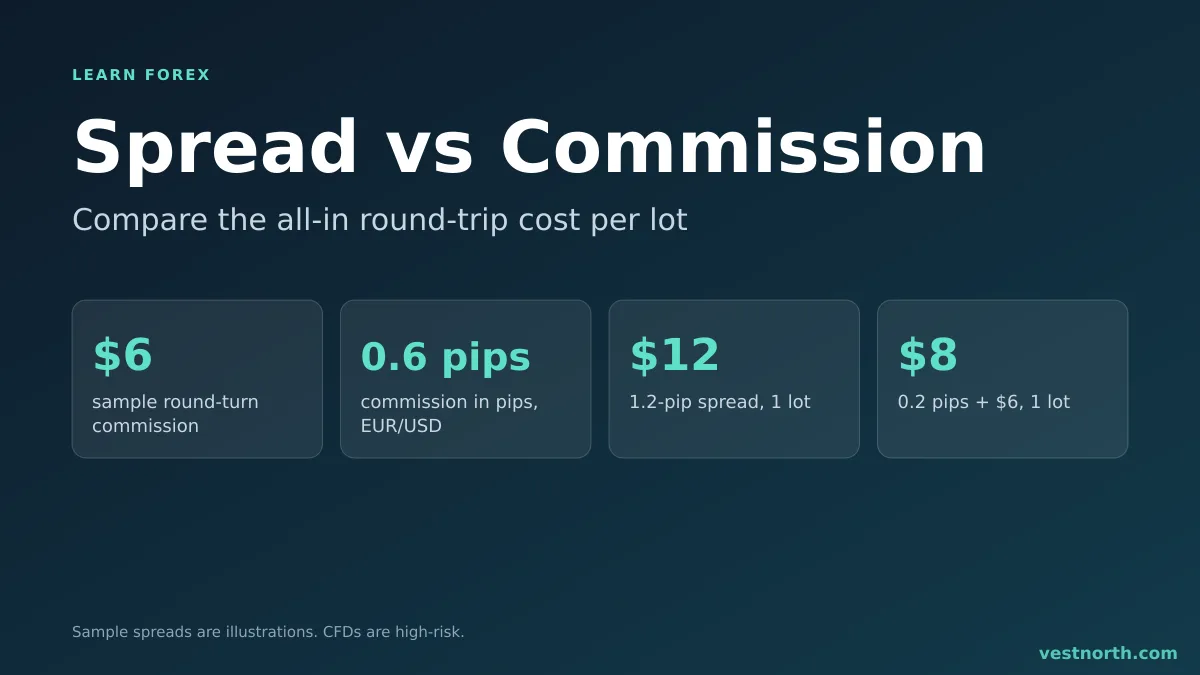
Two pricing models side by side with sample spreads, October 2026. The spread figures are illustrations, the commissions come from our broker reviews.
Two ways to pay the same broker
Every forex or CFD trade has a cost on the way in. Brokers charge it in one of two shapes:
- Spread only. The broker adds a markup to the price, so the gap between bid and ask is wider. No separate fee appears on your statement. Brokers often label these accounts Standard or STP.
- Raw spread plus commission. The spread is close to what the liquidity providers quote, and the broker charges a fixed fee per lot. Brokers often label these accounts Raw or ECN. See ECN vs STP for what the labels do and do not tell you.
Some brokers mix the two, for example a small markup and a smaller commission. The sums below work for any mix.
Commission per side and round turn
Commission is quoted in different ways, and this is where comparisons go wrong.
| Wording | Meaning | Round-turn cost per lot |
|---|---|---|
| $3.00 per lot per side | Charged on open and again on close | $6.00 |
| $6 per lot round turn | One figure for open plus close | $6.00 |
Our reviews report two real examples. Vantage lists Raw ECN from $3.00 per lot per side and Pro ECN from $1.50 per lot per side (see the Vantage review and Vantage account types). VT Markets lists RAW ECN at $6 per lot round turn (see the VT Markets account types guide and VT Markets fees). Both come to $6.00 for a standard lot round trip, although one is written per side and the other per round turn. Commission rates can change, so confirm them in the broker’s current fee table.
Convert commission into pips
A pip is the smallest standard price step in most pairs (see what a pip is). On a USD-quoted pair such as EUR/USD, one pip on one standard lot is about $10.
Commission in pips = round-turn commission ÷ pip value per lot
$6 ÷ $10 = 0.6 pips. Now you can add it to a spread, which is also in pips.
The pip value is not always $10. On USD/JPY, EUR/GBP or gold it differs, so use the pip calculator for the pair you trade. The commission is a fixed dollar amount per lot, but its size in pips changes with the pair.
Worked example: which account costs less?
Take one standard lot of EUR/USD and these sample spreads. They are not live prices from any broker.
| Account A (spread only) | Account B (raw plus commission) | |
|---|---|---|
| Spread | 1.2 pips | 0.2 pips |
| Spread cost | 1.2 × $10 = $12 | 0.2 × $10 = $2 |
| Commission | none | $6 round turn |
| Total to open and close | $12 | $8 |
Account B is $4 cheaper per lot. Change one number and the answer flips. If Account B showed a 0.7-pip spread, its total would be $7 + $6 = $13, which is dearer than Account A.
The break-even rule is the one from the short answer. With a $6 round-turn commission, Account B wins only if its spread is lower than Account A’s by more than 0.6 pips.
Compare on trade size
Both costs scale with lots, so the ratio stays the same. The dollar gap does not.
| Lot size | Account A total | Account B total | Difference |
|---|---|---|---|
| 1.00 | $12.00 | $8.00 | $4.00 |
| 0.10 | $1.20 | $0.80 | $0.40 |
| 0.01 | $0.12 | $0.08 | $0.04 |
A few cents on a micro lot look trivial. They are not, because the cost is paid on every trade, win or lose. A trader who opens 20 round trips of 0.10 lot a month pays $24 on Account A and $16 on Account B in this example. See what a lot is and the lot size calculator for the sizing side.
Why the “from” spread is not the cost you pay
Brokers advertise the best case: “from 0.0 pips” or “from 1.2 pips”. Spreads widen at the daily rollover, around news and in thin markets (see what a spread is and forex trading sessions).
On a raw account the commission stays fixed while the spread moves. On a commission-free account the markup is baked in, so a wide spread hits both. Neither model protects you at a bad moment. The only way to compare real costs is to look at the live spread of both accounts on the same pair at the same time, ideally on a demo account first (see what a demo account is). A demo shows quotes, not what a live account fills.
Costs that sit outside spread and commission
- Swap. Positions held past rollover pay or earn financing. See what a swap is.
- Slippage. The gap between the price you clicked and the price you got. See slippage.
- Deposit and withdrawal fees. These depend on the method and the entity.
- Instrument differences. Commission may apply to forex but not to metals, or the reverse. VT Markets, for example, lists no commission on forex, metals and oil on Standard STP, according to our reviews.
- Minimum deposit. A cheaper account you cannot fund is no help. Vantage lists $10,000 for Pro ECN according to our review.
Who tends to prefer which model
- Few trades, wide targets. One visible number is easier to track, so spread-only is simple.
- Many trades or short targets. Scalpers (see scalping vs swing trading) and algorithmic traders usually compare the raw model first, because 0.6 pips of commission matters less when the raw spread is tight.
- Small lots on a small balance. Check the dollar figures above before assuming that raw is cheaper.
This is a way to read price lists, not advice to pick either. We have not traded real money with these brokers, so we compare published terms only.
A checklist before you choose
- Write down the account’s spread for your pair at the hours you trade.
- Convert the commission into pips for that pair.
- Add the two for the round trip.
- Multiply by the lot size you will really use.
- Repeat for the other account and compare the dollars.
Bottom line
Spread and commission are two billing styles for the same service. Convert both to dollars per lot for a round trip and compare on your pair, at your trading hours, with your lot size. A tight raw spread only helps when it beats the commission in pips. Only deposit money you can afford to lose. CFDs are complex, high-risk instruments.
Frequently asked questions
What is the difference between spread and commission in forex?
The spread is the gap between the bid and ask price and is built into the quote. A commission is a separate fee, usually a fixed amount per lot, charged when you open or close a trade.
Is a raw spread account with commission cheaper than a standard account?
Only when its spread is tighter by more than the commission converted to pips. At $6 per lot round turn (0.6 pips on a USD-quoted pair), the raw spread must be more than 0.6 pips tighter than the commission-free spread.
How do I convert a commission into pips?
Divide the round-turn commission by the pip value for the lot size. On EUR/USD one pip on one standard lot is about $10, so $6 per lot round turn equals 0.6 pips.
What does per side mean?
Per side means the commission is charged once when you open and once when you close. Vantage lists Raw ECN from $3.00 per lot per side, which is $6.00 for the round turn.
Do commission-free accounts have hidden fees?
The markup sits inside the spread, so the cost is not hidden, only less visible. Swaps, deposit and withdrawal fees and inactivity fees can still apply, so read the full fee table.
Is commission-based or spread-only pricing better for active traders?
Active traders and scalpers usually compare the commission model first, because a tight raw spread plus a fixed commission can cost less per trade. It is only cheaper when the raw spread is tighter than the spread-only account by more than the commission in pips.
Which is better for a small account?
It depends on trade size and frequency. On very small lots the commission may be a larger share of the cost, so compare the total in dollars for the lot size you will really trade.