ECN vs STP Broker: What Is the Difference?
Short answer: ECN and STP are labels brokers use for how they say orders are routed. In practice the difference you see is the pricing: an ECN account usually has a raw spread plus a commission, while an STP account usually has a wider spread and no commission. The label does not prove who takes the other side of your trade.
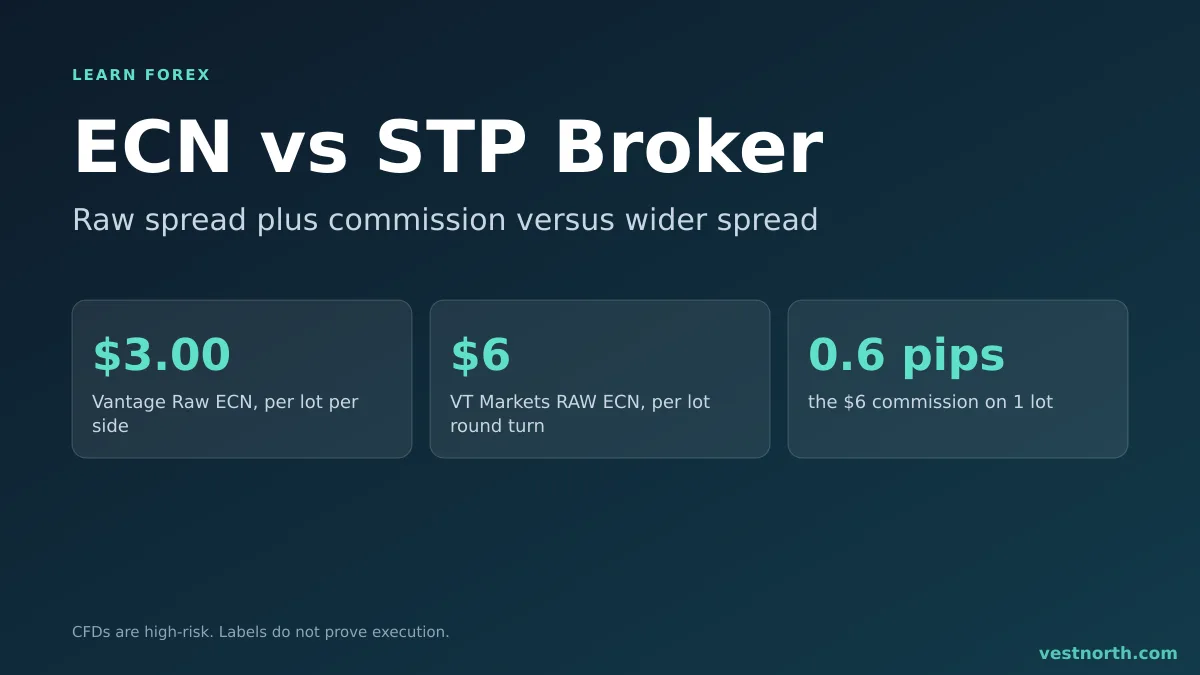
ECN and STP pricing in numbers. Figures taken from our Vantage and VT Markets reviews, October 2026.
What does STP mean?
STP stands for straight-through processing. The broker says your order goes straight to its liquidity providers instead of waiting at a dealing desk. The broker earns by adding a markup to the spread (the gap between the bid and ask price), so the account charges no separate commission on most forex pairs.
What does ECN mean?
ECN stands for electronic communication network. The broker says prices come from several liquidity providers and are shown with little or no markup. The spread can be very tight, and the broker charges a commission per lot.
How the cost looks on the page
Our reviews give two real price lists:
| Account (per our reviews) | Spread | Commission |
|---|---|---|
| Vantage Standard STP | Wider than raw, see the review | None, except some ETFs and stocks |
| Vantage Raw ECN | Raw | From $3.00 per lot per side |
| Vantage Pro ECN | Raw | From $1.50 per lot per side |
| VT Markets Standard STP | From 1.2 pips | None on forex, metals and oil |
| VT Markets RAW ECN | From 0.0 pips | $6 per lot round turn |
See the Vantage account types guide, the Vantage review and the VT Markets account types guide. “From” figures are best-case, not what every trade costs.
A worked example with the VT Markets numbers
The VT Markets help centre lists a commission of $6 per lot round turn on RAW ECN (see our VT Markets fees guide). On a USD-quoted pair a pip on 1 lot is about $10 (see what a pip is), so $6 equals 0.6 pips. That gives a simple rule:
RAW ECN costs less when its live spread is more than 0.6 pips tighter than the Standard STP spread on the same pair.
If Standard STP shows 1.2 pips and RAW ECN shows 0.2 pips, the all-in costs are about 1.2 pips and 0.8 pips. If RAW ECN shows 0.7 pips instead, it costs 1.3 pips and is the dearer account. The only way to know is to compare both live spreads. Read more in what a spread is.
Cost per lot on three trade sizes
Using the VT Markets pair of accounts from above and assuming live spreads of 1.2 pips on Standard STP and 0.2 pips on RAW ECN (an illustration, not a quote). Pip value is $10 per lot on EUR/USD with a dollar account.
| Position | Standard STP (1.2 pips, no commission) | RAW ECN (0.2 pips + $6/lot) | Difference |
|---|---|---|---|
| 1 lot | $12.00 | $2.00 + $6.00 = $8.00 | ECN cheaper by $4.00 |
| 0.1 lot | $1.20 | $0.20 + $0.60 = $0.80 | ECN cheaper by $0.40 |
| 0.01 lot | $0.12 | $0.02 + $0.06 = $0.08 | ECN cheaper by $0.04 |
The gap scales with volume, so it matters mostly to traders who open many positions. At 20 round trips of 1 lot in a month, that illustration gives $240 on STP against $160 on ECN. If the ECN spread were 0.8 pips instead, the ECN cost would be $14 per lot and STP would win. Check the live spread before assuming.
ECN vs STP side by side
| Point | STP account | ECN account |
|---|---|---|
| How cost shows | Wider spread | Raw spread plus commission |
| Commission | None on most forex pairs | Per lot, per side or round turn |
| Easier to read | Yes, one number | No, two numbers |
| Usual minimum deposit | Lower | Can be higher (Vantage Pro ECN: $10,000) |
| Role of the broker | Check the agreement | Check the agreement |
Does the label tell you who takes the other side?
No. Vantage markets Standard STP as bypassing a dealing desk and Raw ECN as unaltered pricing, yet our Vantage review reports that its client agreement says Vantage may act as principal and counterparty to your transactions. A market maker is a different, openly stated model: our AvaTrade review reports that AvaTrade calls itself a market maker with an in-house dealing desk.
None of that is automatically bad. It is a conflict of interest to understand: when the broker is your counterparty, it can profit when you lose. Read the order execution policy and client agreement for the entity that holds your account.
Which should you choose?
- Small trade sizes and no scalping (see scalping vs swing trading): a commission-free STP account is simpler, because one number (the spread) is the cost.
- Frequent trades or short targets: the commission matters. Compare total cost per lot on your pair.
- Check the minimum deposit, since Pro ECN accounts can require far more than a standard account.
Why the spread you see is not always the spread you get
A quoted “from” spread is the best case. Spreads widen around news releases, at the daily rollover and in thin markets, on both account types. With a raw-spread account the commission stays fixed while the spread moves, so the total cost swings with the spread alone. With a commission-free account the markup is built into the spread, so the same widening also hits you. Neither model protects you from a wide spread at a bad moment.
Slippage is a separate cost. It is the gap between the price you clicked and the price you got, and it can go for or against you. Market orders in fast markets slip more than limit orders. No account label removes it.
Questions to ask before choosing an account
- What is the total cost per lot on my pair? Add the spread in pips converted to money, plus any commission, for one standard lot. Do the same for the other account. The pip calculator turns pips into money.
- What is the minimum deposit? Our Vantage review lists 50 units of account currency for Standard STP and Raw ECN and $10,000 for Pro ECN. A cheaper per-lot cost on an account you cannot fund does not help.
- Which legal entity holds the account? Execution terms, leverage and protections follow the entity, not the account label. See our Vantage review and VT Markets review for how global clients sit with offshore entities.
- Is there an upgrade rule? On VT Markets, PRO ECN is an upgrade, not an account you can pick at sign-up, according to our account types guide.
- What does the client agreement say about the broker’s role? Look for wording such as “principal” or “counterparty”.
Common mistakes
- Choosing ECN because “raw spread” sounds cheaper, without adding the commission.
- Comparing a “from” spread on one broker with an average spread on another.
- Reading “no dealing desk” as “the broker cannot profit from my losses”.
- Trading a small account on an ECN account where commission makes up most of the cost of a short trade.
- Ignoring swaps. Overnight charges apply on both account types, see what a swap is.
Bottom line
ECN and STP describe pricing styles more reliably than they describe execution. Compare total cost per lot, spread plus commission, on the pair you trade, and read the client agreement for who is your counterparty. Only deposit money you can afford to lose. CFDs are complex, high-risk instruments.
Frequently asked questions
What is the difference between ECN and STP?
In marketing terms, STP passes your order on without a dealing desk and usually charges the cost in the spread. ECN accounts show a raw spread and charge a separate commission. In practice the account page of your own broker is what matters.
Is a raw ECN account cheaper than a standard STP account?
Not always. The VT Markets help centre lists $6 per lot round turn on RAW ECN, which equals 0.6 pips on a USD-quoted pair. RAW ECN is cheaper only when its live spread is more than 0.6 pips tighter than the Standard STP spread.
Does an ECN or STP label mean there is no dealing desk?
Not necessarily. Vantage markets Standard STP and Raw ECN as no-dealing-desk accounts, yet its client agreement says it may act as principal and counterparty to your transactions. Read the agreement of your entity.
Do ECN accounts have a higher minimum deposit?
Sometimes. Vantage lists 50 units of account currency for Standard STP and Raw ECN, and $10,000 for Pro ECN. Minimums depend on the broker and the account.
Which is better for beginners?
There is no single answer. Many beginners start with a commission-free account because the cost is easier to read, then compare total cost per lot once they know their trade size.
Is a market maker the same as an STP broker?
No. A market maker takes the other side of your trade through an in-house dealing desk. AvaTrade, for example, describes itself as a market maker. STP and ECN are the labels used by brokers that say they pass orders to liquidity providers.
ECN vs STP: which has lower spreads?
ECN accounts usually show the lower raw spread, but add a commission. STP accounts show a wider spread with no commission. Compare spread plus commission per lot, not the spread alone.
How do I calculate the real cost of an ECN account?
Convert the commission to pips (round-turn commission divided by pip value) and add it to the spread. On VT Markets RAW ECN, $6 per lot round turn is 0.6 pips on a USD-quoted pair at $10 per pip.
Is STP the same as no dealing desk?
Brokers use it that way in marketing, but the client agreement decides. A broker can describe an account as STP and still reserve the right to act as counterparty.
Do ECN accounts have slippage?
Yes. Slippage can occur on any account when the price moves between your click and the fill, and it can be positive or negative.