What Is a Pip in Forex? Meaning, Size and How to Count
Short answer: A pip is the standard unit of price movement in forex: 0.0001 on most pairs and 0.01 on yen pairs. If EUR/USD goes from 1.0850 to 1.0890, it moved 40 pips. What a pip is worth in money depends on your trade size and account currency, which our pip value guide covers.
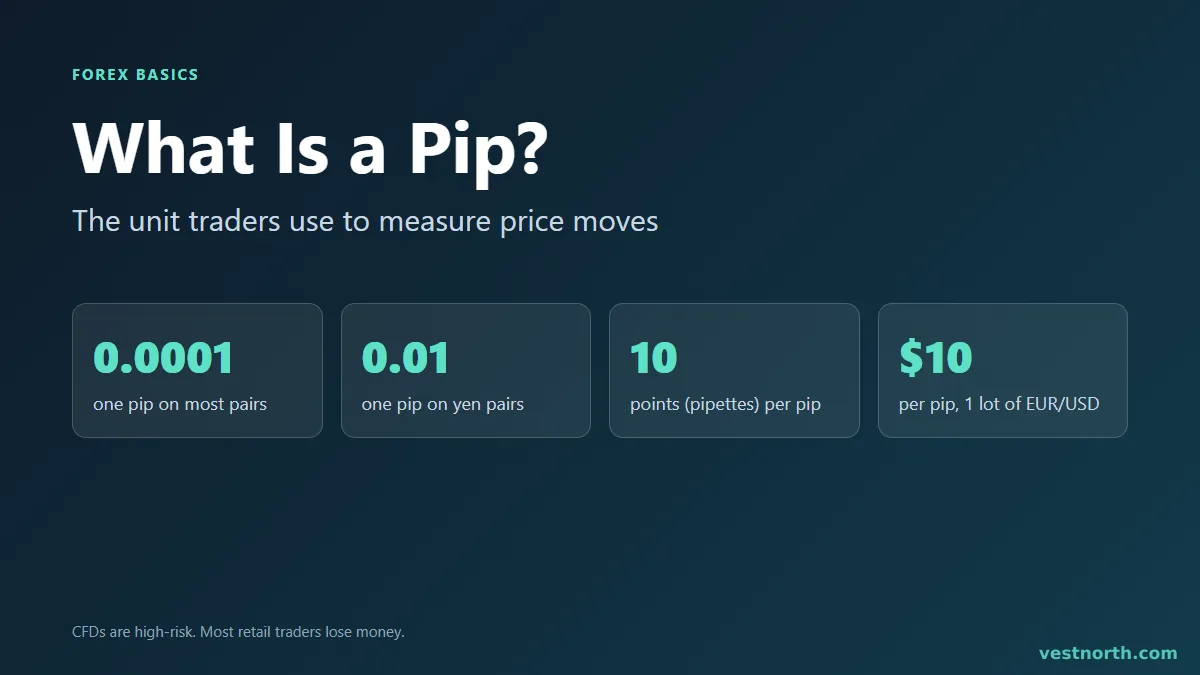
A pip in four numbers. Illustration, October 2026.
Pip size by instrument
| Instrument | Pip size | 1 pip on a quote | Notes |
|---|---|---|---|
| Most pairs (EUR/USD, GBP/USD, AUD/USD, USD/CAD, EUR/GBP) | 0.0001 | 1.0850 → 1.0851 | Fourth decimal place |
| Yen pairs (USD/JPY, EUR/JPY, GBP/JPY) | 0.01 | 150.25 → 150.26 | Second decimal place |
| Gold (XAU/USD), common convention | 0.1 | 2,400.0 → 2,400.1 | Some platforms use 0.01 |
| Index CFDs (US30, US500, NAS100) | No pips | 1 index point | Value per point set by the broker |
The rule for currencies is short: the pip is the fourth decimal place, except on yen pairs, where it is the second. One yen is worth far less than one dollar or euro, so yen prices carry fewer decimals.
Gold and other CFDs have no universal standard. Many platforms treat 0.1 as a gold pip and some use 0.01. That is a tenfold difference in every stop loss you set, so open the contract specification on your platform before you trade gold.
How to read a pip on a live quote
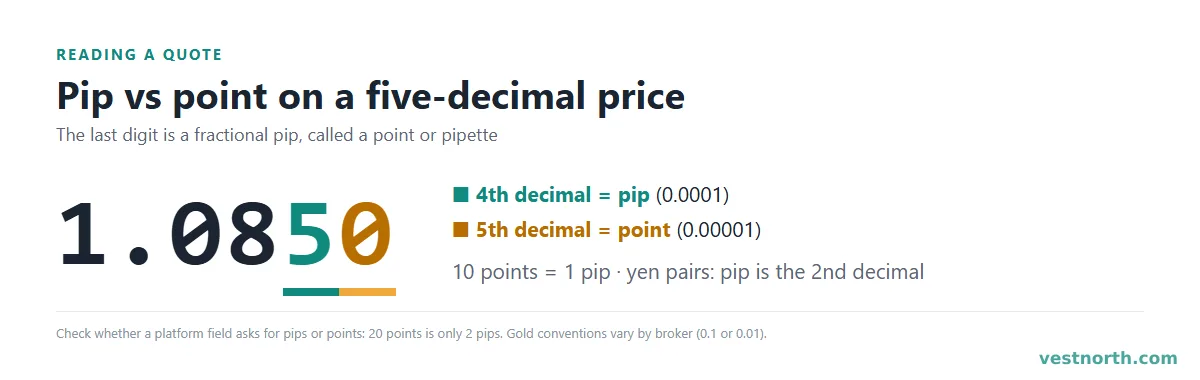
Most brokers quote one decimal more than the pip. Take a EUR/USD price of 1.08537:
- 1.08: the “big figure”, the part that rarely changes during a day.
- 3: the pip digit (the fourth decimal).
- 7: the fractional pip, also called a pipette.
So 1.08537 reads as “1.0853 and seven tenths of a pip”. On USD/JPY the same idea applies two places earlier: in 150.257, the 5 is the pip digit and the 7 is the pipette.
Many platforms print the pip digits larger than the rest of the price for this reason. If the price moves from 1.08537 to 1.08612, that is 0.00075, or 7.5 pips.
Pip, pipette, point and tick
These four words get mixed up, and the confusion causes real errors in order tickets.
| Term | What it means | EUR/USD | USD/JPY |
|---|---|---|---|
| Pip | Standard unit of movement | 0.0001 | 0.01 |
| Pipette (fractional pip) | One tenth of a pip | 0.00001 | 0.001 |
| Point (MetaTrader) | Smallest price step the symbol shows | 0.00001 | 0.001 |
| Tick | One change in the price, of any size | varies | varies |
On a five-decimal quote, 1 pip = 10 points. If a MetaTrader field asks for a distance in points and you type 20 thinking in pips, your stop sits 2 pips away and will likely be hit by normal price noise.
“Point” has a second meaning on indices. Traders say the US500 “fell 30 points” when the index dropped 30.0, while MetaTrader’s point for that symbol may be 0.1 or 0.01. Read the field label and the contract specification, and never assume the two meanings match.
How to count pips
Subtract the lower price from the higher one, then divide by the pip size.
| Move | Difference | ÷ pip size | Pips |
|---|---|---|---|
| EUR/USD 1.0850 → 1.0912 | 0.0062 | ÷ 0.0001 | 62 |
| GBP/USD 1.2745 → 1.2698 (down) | 0.0047 | ÷ 0.0001 | 47 |
| USD/JPY 149.80 → 150.35 | 0.55 | ÷ 0.01 | 55 |
| EUR/USD 1.08537 → 1.08612 | 0.00075 | ÷ 0.0001 | 7.5 |
| Gold 2,400.0 → 2,412.5 (0.1 pip) | 12.5 | ÷ 0.1 | 125 |
A quick check for yen pairs: a move of 1.00 yen (150.00 to 151.00) is 100 pips. On gold with a 0.1 pip, a $1 move in the price is 10 pips.
What is a pip worth in money?
A pip is a distance, not an amount. It turns into money only once you pick a trade size. One case worth remembering: on EUR/USD with a US dollar account, 1 pip is $10 on 1 lot, $1 on 0.1 lot and $0.10 on 0.01 lot. On USD/JPY at 150.00 it is about $6.67 per lot, and on gold it depends on how your platform defines a gold pip.
The formula, the pair-by-pair table, euro and pound accounts, and the link between pip value and your stop loss are in the pip value guide. For a live number, use the pip calculator.
Pips in a trade plan: a quick example
You buy EUR/USD at 1.0850, with a stop loss at 1.0820 and a target at 1.0910. Count the distances first: the stop is 30 pips away and the target 60 pips. Those two figures stay the same whether you trade 0.01 lot or 1 lot. Only the money attached to each pip changes. Planning in pips first, then choosing the size, is why traders quote exits in pips.
A yen pair works the same way, with two decimals. You sell USD/JPY at 150.40 and the price falls to 149.90: that is 0.50 ÷ 0.01 = 50 pips in your favour. Gold is the odd one out, because a “gold pip” is a platform convention (see the table above). A $12.50 move in gold is 125 pips at 0.1 and 1,250 pips at 0.01.
All figures are arithmetic illustrations, not forecasts, and losses are counted exactly the same way.
Worked example: what the spread costs in pips
The spread is the first pip distance you meet. You see EUR/USD quoted at 1.08500 bid and 1.08512 ask. The gap is 0.00012, which is 1.2 pips. Buying at the ask means the trade starts 1.2 pips below break-even.
| Trade size | Spread cost (1.2 pips) | Pips needed to break even |
|---|---|---|
| 1 lot | $12 | 1.2 |
| 0.1 lot | $1.20 | 1.2 |
| 0.01 lot | $0.12 | 1.2 |
The pip count does not change with size, only the dollar cost does. On a 20-pip target that spread takes 6% of the move. On a 5-pip scalping target it takes 24%, which is why the spread matters more the smaller your target is. See what a spread is and spread vs commission.
Pips and risk-reward
Pips make it easy to compare the size of the stop with the size of the target. A trade with a 30-pip stop and a 60-pip target has a reward-to-risk ratio of 2. Add the 1.2-pip spread and the effective stop is about 31.2 pips and the target about 58.8, so the ratio is nearer 1.9. Small, but it adds up over many trades. The ratio is covered in risk-reward ratio, and turning the stop distance into a position is covered in position sizing.
Practice: count these five moves
Try them before reading the answers. Each one uses the rules above and nothing else.
- GBP/USD moves from 1.2610 to 1.2588.
- EUR/JPY moves from 162.40 to 163.15.
- AUD/USD moves from 0.66512 to 0.66587 on a five-decimal quote.
- Gold moves from 2,385.0 to 2,379.4 on a platform that uses a 0.1 gold pip.
- A MetaTrader stop loss field on EUR/USD shows 150 points.
Answers:
| # | Working | Result |
|---|---|---|
| 1 | 1.2610 − 1.2588 = 0.0022, ÷ 0.0001 | 22 pips down |
| 2 | 163.15 − 162.40 = 0.75, ÷ 0.01 | 75 pips up |
| 3 | 0.66587 − 0.66512 = 0.00075, ÷ 0.0001 | 7.5 pips up |
| 4 | 2,385.0 − 2,379.4 = 5.6, ÷ 0.1 | 56 pips down |
| 5 | 150 points ÷ 10 points per pip | 15 pips |
If you got number 2 or number 5 wrong, the yen rule and the pip-versus-point rule are the two to practise. They cause most sizing errors on real order tickets. To turn any of these distances into dollars, put the pip count and your lot size into the lot size calculator.
Counting pips in a spreadsheet
If you keep a trade log, let the sheet do the counting. With the entry price in cell A2 and the exit price in B2, a buy on EUR/USD is =(B2-A2)/0.0001 and a sell is =(A2-B2)/0.0001. For a yen pair, swap 0.0001 for 0.01. A positive result is a gain and a negative one a loss, which keeps wins and losses in one column.
To turn the pips into money, multiply by the pip value for your lot size, for example =C2*10*D2 for pips in C2 and lots in D2 on a USD-quoted pair. Because pips ignore account size, a column of pips lets you compare trades of different sizes, and a second column of money shows what they actually cost or paid. The trading journal guide lists what else to record.
How big is one pip relative to the price?
A pip is a fixed step, but its share of the price differs by pair. On EUR/USD at 1.0850, one pip (0.0001) is about 0.009% of the price. On USD/JPY at 150.00, one pip (0.01) is about 0.007%. On gold at 2,400.0 with a 0.1 pip, it is about 0.004%. Pips are comparable as steps, not as percentage moves, so a 50-pip move on one instrument is not the same relative move as 50 pips on another. Percentage change, or the average true range, is a fairer way to compare volatility across instruments.
Where you meet pips every day
- Spreads. The gap between the buy and sell price is quoted in pips. See what is a spread and how it compares with a commission in spread vs commission.
- Stop losses. A stop is set as a price or a pip distance. See what is a stop loss.
- Swaps. Some brokers list overnight financing in points per lot, which you convert the same way.
- Results. Traders often log results in pips because pips do not depend on account size. Money is still what counts.
Common mistakes with pips
- Typing pips into a points field. A 20-point stop on a five-decimal quote is 2 pips.
- Counting yen pairs with four decimals. 150.25 to 150.75 is 50 pips, not 5,000.
- Assuming $10 per pip on every pair. That holds only when the quote currency is the dollar and your account is in dollars.
- Using another broker’s gold convention. 0.1 or 0.01 per pip changes the dollar risk tenfold.
- Reading 0.01 lot as $0.01. It is 1,000 units of the base currency, worth about $1,085 on EUR/USD at 1.0850.
- Counting a stop from the wrong price. A buy order exits at the bid, so measure the stop distance from the ask you paid and add the spread.
- Forgetting the spread. A trade opens already down by the spread, so a 1.2-pip spread on 1 lot of EUR/USD is $12 before the price moves.
Bottom line
A pip is 0.0001 on most pairs, 0.01 on yen pairs, and whatever your platform defines on gold. Count pips first, then turn them into money with your lot size. Check whether a field asks for pips or points before you place an order. Only risk money you can afford to lose, because leveraged CFDs can lose value quickly.
Frequently asked questions
What is a pip in simple terms?
A pip is the standard unit for measuring how much a currency price has moved. On most pairs it is the fourth decimal place (0.0001); on yen pairs it is the second decimal place (0.01).
1 pip is equal to how many dollars?
On EUR/USD with a US dollar account, 1 pip is $10 on 1 lot, $1 on 0.1 lot and $0.10 on 0.01 lot. Other pairs and account currencies change the figure; the pip value guide shows how to calculate it.
What is the difference between a pip and a pipette?
A pipette is one tenth of a pip, the extra fifth decimal (or third decimal on yen pairs) that most brokers now quote. MetaTrader calls it a point. 10 pipettes or points make 1 pip.
How many pips is 1.0850 to 1.0900?
50 pips. Subtract the prices (0.0050) and divide by the pip size (0.0001).
How many pips is a $1 move on gold?
It depends on how your platform defines a gold pip. With a pip of 0.1, a $1 move in the gold price is 10 pips; if your platform counts 0.01 as a pip, it is 100 pips.
How many pips is a normal EUR/USD day?
It varies with the market. Many days move several dozen pips and quiet days far fewer, so check the average true range on your own chart instead of relying on a fixed number.
Is a spread of 1 pip a lot?
It is the cost of opening a trade, paid in pips. On 1 lot of EUR/USD with a USD account, a 1-pip spread costs $10; on 0.01 lot it costs $0.10. Compare it with the size of your stop and target.
What does 'pip' stand for?
It is commonly expanded as 'percentage in point' or 'price interest point'. Both are backronyms; in practice it simply means the standard price increment.