What Is a Forex Trading Journal? What to Record and How to Review It
A forex trading journal is a written record of each trade you take: what you traded, why, how it ended and what it cost. It does not make trades profitable on its own. What it does is replace memory, which tends to remember the best trades and forget the rest, with a record you can count.
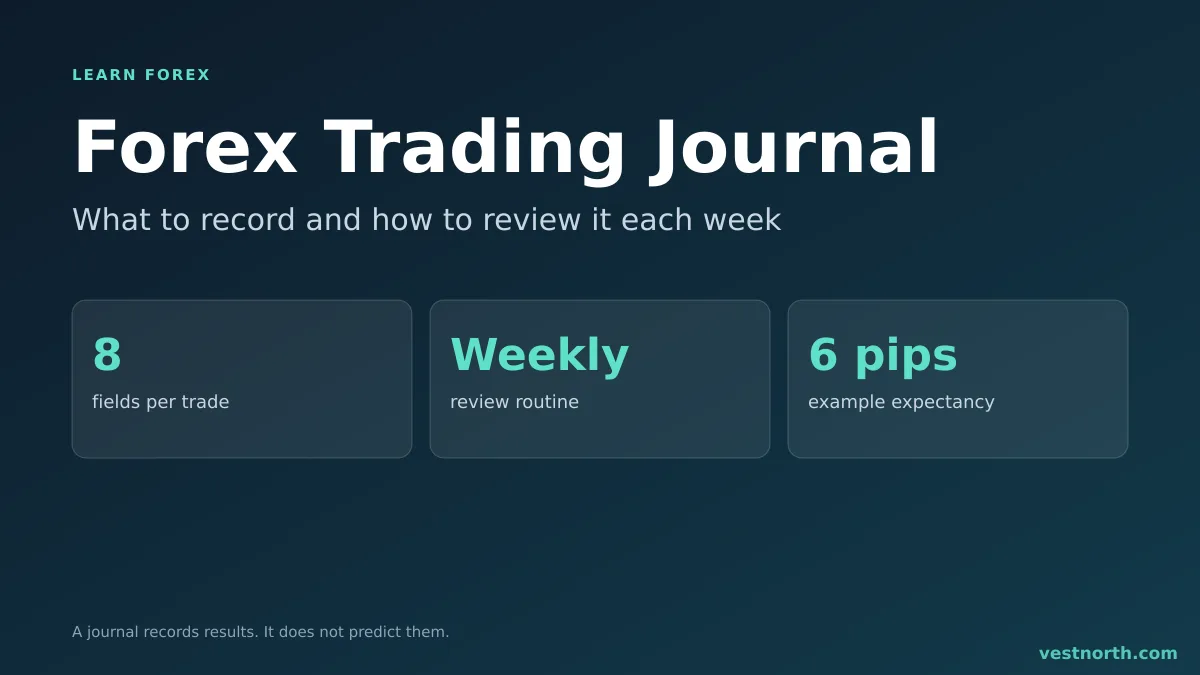
A journal in one picture.
What to record for each trade
Keep the fields few, or you will stop filling them in.
| Field | Why it helps |
|---|---|
| Date, time, pair, direction | Shows which sessions and pairs you trade |
| Position size | Links the result to your risk rule |
| Entry, stop loss, target | Lets you check the planned risk reward |
| Exit price and reason | Stop hit, target hit or closed by hand |
| Result in pips and in money | The two numbers you compare over time |
| Spread and commission | Costs eat into short trades, see spread vs commission |
| Setup name | Lets you group similar trades |
| One-line note | Why you entered, and whether you followed the plan |
A screenshot of the chart at entry is useful if you can take one. Take it from your own platform. Do not copy images from other sites.
A sample entry with made-up figures
- Pair and direction: GBP/USD, buy, 0.10 lot.
- Entry: 1.2700. Stop loss: 1.2670 (30 pips). Target: 1.2760 (60 pips). Planned reward to risk: 2 to 1.
- Exit: 1.2670, stop hit. Result: minus 30 pips, about minus $30 at roughly $1 per pip on a 0.10 lot, plus spread.
- Note: “Entered five minutes before a data release. Plan said to wait. Broke my own rule.”
The last line is the most valuable part. The result alone says you lost. The note says why, and a pattern of notes like it is what a review looks for.
How to review
A journal pays off when you read it. A simple routine:
- Weekly. Total the pips and money. Count winners and losers. Mark every trade where you broke your trading plan.
- Compare planned and actual. If the plan was 2 to 1 reward to risk and you often closed early, the average winner will be smaller than planned.
- Group by setup, pair and session. You may find that most of your losses come from one setup or one hour of the day. See trading sessions.
- Check costs. Add up spreads and commissions. On short trades they can be a large share of the result.
- Pick one change. Choose one rule to adjust or tighten, then record whether the next batch of trades follows it.
Do not judge a strategy on a handful of trades. Ten trades can look good or bad by chance. A larger sample, in the hundreds, tells you more, and even then the market changes.
Numbers worth calculating
- Win rate: winners divided by total trades.
- Average win and average loss in pips or money.
- Expectancy: average win times win rate, minus average loss times loss rate.
For example, a strategy winning 40% of trades with an average win of 60 pips and an average loss of 30 pips has an expectancy of 0.4 × 60 − 0.6 × 30 = 24 − 18 = 6 pips per trade, before costs. If costs average 2 pips per trade, it is 4 pips. A win rate of 40% can still be positive if winners are larger than losers, and a 60% win rate can lose money if losers are larger. The figures here are for illustration and do not predict results.
The emotional side
A journal is useful for trading psychology. Add a column for your state at entry, such as calm, rushed or trying to win back a loss. Over a month, you may see that trades labelled “rushed” lose more often. That is a finding about your own habits, and no one else can supply it.
Where to keep it
A spreadsheet is enough. One row per trade, the fields above as columns, and a summary tab with formulas for totals. A paper notebook also works if you will use it. Your platform’s trade history gives the numbers, so do not retype what it already shows. Add what it cannot know: your reason and your state of mind.
Log demo account trades too, marked as demo. The habit is the point there.
Bottom line
A trading journal is a record of each trade with the figures, the plan and a short note on your reasoning. Review it weekly, count what you followed and what you broke, and change one thing at a time. It gives you data about your own decisions, and it does not predict future results. Risk only money you can afford to lose. CFDs are complex, high-risk instruments.
Frequently asked questions
What is a forex trading journal?
It is a written record of each trade: the pair, entry, stop, target, result, and the reason you took it. Reviewing it shows patterns in your decisions that memory tends to hide.
What should I record in a trading journal?
At minimum, the date and time, pair, direction, size, entry, stop loss, target, exit, result in pips and money, costs, and a short note on why you entered and how you felt.
Do I need special software for a trading journal?
No. A spreadsheet or notebook works. Some traders use journal apps, which can import trade history from the platform, but the value is in the notes you write and how often you review.
How often should I review my journal?
Many traders review weekly and look at a larger sample monthly. A handful of trades is too few to show anything reliable, so avoid changing a strategy after a few results.
Should I log demo trades too?
Yes, mark them as demo. The habit of logging matters, and the notes on your decisions are useful, but demo results do not reflect live fills or the pressure of real money.