Forex Trading Psychology: Common Mistakes and Practical Rules
Short answer: Most expensive trading habits are emotional ones: moving a stop loss, trading again right after a loss, and opening a position too big for the account. The fix is a short written plan made before the trade, with a fixed risk per trade, a stop on every position and a daily loss limit you do not override.
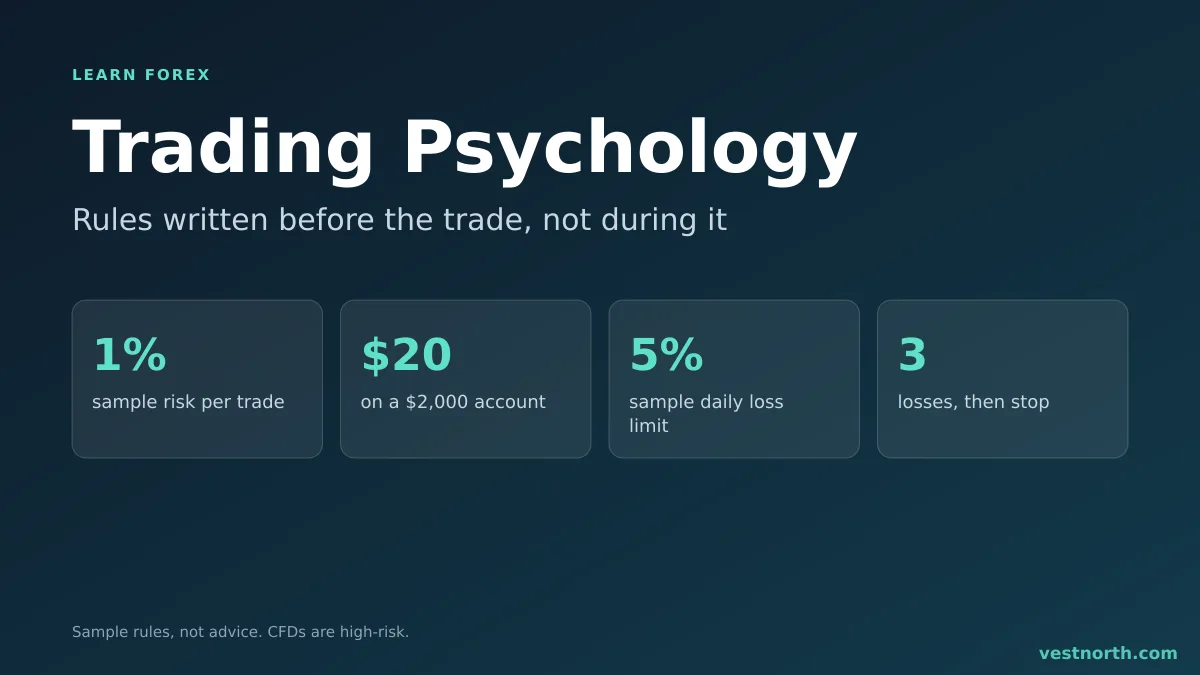
A sample rule set for a $2,000 account. Illustration, October 2026, not advice on how much to risk.
Why emotion matters more in leveraged trading
Leverage magnifies both the gain and the loss from a price move (see what leverage is). Small price changes can swing the account balance in minutes, and that is what puts pressure on decisions. A rule you would follow calmly on a demo account is much harder to follow when a real balance is falling.
CFDs are high-risk instruments, and brokers must show a warning on the share of retail accounts that lose money. Read the warning on your broker’s site, because the percentage varies by broker and entity. This guide does not promise that any habit leads to profit.
Five habits that cost money
1. Moving the stop loss away
You set a stop at a price that proves the idea wrong. Price approaches it, and you pull the stop further out to give the trade “room”. The loss you planned is now larger than the loss you accepted. If you move a stop, move it only to reduce risk, such as locking in profit. See what a stop loss is.
2. Revenge trading
After a loss, the urge is to win the money back at once. The next trade is bigger, taken faster and not in the plan. Step away from the screen after a loss, or after a set number of losses in a row.
3. Oversized positions
Beginners often pick the lot size they want and place the stop wherever it fits. Reverse it: stop first, then lot size from the money you will risk. Position sizing shows the steps.
4. Cutting winners short and letting losers run
A small profit feels good, so traders close early. A loss feels bad, so they hold it hoping it turns. The result is average wins smaller than average losses. A risk-reward ratio of at least 1:1, set in advance, makes this visible.
5. Overtrading
More trades mean more spread and commission, even when none of them is a good setup (see spread vs commission). Boredom and the wish to be “in the market” are the usual drivers. Our guide to overtrading and how to avoid it sets out daily trade and loss limits you can write down in advance.
A worked example: rules in numbers
Say your account is $2,000 and your written plan says:
| Rule | Number | In dollars |
|---|---|---|
| Risk per trade | 1% | $20 |
| Daily loss limit | 5% | $100 |
| Stop after consecutive losses | 3 | $60 |
You buy EUR/USD with a 40-pip stop. One pip on one standard lot is about $10 (see what a pip is). To risk $20 over 40 pips you need $0.50 per pip, which is 0.05 lot. Check it with the lot size calculator.
After three losses of $20 you have lost $60 and the plan says stop for the day. You never reach the $100 daily limit, and the account is down 3% instead of a figure driven by a revenge trade.
These percentages are examples. Pick numbers you could lose several times in a row without changing how you trade. Read more in forex risk management.
Write the plan before you trade
Emotion is hardest to resist in the middle of a trade. Write a short plan when you are calm. A forex trading plan normally lists:
- Which pairs and sessions you trade (see forex trading sessions).
- What setup qualifies, in plain words.
- Entry, stop and target, set before you click.
- Risk per trade and daily loss limit.
- When you stop for the day.
If a trade does not match the written plan, you skip it. That one rule removes many decisions.
Keep a journal
For each trade write the date, pair, reason for entry, planned stop and target, result in money and one line on how you felt. After 20 trades, look for patterns:
- Do your worst trades come after a loss?
- Do you break the plan on the same weekday or session?
- Do you close winners earlier than the plan says?
A journal does not predict the next trade. It shows which of your own habits to fix.
Practise on a demo first, with limits
A demo account is a safe place to practise following the plan, because mistakes cost nothing. Its limits matter though: virtual money does not feel the same, and fills can differ from a live account. When you move to live, start with a small balance and the smallest lot size.
Warning signs to stop trading for the day
- You are trading to recover a loss.
- You are angry, tired or distracted.
- You moved or removed a stop.
- You hit your daily loss limit.
- You are using money you need for rent, food or debts.
The last point is the most important. Money you cannot afford to lose changes every decision you make.
Bottom line
Psychology in trading is mostly about following rules you set while calm. Fix the risk per trade, put a stop on every position, cap your daily loss, and keep a journal. None of this removes risk, and CFDs can lose money quickly. Only deposit money you can afford to lose.
Frequently asked questions
What is trading psychology in forex?
It is how your emotions and habits affect decisions such as when you enter, where you place a stop and whether you stick to your plan. It covers fear, greed, impatience and overconfidence.
What is revenge trading?
Revenge trading means opening a new, often larger, trade right after a loss to win the money back. The trade is driven by the loss, not by your plan, and it tends to make the loss bigger.
How do I stop moving my stop loss?
Decide the stop before you enter, size the lot so that distance risks an amount you accept, and only move it in the direction that reduces risk. A stop moved further away raises the loss you planned.
Can a demo account fix trading psychology?
It helps you practise a plan and learn the platform, but virtual money does not trigger the same pressure as real money. Treat it as practice for the rules, not a test of your nerves.
How much should I risk per trade?
There is no correct number, but many risk guides use a small fixed percentage of the account, such as 1%. Pick an amount you can lose several times in a row without changing your behaviour.
Is a trading journal useful?
Yes. Writing down the reason for each trade, the planned risk and the result shows patterns you cannot see in the moment, such as trades taken after a loss or outside your plan.