Overtrading in Forex: The Warning Signs, What It Costs and How to Stop
Short answer: Overtrading means taking more trades, or bigger trades, than your plan allows. It costs you in three ways: spread and commission on every extra trade, more total risk, and worse decisions when you are tired or chasing a loss. The fix is rules you set before the session: a maximum number of trades, a maximum daily loss, and a written list of setups you will take.
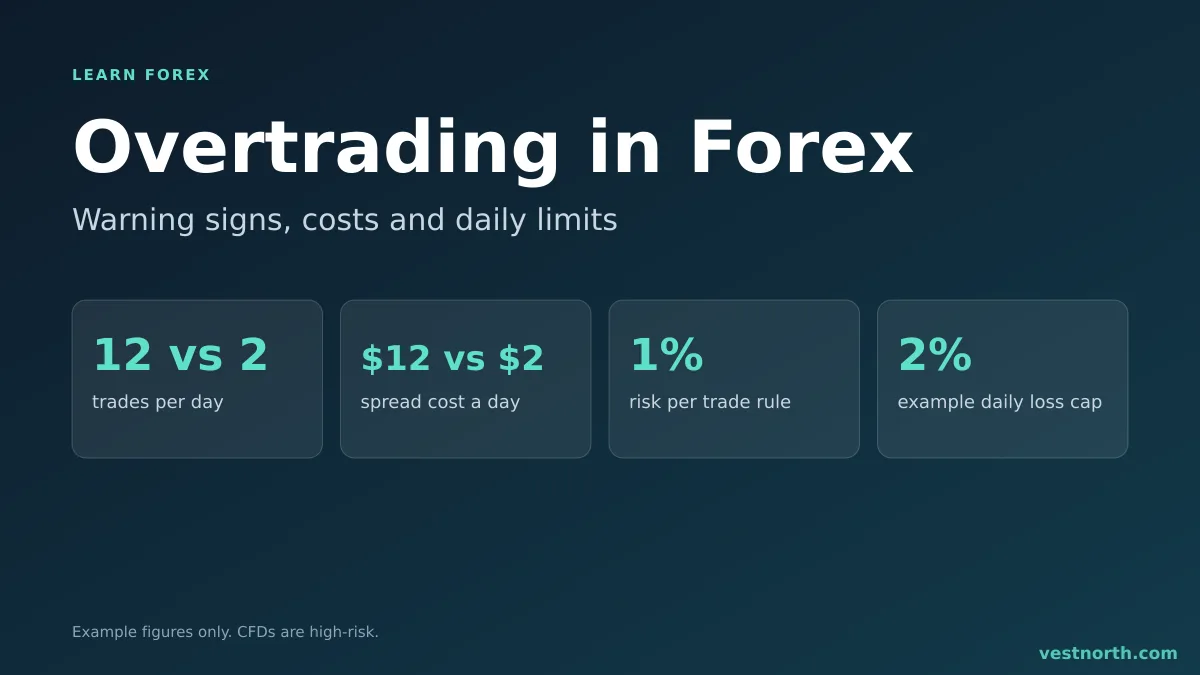
Overtrading in four ideas. Illustration, October 2026.
What counts as overtrading
Overtrading is relative to your own plan. Someone who scalps may place twenty trades a day within the rules. A swing trader who places twenty trades in a day is probably off plan. The test is whether each trade meets criteria you wrote down before the session.
There are two forms:
- Too many trades: entries with no clear setup, often out of boredom or fear of missing out.
- Too much size: positions larger than your risk rule allows, often after a loss or a win streak.
Both are covered by the discipline in a forex trading plan and by trading psychology.
Warning signs
- You open a trade and cannot say which setup it is.
- You move or remove a stop loss to stay in a losing trade.
- You enter again within minutes of a loss, with a larger lot size.
- You trade during hours you normally avoid, such as late at night, because you “must” trade today.
- You watch charts for hours and feel anxious when you are flat.
- Your journal shows many small trades with no notes. See trading journal.
What extra trades cost
Every trade pays the spread, and some account types add commission. The example below uses made-up figures for illustration only.
Assume a spread cost of 1.0 pip on EUR/USD and 0.10 lot (about $1 per pip), so each entry costs about $1 before any price movement.
| Plan | Trades per day | Spread cost per day | Per 20 trading days |
|---|---|---|---|
| Rules-based | 2 | about $2 | about $40 |
| Overtrading | 12 | about $12 | about $240 |
The extra $200 is not a loss from bad analysis. It is the price of entering. For a $1,000 account that is 20% of the balance over the month, spent before a single idea was right or wrong. See the spread vs commission page and the trading costs guide for how the costs add up.
The risk side
Risk per trade matters more than the spread. If your rule is 1% of the account per trade, then 2 trades risk at most 2%. Twelve trades with the same stop distance can risk 12% in one day if they all lose. Related pairs make it worse, because several positions may be one bet. See correlation between pairs.
Why it happens
- Revenge trading. A loss feels like something to win back immediately.
- Overconfidence. A short winning streak makes rules feel optional.
- Boredom. Quiet markets feel like wasted time, so you force a trade. Ranging periods are normal; see range markets.
- Small timeframes. Charts that update every minute produce a constant stream of apparent signals.
- Easy access. A phone app makes placing a trade take seconds.
Rules that help
- Write a daily trade limit. For example, no more than three trades a day. Choose a number that fits your strategy and keep it.
- Write a daily loss limit. For example, stop after losing 2% of the account. Stopping is the rule, not a suggestion.
- Trade only listed setups. Put the setup name in the journal before you enter, not after.
- Take a break after a loss. A fixed pause of 30 minutes or more, away from the screen, breaks the urge to chase.
- Fix your lot size by formula. Use position sizing and the lot size calculator so size is not decided by mood.
- Review weekly. Count the trades that broke the rules and what they cost. Our risk management guide lists limits worth adding.
- Practise on a demo account if a new plan feels hard to follow. See demo accounts.
When fewer trades is the right answer
A flat day is a valid result. If the market offers no setup that meets your rules, doing nothing protects your balance. Many traders find that cutting the trade count while keeping the same rules reduces costs without cutting the good trades. We have no data on average results for retail traders to quote here, so judge it by your own journal.
Bottom line
Overtrading adds spread costs, stacks risk and replaces your plan with mood. Set a maximum number of trades and a maximum daily loss before you open the platform, take only written setups, and stop when a limit is hit. Only risk money you can afford to lose. CFDs are complex, high-risk instruments.
Frequently asked questions
What is overtrading in forex?
Overtrading is placing more trades, or larger trades, than your trading plan calls for. It is usually driven by boredom, excitement or the urge to win back a loss.
What are the signs of overtrading?
Common signs are trades without a setup, breaking your own size or stop rules, trading right after a loss, and checking charts constantly. A trading journal makes the pattern visible.
How many trades per day is too many?
There is no universal number. It is too many when you take trades that do not meet your written rules, or when costs and risk exceed your plan's limits.
How do spreads make overtrading expensive?
Each trade pays the spread, and some accounts also charge commission. Ten trades cost roughly ten times the spread of one, before any losses.
Is revenge trading the same as overtrading?
Revenge trading is one cause of overtrading. It means entering trades quickly to recover a loss, usually with bigger size and no setup.
How do I stop overtrading?
Set a daily trade limit and a daily loss limit in advance, trade only written setups, and stop for the day when you hit either. Review a journal weekly.