Forex Position Sizing: How to Calculate Your Lot Size
Short answer: Position sizing picks the lot size so a losing trade costs an amount you set in advance. Lots = money at risk ÷ (stop loss in pips × pip value per lot). On a $5,000 account risking 1% ($50) with a 25-pip stop on EUR/USD, the size is 0.2 lot.
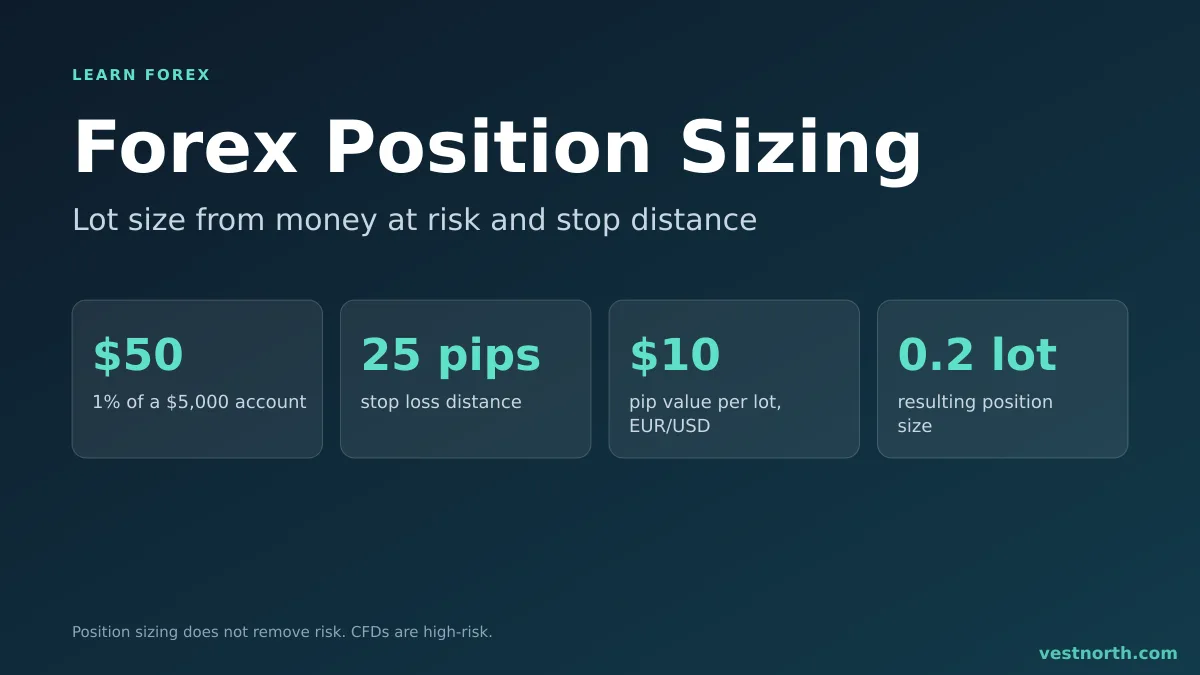
Position size for $50 at risk and a 25-pip stop, pip value about $10 per lot. Illustration, October 2026.
The formula in three steps
- Decide the money at risk. For example 1% of a $5,000 account is $50.
- Measure the stop distance in pips. Place the stop where your trade idea is wrong, then count the pips from your entry. See what a stop loss is.
- Divide. Lots = money at risk ÷ (pips × pip value per lot).
For EUR/USD on a US dollar account, one pip on one standard lot is about $10 (see pip value by lot size). Other pairs and account currencies differ, so check the pip calculator.
Worked example
Account: $5,000. Risk: 1%, so $50. Trade: buy EUR/USD with a stop 25 pips away.
- Pip value per standard lot: about $10.
- Loss per lot at the stop: 25 × $10 = $250.
- Lots: $50 ÷ $250 = 0.2 lot.
Check: 0.2 lot is about $2 per pip, and 25 pips × $2 = $50.
Same risk, different stops
The money at risk stays at $50. Only the stop distance changes the size.
| Stop distance | Loss per 1 lot | Position size |
|---|---|---|
| 10 pips | $100 | 0.5 lot |
| 20 pips | $200 | 0.25 lot |
| 25 pips | $250 | 0.2 lot |
| 50 pips | $500 | 0.1 lot |
| 100 pips | $1,000 | 0.05 lot |
A wide stop means a smaller position, not a bigger risk. If the lot size you want does not fit the stop, change the lot size.
Where the risk percentage comes from
There is no rule that fixes the right percentage. Many beginner guides use 1% to 2% so that a string of losses does not empty the account. The table shows why: at 1% risk, ten losing trades in a row leave you with about 90% of the account. At 10% risk per trade, ten losses leave about 35%.
| Risk per trade | After 10 losses in a row (approx.) |
|---|---|
| 1% | 90% of the account |
| 2% | 82% of the account |
| 5% | 60% of the account |
| 10% | 35% of the account |
These are compounded: 0.99 to the power of 10 is about 0.904, and 0.90 to the power of 10 is about 0.349. Choose a figure you could live with, using only money you can afford to lose.
Spread, commission and slippage
The formula sizes the loss at the stop price. In practice the loss is a little larger. You pay the spread on entry, you may pay a commission on some account types, and a stop can fill worse than its level (see slippage). Leave a small buffer if the numbers are tight.
Position size and leverage are different things
Leverage decides how much margin a trade locks, not how much you should trade. The same 0.2 lot needs about $217 of margin at 500:1 and about $1,085 at 100:1 on EUR/USD at 1.0850, and it risks $50 at a 25-pip stop either way. More on this in what margin is.
Lot size steps and minimums
Brokers set a minimum lot size and a step. If your calculated size is 0.037 lot and the step is 0.01, round down to 0.03. Rounding up raises your risk above the plan. Micro and cent accounts help small balances, but the terms vary by broker, so read your account’s contract specifications. For lot units see what a lot is, and use the lot size calculator to check your result.
Several trades at once
Open positions on pairs that share a currency, such as EUR/USD and GBP/USD, can lose together when the dollar moves. Count them as one larger risk, or lower the size of each. Risk plans are covered in forex risk management.
Bottom line
Fix the money at risk first, set the stop where your idea fails, then divide to get the lot size. Round down, leave room for spread and slippage, and treat correlated trades as one risk. Only trade with money you can afford to lose. CFDs are complex, high-risk instruments.
Frequently asked questions
What is position sizing in forex?
It is choosing the lot size for each trade so that if the stop loss is hit, the loss equals a fixed amount you decided beforehand, usually a small percentage of the account.
What is the position size formula?
Lots = money at risk ÷ (stop loss in pips × pip value per lot). With $50 at risk, a 25-pip stop and $10 per pip per lot, the size is 0.2 lot.
How much of my account should I risk per trade?
There is no official figure. Many educators suggest 1% to 2% as a way to survive a losing run. The right number depends on your own limits. Risk only money you can afford to lose.
Does leverage change my position size?
No. Leverage only sets the margin needed to open the position. The lot size comes from your risk amount and stop distance.
What if the calculated lot size is smaller than my broker's minimum?
Then the trade risks more than you planned. Use a tighter stop only if the trade idea still holds, or skip the trade. Do not round the lot size up.
Do I need a different pip value for other pairs?
Yes. Pairs where USD is not the quote currency have a pip value that depends on the exchange rate. The pip calculator converts it to your account currency.