What Is Margin in Forex Trading?
Short answer: Margin is the money the broker locks in your account to keep a leveraged trade open. It is a deposit, not a fee, and it comes back when the trade closes. Required margin = position value ÷ leverage. One standard lot of EUR/USD is a 100,000-euro position, so at 100:1 leverage the margin is about 1,000 euros.
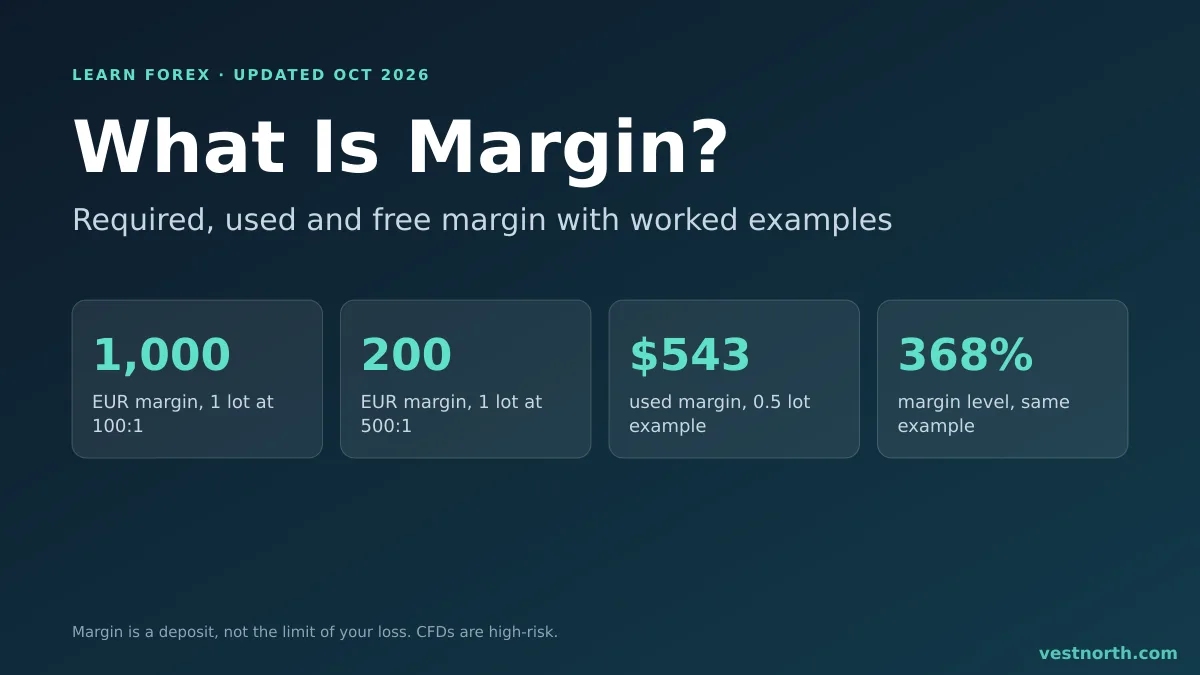
Required margin on one standard lot of EUR/USD, ignoring the exchange rate. Illustration, October 2026.
Margin in plain words
Forex and CFD brokers let you trade positions larger than your deposit. To cover the risk of a loss, the broker holds back a slice of your balance for as long as the trade is open. That slice is the margin.
Two points that confuse beginners:
- Margin is not a cost. Costs are the spread, commissions and swaps.
- Margin is not the maximum you can lose. Your profit or loss is calculated on the full position, so a loss can exceed the margin held.
How to calculate required margin
Margin = position value ÷ leverage
Position value is the lot size times the contract size (100,000 units for one standard lot of a currency pair, see what a lot is), converted into your account currency.
| Position | Leverage | Margin (base currency) |
|---|---|---|
| 1 lot EUR/USD (100,000 EUR) | 30:1 | about 3,333 EUR |
| 1 lot EUR/USD | 100:1 | 1,000 EUR |
| 1 lot EUR/USD | 500:1 | 200 EUR |
| 0.1 lot EUR/USD (10,000 EUR) | 100:1 | 100 EUR |
| 0.01 lot EUR/USD (1,000 EUR) | 100:1 | 10 EUR |
For a US dollar account the margin is converted: with EUR/USD at 1.0850, 1,000 euros is about $1,085. Our margin calculator does the conversion for you. Read what leverage is for the leverage side of the formula.
Leverage limits differ by regulator and by broker entity, and brokers set margin rates for gold, indices and crypto CFDs separately. Check your account’s contract specifications for each instrument.
The numbers on your platform
Trading platforms show a row of figures that all relate to margin.
| Term | Meaning |
|---|---|
| Balance | Deposits plus closed profits and losses |
| Equity | Balance plus floating profit or loss on open trades |
| Used margin | Money locked by open trades |
| Free margin | Equity minus used margin |
| Margin level | Equity ÷ used margin × 100 |
Floating profit raises equity and free margin. Floating loss lowers them, even though the loss is not yet “real” until you close the trade.
Worked example
You have $2,000 and open 0.5 lot of EUR/USD at 1.0850 with 100:1 leverage.
- Position value: 50,000 EUR, about $54,250.
- Used margin: $54,250 ÷ 100 = about $543.
- Free margin: $2,000 − $543 = about $1,457.
- Margin level: $2,000 ÷ $543 × 100 = about 368%.
Now the price moves 100 pips against you. At 0.5 lot a pip is worth about $5, so the floating loss is about $500.
- Equity: $2,000 − $500 = $1,500.
- Free margin: $1,500 − $543 = about $957.
- Margin level: $1,500 ÷ $543 × 100 = about 276%.
Used margin did not change. Equity and free margin fell by the loss. The margin level is the number your broker watches. When it falls to the broker’s margin call level you get a warning, and at the stop out level positions are closed. We explain both in margin call and stop out.
Margin, leverage and risk
Higher leverage means a smaller margin per trade, so more of the account stays free. That feels safer but is the opposite. With plenty of free margin it is easy to open a position so large that a normal move eats the account.
Compare the same $2,000 account at two leverage levels, both opening 1 lot of EUR/USD (about $1,085 per 1,000 euros of margin at 100:1):
| Leverage | Used margin | Pip value | Loss at a 50-pip move |
|---|---|---|---|
| 100:1 | about $1,085 | about $10 | about $500 |
| 500:1 | about $217 | about $10 | about $500 |
The loss is the same. Only the margin differs. Leverage decides whether you are allowed to open the trade, not how much it costs you when it moves. Size positions by the money you are willing to lose on the stop loss. See forex risk management for the steps.
Hedged positions and margin
Some brokers charge less margin on hedged positions, for example a buy and a sell of the same pair at the same time. Others charge on both or on the larger side only. The rule is set per broker and per account, so check the terms.
What reduces your free margin
- Opening more or larger positions.
- Floating losses on open trades.
- Higher margin requirements on some instruments or around weekends and news.
- Withdrawing money while trades are open.
Free margin of zero means no new trades. A margin level that keeps falling leads to the margin call and then the stop out.
Bottom line
Margin is a deposit the broker holds against your open trades. Calculate it as position value divided by leverage, and watch free margin and margin level, not just the balance. Using a smaller part of the leverage on offer keeps you away from the stop out. Only deposit money you can afford to lose. CFDs are complex, high-risk instruments.
Frequently asked questions
What is margin in forex in simple terms?
Margin is the amount of your own money the broker locks while a leveraged trade is open. You get it back, plus or minus the profit or loss, when the trade closes. It is not a fee.
How do I calculate required margin?
Position value divided by leverage. One standard lot of EUR/USD is a position of 100,000 euros. At 100:1 leverage the margin is 1,000 euros, converted to your account currency at the current rate.
What is free margin?
Free margin is equity minus used margin. It is the money still available to open new trades or absorb losses on open ones.
What is the difference between margin and margin level?
Margin is an amount of money. Margin level is a percentage: equity divided by used margin, times 100. Brokers use the margin level to trigger a margin call and a stop out.
Does higher leverage mean I lose more money?
Higher leverage lowers the margin each trade needs, so you can open a bigger position. The bigger position is what increases the loss for the same price move. Leverage alone does not change the pip value.
What happens if I run out of free margin?
You cannot open new trades. If equity keeps falling and the margin level reaches your broker's stop out level, the platform begins closing positions.