What Is Slippage in Forex Trading?
Short answer: Slippage is the gap between the price you expected and the price your order filled at. It is most common during fast markets, news and thin liquidity. A 3-pip slip on 1 lot of EUR/USD costs about $30, because one pip is about $10 on that size.
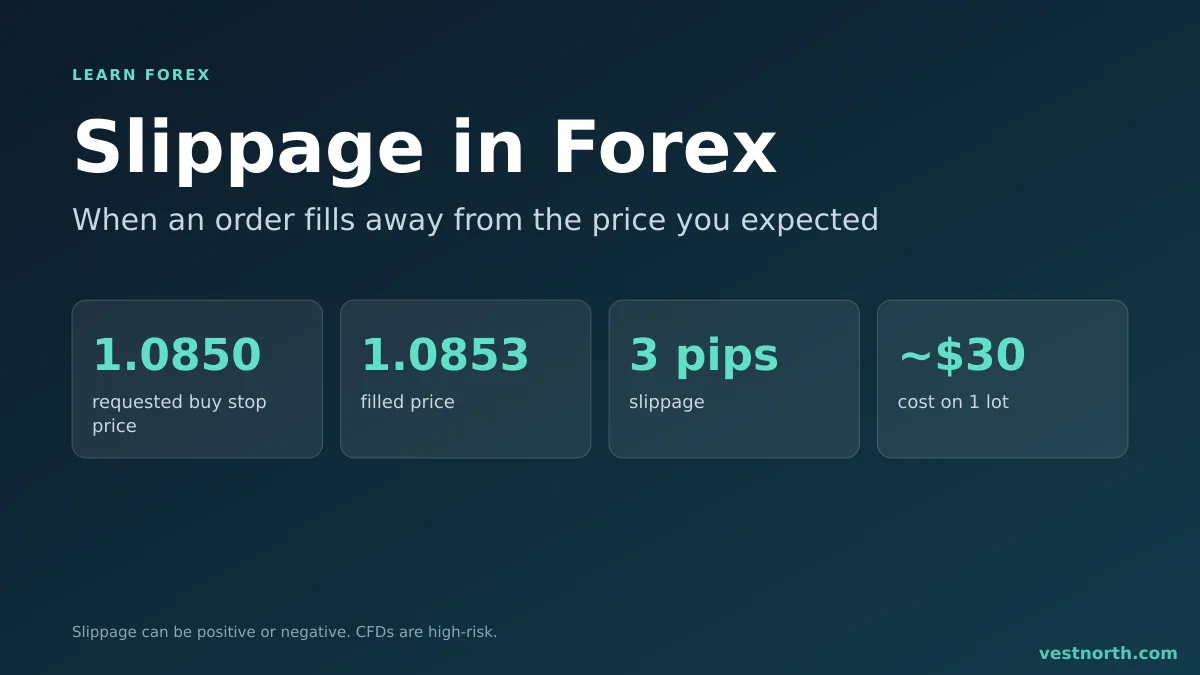
Slippage on a buy stop order, EUR/USD, pip value about $10 per lot. Illustration, October 2026.
How slippage happens
When you send an order, the platform asks the broker’s liquidity for a price. Prices move many times a second. If the price changes between the moment you click and the moment the order is matched, the fill differs from the quote you saw.
- Negative slippage: you buy higher or sell lower than expected.
- Positive slippage: you buy lower or sell higher than expected.
- No slippage: the fill equals the requested price.
How a broker handles positive slippage, and whether it applies it, is set in its order execution policy. We do not state a figure for any broker here.
A worked example
You place a buy stop on EUR/USD at 1.0850, planning to enter if price breaks upward. News hits and the order fills at 1.0853.
- Slippage: 1.0853 − 1.0850 = 3 pips.
- On 1 lot (pip value about $10): about $30.
- On 0.5 lot: about $15.
If the same order had filled at 1.0848 you would have gained 2 pips. Use the pip calculator to turn pips into your account currency.
When slippage is most likely
| Situation | Why it matters |
|---|---|
| Major news releases (see the economic calendar) | Price jumps and liquidity thins out |
| Rollover and market open | Fewer participants, wider spreads |
| Weekend gaps | The market reopens away from Friday’s close |
| Large positions | One order may need several price levels to fill |
| Slow connection | The quote you saw is already old |
Slippage and stop losses
A stop loss is a stop order. It waits at your level, then becomes a market order when touched, and the market order takes the next available price. In a gap, that price can be far from the level you set.
Example: a sell stop-loss on a long EUR/USD trade at 1.0800, with the market gapping from 1.0830 to 1.0770 at the open. The stop fills near 1.0770, so the loss is 30 pips bigger than planned. On 0.2 lot at about $2 per pip, that extra is about $60.
Some brokers offer guaranteed stop losses on certain accounts. These usually cost extra or require a minimum distance, and rules differ by broker and regulator, so read the terms.
Order types and slippage
| Order | Slippage risk |
|---|---|
| Market order | Fills at the current price, which may differ from the quote |
| Stop and stop loss | Can fill beyond the set price once triggered |
| Limit order | Fills at your price or better, but may not fill at all |
The trade-off is certainty of price against certainty of execution. All the order types are covered in forex order types.
Slippage is part of your real cost
Spread and commission are known in advance. Slippage is not. If you size trades from the stop distance, add a margin for it. Our guide to forex position sizing shows the formula, and forex risk management covers how to keep losses within a plan.
Ways to limit slippage
- Use limit orders for entries when you do not need to be filled immediately.
- Avoid placing market orders seconds before or after major news.
- Avoid holding large positions over the weekend if a gap would hurt you.
- Read your broker’s order execution policy for how slippage and requotes are handled.
- Use smaller sizes in thin markets.
None of these removes the risk completely.
Bottom line
Slippage is the difference between the price you requested and the price you got. It can help or hurt, and it grows in fast or thin markets, so it belongs in your risk plan next to spread and commission. Limit orders trade a guaranteed price for a possible non-fill. Only trade with money you can afford to lose. CFDs are complex, high-risk instruments.
Frequently asked questions
What is slippage in forex?
Slippage is the difference between the price you expected when you sent an order and the price at which it was filled. It can be negative (worse for you) or positive (better).
What causes slippage?
Fast price moves around news, low liquidity such as rollover or weekends, market gaps, large order sizes and slow connections. The price changes between your click and the fill.
How much does slippage cost?
Pips of slippage times the pip value. A 3-pip slip on 1 lot of EUR/USD, at about $10 per pip, costs about $30. On 0.5 lot it costs about $15.
Does a stop loss prevent slippage?
No. A normal stop loss becomes a market order when triggered, so it can fill beyond the stop price. Some brokers offer guaranteed stops, usually with extra conditions.
Can slippage be positive?
Yes. If the price moves in your favour between the request and the fill, you get a better price. Brokers treat positive slippage differently, so check their order execution policy.
How can I reduce slippage?
Use limit orders for entries, avoid trading right at major news releases and rollover, and keep position sizes reasonable. Limit orders may not fill at all.