Forex Order Types Explained: Market, Limit, Stop and Stop-Limit
Short answer: A market order fills straight away at the current price. A pending order waits until the price reaches a level you chose. There are four pending types: buy limit, sell limit, buy stop and sell stop. A stop loss and a take profit attach to a trade and close it at a set price.
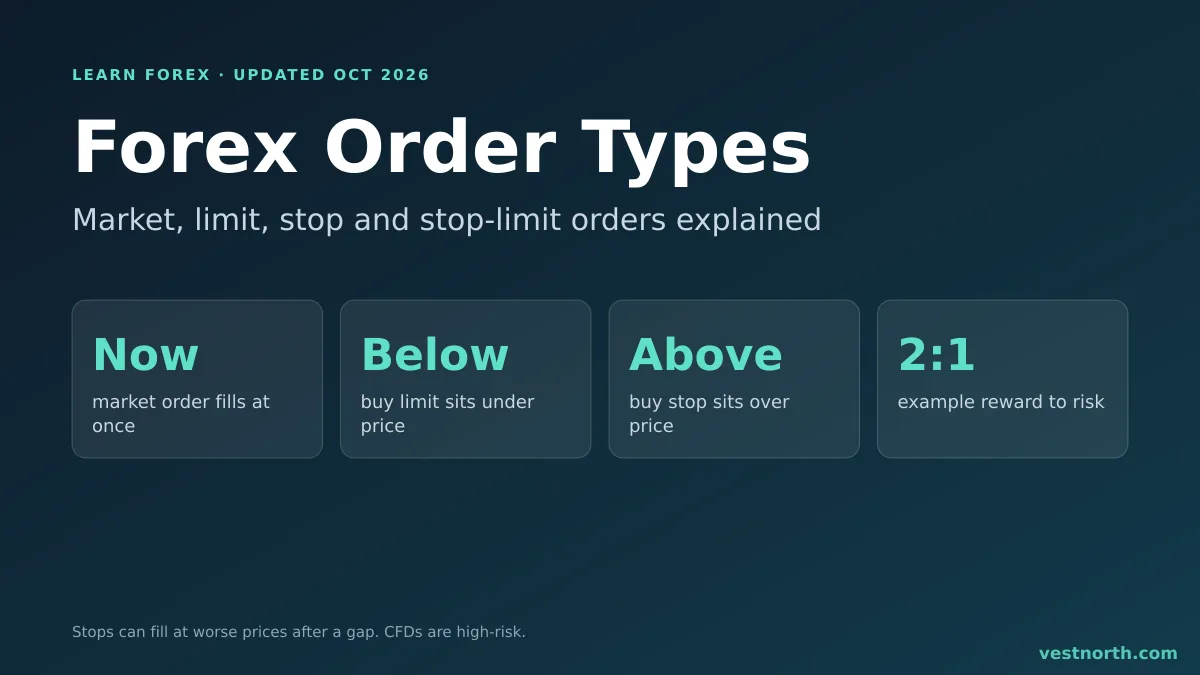
The order types in this article, October 2026. Prices in the examples are illustrative.
Market orders
A market order says “buy or sell now”. You get the best available price at that moment. On a quote of 1.0850 / 1.0852 (bid / ask), a buy fills near 1.0852 and a sell near 1.0850. The gap between the two is the spread.
Market orders are the simplest. The trade is that the fill price can differ from the price on your screen, especially in fast markets. That difference is slippage.
Pending orders: limit and stop
A pending order is an instruction to open a trade later, if the price gets to a level. Every pending order is either a limit or a stop. The one question that sorts them: is your level on the better side or the worse side of the current price?
| Order | Where the level sits | Triggers when | Typical use |
|---|---|---|---|
| Buy limit | Below the current price | Price falls to the level | Buy a dip or a support area |
| Sell limit | Above the current price | Price rises to the level | Sell a rally or a resistance area |
| Buy stop | Above the current price | Price rises to the level | Buy a breakout |
| Sell stop | Below the current price | Price falls to the level | Sell a breakdown |
Example: EUR/USD trades at 1.0850. A buy limit at 1.0800 fills only if the price drops 50 pips. A buy stop at 1.0900 fills only if the price climbs 50 pips. Both buy, but one waits for a pullback and the other waits for strength. A platform will normally reject a pending order placed on the wrong side of the market, for example a buy limit above the current price.
Brokers also set a minimum distance between the market price and a pending order. The figure is in the contract specifications of your account.
All six orders on one price
EUR/USD is trading at 1.0850 and you hold no position. Here is where each order would sit and what happens if the price touches your level.
| Order | Level | Fires when price… | Becomes |
|---|---|---|---|
| Buy limit | 1.0800 | falls 50 pips | Market buy at 1.0800 or better |
| Sell limit | 1.0900 | rises 50 pips | Market sell at 1.0900 or better |
| Buy stop | 1.0900 | rises 50 pips | Market buy at the next price |
| Sell stop | 1.0800 | falls 50 pips | Market sell at the next price |
| Buy stop-limit | stop 1.0900, limit 1.0910 | reaches 1.0900 | Buy limit at 1.0910 |
| Sell stop-limit | stop 1.0800, limit 1.0790 | reaches 1.0800 | Sell limit at 1.0790 |
The MetaTrader 5 help lists six pending types: Buy Limit, Sell Limit, Buy Stop, Sell Stop, Buy Stop Limit and Sell Stop Limit, and says a stop-limit is used to “place a stop-style order while limiting slippage” (source). We have not confirmed which of these your broker enables, so check your platform.
How long a pending order lasts
A pending order sits on the server until it fills, expires or you remove it. MetaTrader 5 lets you set the expiry: Good Till Canceled, Today, or a specified date (source). A forgotten order can fill days later at a price you no longer want, so set an expiry when your idea has a time limit, and review open pending orders on Monday morning after a weekend.
Step by step: placing a pending order
- Decide the idea: pullback or breakout.
- Pick the side of the price: below for buy limit or sell stop, above for sell limit or buy stop.
- Set the stop loss and take profit distances in pips before sending, using the pip calculator for money.
- Choose the expiry.
- Check the size with the lot size calculator.
- After it fills, confirm the stop loss attached.
Stop loss and take profit
These two orders attach to an open trade. Neither opens a position.
- Stop loss: closes the trade at a worse price than your entry, to cap the loss.
- Take profit: closes the trade at a better price than your entry, to bank the gain.
Worked example. You buy 0.1 lot of EUR/USD at 1.0852 with a stop loss at 1.0822 and a take profit at 1.0912.
- Risk: 30 pips, about $30 at 0.1 lot ($1 per pip).
- Target: 60 pips, about $60.
- Reward-to-risk: 2:1, before spread and commission.
The pip calculator gives the pip value for other pairs and lot sizes, and the lot size calculator works backwards from the money you are willing to lose. Our page on the stop loss covers where to place one.
Stop-limit orders
A stop-limit order has two prices: a stop price that activates the order and a limit price that caps what you will pay. The stop limit price is that second figure: the worst fill you accept once the stop has triggered. Buy stop-limit with stop 1.0900 and limit 1.0910: once the price touches 1.0900, the order becomes a buy limit at 1.0910. It will not fill above 1.0910.
The catch is that it may not fill at all. If the market jumps from 1.0899 to 1.0925, your limit is already behind the price and the order sits unfilled while the move runs. A plain stop would have filled, at a worse price. Stop-limit orders are not available on every platform, so check before you plan around one.
Trailing stops
A trailing stop moves your stop loss behind the price by a fixed distance as the trade gains, and never moves back. If you buy at 1.0852 with a 30-pip trail, the stop starts at 1.0822. When the price reaches 1.0900, the stop sits at 1.0870. If the price then falls 30 pips, the trade closes at 1.0870.
On MetaTrader a trailing stop is run by the platform, so it only updates while the terminal is connected. Close the terminal and the stop stays where it last was. Check how your own platform handles this.
What happens when the price gaps
Stops are not guaranteed prices. A stop loss turns into a market order once triggered, and a market order fills at whatever is available. Around news releases on the economic calendar and at the weekly open, the price can gap past your level, and the fill is worse than the one you set. The same applies to a buy stop or sell stop. A limit order does the opposite: it will fill at your price or better, or not at all.
If a broker offers guaranteed stops, they are usually a separate feature with a cost and conditions. Read the terms before relying on one.
Choosing an order type
- Want in now and accept the current price: market order.
- Have a price level in mind from the chart and cannot watch the screen: pending order.
- Waiting for a pullback: buy limit or sell limit.
- Waiting for the price to confirm a move: buy stop or sell stop.
- Every open trade: a stop loss, set before you click.
- Want to offset an open trade without closing it: an opposite position, known as hedging, where your broker allows it.
Beginners often place the stop loss only “in their head”. If the price moves while you sleep, nothing closes the trade. Put the order on the platform.
Bottom line
Market orders fill now and pending orders wait. Limit orders get you a better price or nothing, and stop orders get you a fill after the move has started, at a price you cannot fully control. Attach a stop loss to every trade and size it using the money you can lose, not the margin you have. Only deposit money you can afford to lose. CFDs are complex, high-risk instruments.
Frequently asked questions
What are the main order types in forex?
A market order, which fills now at the current price, and pending orders, which wait for a price: buy limit, sell limit, buy stop and sell stop. Stop loss and take profit orders attach to a trade to close it at a set price.
What is the difference between a limit order and a stop order?
A limit order buys below or sells above the current price, so you get a better price or no trade. A stop order buys above or sells below the current price, so it triggers once the market has moved in that direction.
What is a stop-limit order?
A stop-limit order becomes a limit order once the stop price is touched. It caps the price you accept, but it may not fill at all if the market moves past your limit.
What is the stop limit price in forex?
It is the second price on a stop-limit order: the worst price you accept once the stop price has triggered. A buy stop-limit with stop 1.0900 and limit 1.0910 will not fill above 1.0910, and stays unfilled if the market jumps past it.
Can a stop loss fill at a worse price than I set?
Yes. A stop loss becomes a market order when triggered, so if the price gaps, the fill can be worse than your level. This is called slippage.
Which order type should a beginner use?
Most beginners start with market orders and a stop loss on every trade. Pending orders are useful when you have a price level planned and cannot watch the chart all day.
Do all brokers offer the same order types?
Not exactly. Buy limit, sell limit, buy stop, sell stop, stop loss and take profit are standard on MetaTrader. Stop-limit orders and trailing stops depend on the platform, so check yours.
How many pending order types does MetaTrader 5 have?
Six: Buy Limit, Sell Limit, Buy Stop, Sell Stop, Buy Stop Limit and Sell Stop Limit, according to the MetaTrader 5 help. MetaTrader 4 offers the first four.
How long does a pending order stay active?
On MetaTrader 5 you choose: Good Till Canceled (until you remove it), Today (the current trading day) or Specified (until a date you enter). Other platforms may offer fewer options.
Where do I place a buy limit if EUR/USD is at 1.0850?
Below the market, for example at 1.0800. It fills only if the price falls to 1.0800. A buy limit above the current price is normally rejected by the platform.
What is the difference between a buy stop and a buy stop-limit?
A buy stop becomes a market order when the price rises to your level and fills at the next available price. A buy stop-limit becomes a limit order at that level, so it caps the price you pay but may not fill.
Sources
Sources checked on October 19, 2026. Broker terms change often: confirm the current conditions on the broker's own site before you open an account.