What Is a Breakout in Forex Trading?
Short answer: A breakout is a move of price through a support or resistance level that held before. A close above resistance is an upside breakout, and a close below support is a downside breakout. Some breakouts continue and many reverse, so every breakout trade needs a stop loss placed where the idea is proven wrong.
A breakout through resistance, with entry, stop and retest. Illustration, October 2026.
What counts as a breakout
A breakout needs a level to break. Price has to have stopped at the same area at least a couple of times, either as a ceiling (resistance) or a floor (support). Support and resistance shows how to mark them. When price pushes through, traders who were waiting on the other side may enter, and traders holding the opposite position may close, which adds to the move.
Breakouts are usually described by the shape that came before them:
- Range breakout: price moved sideways between a floor and a ceiling, then leaves the band.
- Trendline or channel breakout: price breaks a sloping line instead of a flat level.
- Session breakout: price leaves the high or low of an earlier session, for example the Asian range at the start of London. See forex trading sessions.
A touch is not a close
Price can poke through a level and snap back within minutes. On a chart, that shows as a candle with a long wick beyond the level and a body that closes inside the range. A close beyond the level is stronger evidence than a wick, which is why many traders wait for the candle to finish. On a 1-hour chart that means waiting up to an hour. Forex candlestick basics explains wicks and bodies.
Waiting costs some of the move, because the entry comes later and further from the level. The trade-off is fewer false signals. Neither choice removes the risk.
False breakouts
A false breakout is a break that fails. Price closes outside the level, then returns and closes back inside. Traders who bought the break are now holding a position at the top of the range with a stop below it.
Signs a break may be weak, none of them reliable on its own:
- The breakout candle has a long wick and a small body.
- Price breaks just before a scheduled news release, as covered in the economic calendar guide.
- Price breaks a level in the middle of a quiet session, when few orders are trading.
- The level had only been touched once.
Entry methods
There are three common ways in, and each has a cost.
| Method | How it works | Cost |
|---|---|---|
| Buy stop / sell stop | A pending order above resistance or below support fills when price reaches it | Can fill at a worse price in a fast move |
| Market order after the close | Enter once a candle has closed beyond the level | Later entry, smaller reward |
| Retest entry | Wait for price to return to the broken level and hold | The retest may never come, and you miss the trade |
For the difference between these order types, see forex order types.
Spread and slippage on breakouts
A buy order fills at the ask, not at the bid line drawn on the chart, so the spread is part of the cost of entry. When a level breaks, spreads can widen and prices can jump past your order price. A stop order then fills at the next available price, which can be several pips away from the one you chose. Slippage covers how it works and why it can go in either direction.
A worked example
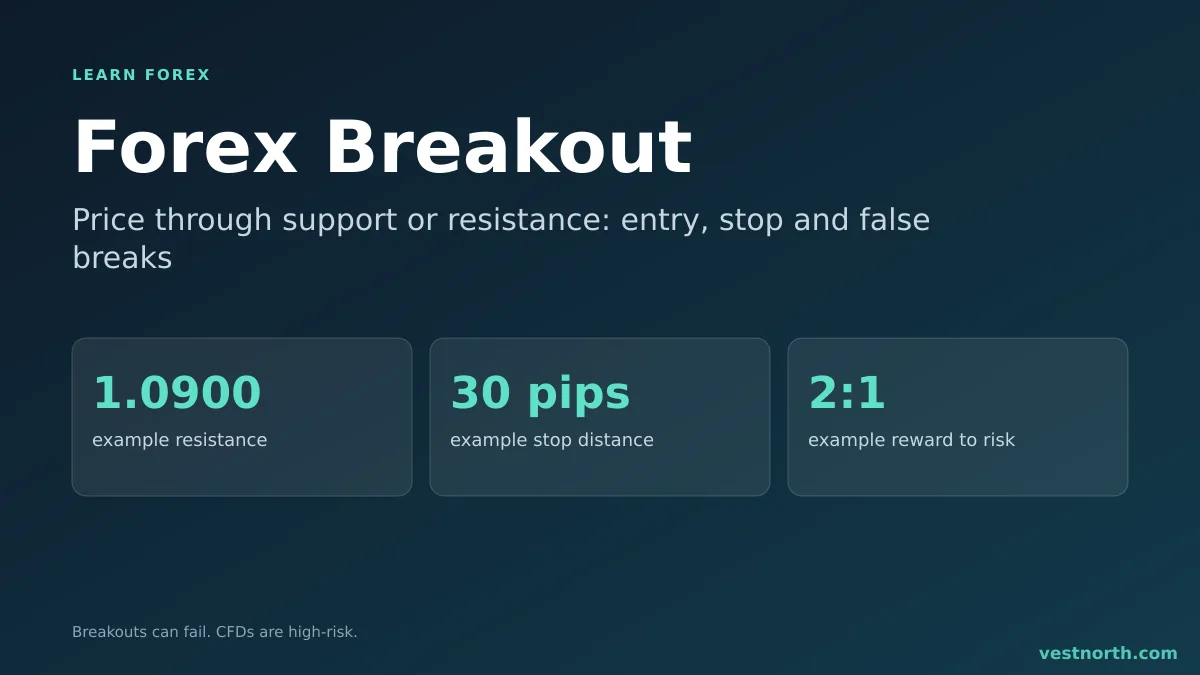
EUR/USD has stopped at 1.0900 three times over two days. You decide to buy a break above it.
- Entry: a buy stop at 1.0905, five pips above the level.
- Stop loss: 1.0875, which is back inside the range. The risk is 30 pips.
- Target: 1.0965, which is 60 pips from the entry.
On a 0.10 lot, one pip is worth about $1, so the risk is about $30 and the target about $60, a 2:1 ratio before spread and slippage. If your account is $3,000 and you accept risking 1%, that is exactly $30. The lot size calculator does this sum for any pair, and the pip calculator gives the pip value.
If price spikes to 1.0910, falls back and closes at 1.0880, the order has filled and the trade is near its stop. That is the cost of a false breakout, and it is why the stop is set before the trade, not after. Compare the ratio with risk to reward planning.
Common mistakes
- Entering with no stop loss, or moving the stop further away once the trade goes wrong.
- Using the same lot size on a 15-pip stop and a 60-pip stop.
- Treating every touch of a level as a signal.
- Trading breakouts around major news without checking the calendar.
Practise the routine on a demo account first. A demo does not reproduce real-market slippage, so expect live fills to differ.
Related chart patterns and levels: the cup and handle pattern, mean reversion trading and wedge patterns.
Bottom line
A breakout is a move through a known level, and it is a description of what price did, not a forecast of what comes next. Mark the level, decide whether you need a close beyond it, put the stop where the idea fails and size the lot from that distance. Some breakouts will reverse, so risk only an amount you can afford to lose. CFDs are complex, high-risk instruments.
Frequently asked questions
What is a breakout in forex?
A breakout happens when price moves through a support or resistance level that had held before. A move above resistance is an upside breakout, and a move below support is a downside breakout.
What is a false breakout?
A false breakout is a move through a level that reverses and closes back inside the old range. Traders who entered on the break are then in a losing position, usually close to their stop loss.
How do you confirm a breakout?
Many traders wait for a candle to close beyond the level instead of acting on a brief spike through it. Some also wait for a retest, where price returns to the broken level and holds on the other side.
Should I use a buy stop order for a breakout?
A buy stop is a pending order placed above the current price, so it fills only if price reaches that level. It is one way to enter a breakout without watching the screen, but it can fill at a worse price during fast moves.
Where does the stop loss go on a breakout trade?
A common place is just back inside the old range, where the breakout idea would be wrong. Size the trade so that distance matches an amount of money you accept losing.
Why do breakouts get worse fills?
Prices often move fast when a level breaks, and spreads can widen. A pending order may fill several pips from the level you chose, which is called slippage.