What Is a Stop Loss in Forex Trading?
Short answer: A stop loss is an order that closes your trade at a price you choose so the loss stops growing. Its size is the distance in pips times the pip value: 50 pips on 0.2 lot of EUR/USD risks about $100. It limits the planned loss but does not guarantee the exact fill price.
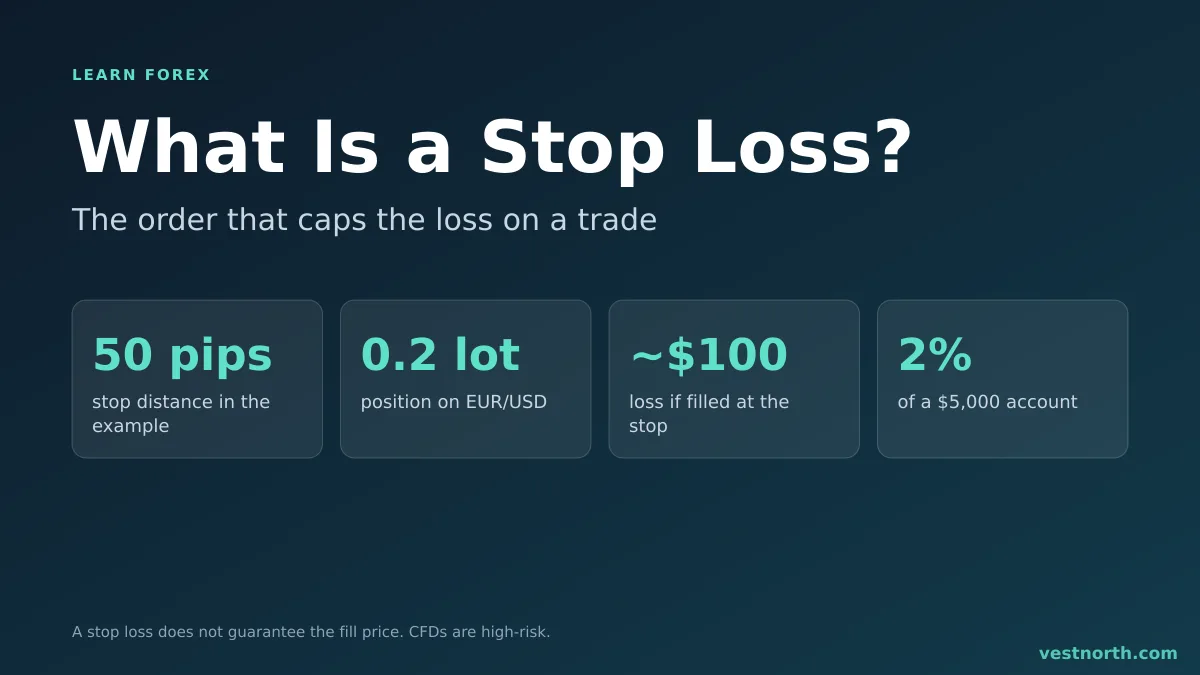
A 50-pip stop loss on 0.2 lot of EUR/USD, pip value about $2. Illustration, October 2026.
How a stop loss works
You open a trade and attach a stop loss price. The platform watches the price. When the market reaches that level, the stop loss turns into an order to close the trade at the next available price.
- On a buy, the stop sits below the entry price.
- On a sell, the stop sits above the entry price.
Because you set it before the trade goes wrong, it takes the decision out of the moment. It is a type of stop order, covered with the other types in forex order types.
A worked example
You buy EUR/USD at 1.0850 and place the stop at 1.0800.
- Distance: 1.0850 − 1.0800 = 0.0050, which is 50 pips (see what a pip is).
- Position: 0.2 lot. For a US dollar account one pip on one standard lot of EUR/USD is about $10, so 0.2 lot is about $2 per pip.
- Loss if the stop fills at 1.0800: 50 × $2 = about $100.
On a $5,000 account that is 2% of the balance. You can check the figure with the pip calculator.
Stop distance and position size
The common mistake is choosing the lot size first and the stop second. Reverse it. Put the stop where your trade idea is proven wrong, measure the pips, then pick a lot size so the loss stays at the amount you set. The steps are in forex position sizing and the lot size calculator.
| Stop distance | Lot size on EUR/USD | Loss if filled at the stop |
|---|---|---|
| 25 pips | 0.4 | about $100 |
| 50 pips | 0.2 | about $100 |
| 100 pips | 0.1 | about $100 |
A wider stop is not more dangerous when the lot size shrinks to match.
Spread and your stop
On a buy, your stop is triggered by the bid price, because you close by selling. The chart often shows the bid, and your entry was at the higher ask price. The spread is therefore already lost when the trade opens. A very tight stop inside normal spread and noise can be hit with no real move against you.
When a stop loss does not fill at your price
A stop loss is not a promise of a price.
- Slippage: in fast markets the next available price can be worse than the stop level.
- Gaps: if the market closes on Friday and opens higher or lower on Monday, a stop in between fills at the open.
- Wide spreads: around news or rollover the spread can widen and trigger a stop.
Some brokers offer a guaranteed stop loss on some accounts, often with a fee or a wider minimum distance. Check your broker’s terms, because availability differs by broker and by regulator. Our coverage of slippage is in what slippage is.
Stop loss, margin call and stop out
A stop loss is your own exit on a single trade. A margin call and stop out are the broker’s account-level levels. A stop loss that is set and sized sensibly usually closes the trade long before those levels matter. Without one, a leveraged loss can run until the platform closes positions for you.
Habits that undo a stop loss
- Moving the stop further away once the trade goes against you.
- Removing the stop and hoping the price comes back.
- Setting it so tight that normal movement closes the trade.
- Opening several trades on the same currency, so one move triggers all the stops.
See forex risk management for how stops fit into a wider plan.
A stop that follows the price as a trade moves in your favour is a trailing stop. See what a trailing stop is for how it locks in part of a gain.
Related risk topics: moving a stop to break-even and account size and leverage.
Bottom line
A stop loss closes a trade at a level you set before the trade can run further against you. Work out the pips to the stop, then choose the lot size that makes that loss an amount you accept. Expect that the fill can be worse than the level in fast markets. Only trade with money you can afford to lose. CFDs are complex, high-risk instruments.
Frequently asked questions
What is a stop loss in forex?
A stop loss is an order attached to an open trade. When price reaches the level you set, the platform closes the trade to stop the loss from growing.
How do I calculate the loss on a stop loss?
Multiply the distance in pips by the pip value for your lot size. A 50-pip stop on 0.2 lot of EUR/USD, at about $2 per pip, risks about $100.
Does a stop loss guarantee my exit price?
No. A standard stop loss becomes a market order when price touches it, so the fill can be worse than the level you set (slippage), especially in fast markets or over a weekend gap.
Where should I place a stop loss?
Place it at a price that would show your trade idea is wrong, then size the position so that distance risks only the amount you accept. Do not pick the distance from the lot size you want.
What is the difference between a stop loss and a stop out?
A stop loss is an order you set on one trade. A stop out is the broker closing positions automatically when your margin level falls to its stop out level.
Can I move my stop loss?
Yes, you can change or remove it while the trade is open. Moving it further away to avoid a loss raises your risk beyond what you planned.