What Is a Trailing Stop in Forex Trading?
Short answer: A trailing stop is a stop loss that follows price at a fixed distance in pips. On a buy it moves up as price rises and never moves back down. With a 30-pip trail, a buy that reaches 1.0900 has its stop at 1.0870. It can lock in a gain, but it can also close a trade on a normal pullback.
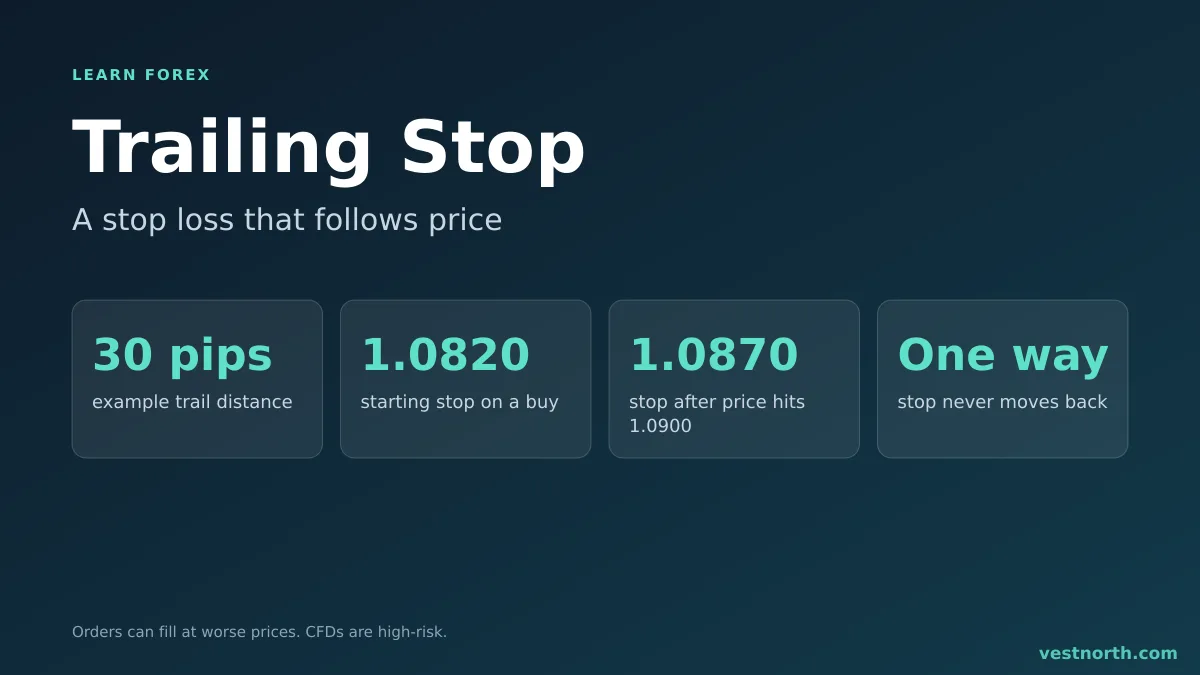
A 30-pip trailing stop on a EUR/USD buy opened at 1.0850. Illustration, October 2026.
How a trailing stop works
A normal stop loss sits at one price until you move it. A trailing stop is set as a distance, not a price. The platform keeps the stop that many pips behind the best price reached.
- On a buy, the stop trails below price and moves up.
- On a sell, the stop trails above price and moves down.
- When price pulls back, the stop stays where it is. It only moves in the direction of profit.
- When price touches the stop, it becomes an order to close the trade.
A worked example in pips
You buy EUR/USD at 1.0850 with a 30-pip trailing stop. The starting stop is at 1.0820.
| Price reaches | Stop moves to | Locked result at the stop |
|---|---|---|
| 1.0850 (entry) | 1.0820 | −30 pips |
| 1.0880 | 1.0850 | 0 pips (breakeven) |
| 1.0900 | 1.0870 | +20 pips |
| 1.0930 | 1.0900 | +50 pips |
| Falls to 1.0905 | stays at 1.0900 | none yet |
| Falls to 1.0900 | trade closes at about 1.0900 | about +50 pips |
On 0.1 lot of EUR/USD, at about $1 per pip, that is a gain of about $50 (see what a pip is and the pip calculator). Spread, commission and slippage come out of the result.
The stop never went back down from 1.0900 when price fell to 1.0905. That is the feature: the stop only ratchets one way.
Trailing stop versus fixed stop
| Fixed stop loss | Trailing stop | |
|---|---|---|
| Set as | A price | A distance in pips |
| Moves | Only if you change it | Automatically with price |
| Protects | The planned loss | The loss first, then part of the gain |
| Main weakness | Does not follow a winning trade | Can be hit by a normal pullback |
Many traders start with a fixed stop to cap the loss, then switch to a trailing stop once the trade is in profit. Trend followers often trail the stop behind a moving average or recent swing lows, as described in trend trading basics. This is a choice, not a rule. Write down which one you will use in your trading plan before you enter.
Choosing the trailing distance
The distance sets how the stop behaves.
- Too tight. If it is smaller than the pair’s usual pullbacks, the trade closes on noise. On a pair that moves 20 pips back and forth during a session, a 10-pip trail will rarely survive.
- Too wide. A 150-pip trail on a 100-pip move gives back most of the gain before it closes.
A common starting point is to base the distance on how far the pair normally pulls back on the time frame you trade, then check it on a demo account. The trail should also be wider than the typical spread, because a spread that widens can trigger the stop on its own.
Where the trailing stop runs
This detail trips up many beginners. On MetaTrader 4 and MetaTrader 5, the usual trailing stop is a function of the terminal on your computer or phone. It moves only while the platform is running and connected. If you close the terminal, the stop stays at the last level it reached.
Some platforms and brokers offer a server-side trailing stop, which keeps working when you are logged off. Availability and the exact behaviour differ by broker, account type and platform, so check your broker’s help centre before you rely on it. We do not state one broker’s rules here because they vary.
Slippage and gaps
A trailing stop is still a stop order. When price touches it, it becomes a market order, and the fill can be worse than the stop level.
- Fast markets: around news the price can jump past your stop.
- Weekend gaps: if the market opens beyond your stop on Monday, the trade closes at the open price. A terminal-based trailing stop also does not move while the platform is closed, so its level can be older than the price you expect.
See what slippage is for how the cost is measured.
Combining it with a take profit
You can use a trailing stop and a take profit on the same trade. The take profit caps the gain at a target, while the trailing stop protects the gain if price turns before the target. If you want the trade to run without a cap, leave the take profit off and let the trailing stop do the exit. The trade-off is that you give up a known target for a stop that may close earlier than you hoped.
Position size still comes first. Choose the lot size from the starting stop distance, as in forex position sizing, so the worst case is an amount you accept.
Common mistakes with trailing stops
- Starting the trail so tight that spread and noise close the trade.
- Assuming it works with the platform switched off.
- Moving the trail closer by hand after every small gain, which is the same as closing early.
- Using one distance for every pair and every time frame.
- Forgetting that the trade can still end in a loss if price never moves far enough.
More on keeping losses small is in forex risk management.
Related risk topics: moving a stop to break-even and account size and leverage.
Bottom line
A trailing stop follows price by a set number of pips and only moves in your favour. It can lock in a gain without you watching the screen, but a distance that is too tight closes trades on normal pullbacks, and a terminal-based version stops moving when the platform is closed. Choose the distance from the pair’s usual movement, size the position from the starting stop and test the setup on a demo account first. Only trade with money you can afford to lose. CFDs are complex, high-risk instruments.
Frequently asked questions
What is a trailing stop in forex?
A trailing stop is a stop loss that follows price at a fixed distance in pips. It moves only when price moves in your favour and stays still when price pulls back.
How does a trailing stop differ from a normal stop loss?
A normal stop loss stays at the price you set until you change it. A trailing stop moves up behind a buy, or down behind a sell, as the trade gains.
Does a trailing stop work when my platform is closed?
It depends on where it runs. On MetaTrader 4 and 5 the trailing stop is a terminal feature, so it only moves while the platform is open. A server-side trailing stop, where offered, keeps working when you log off. Check your broker's terms.
What trailing distance should I use?
There is no fixed answer. A distance smaller than the pair's normal pullbacks will close the trade early, and a very wide one protects little. Test the distance on a demo account first.
Does a trailing stop guarantee my exit price?
No. Like any stop, it becomes a market order when price touches it, so the fill can be worse than the stop level during fast moves or gaps.
Can a trailing stop lose money?
Yes. If price never moves far enough in your favour, the trailing stop stays at or near its starting level, and the trade can still close at a loss.