What Is a Take Profit Order in Forex?
Short answer: A take profit order closes an open trade at a price you choose so a gain is banked without you watching the screen. Its size is the distance in pips times the pip value: 100 pips on 0.1 lot of EUR/USD pays about $100 before costs. It sits on the opposite side of the entry price from a stop loss.
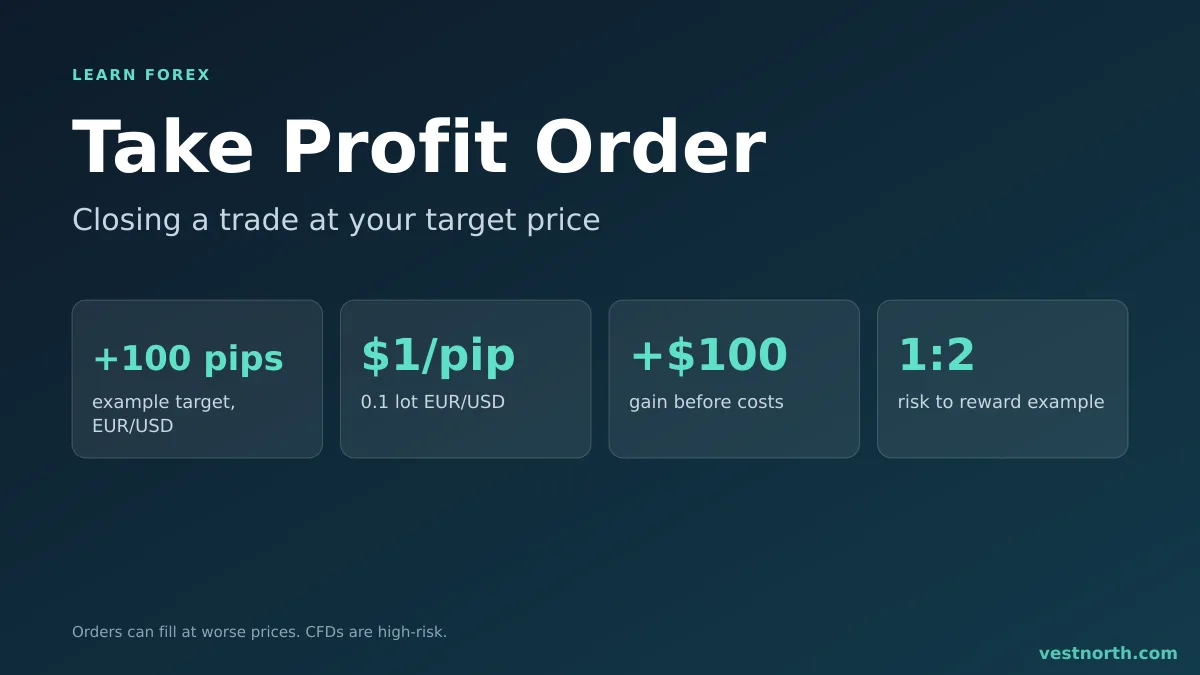
A 100-pip take profit on 0.1 lot of EUR/USD, pip value about $1. Illustration, October 2026.
How a take profit order works
You open a trade and attach a take profit price. The platform watches the market. When price reaches that level, the order closes the trade and the profit is added to your account balance.
- On a buy, the take profit sits above the entry price.
- On a sell, the take profit sits below the entry price.
It is a type of limit order, because it waits for a price that is better than the current one. The other order types are covered in forex order types. A take profit is also different from a pending order, which opens a trade instead of closing one.
A worked example
You buy EUR/USD at 1.0850 and set the take profit at 1.0950.
- Distance: 1.0950 − 1.0850 = 0.0100, which is 100 pips (see what a pip is).
- Position: 0.1 lot. For a US dollar account one pip on one standard lot of EUR/USD is about $10, so 0.1 lot is about $1 per pip.
- Profit if the order fills at 1.0950: 100 × $1 = about $100, before the spread, any commission and swap.
The pip calculator gives the same figure for other pairs and lot sizes.
Pair it with a stop loss
A take profit alone leaves the loss side open. Most traders set both at the start, so the trade has a planned best case and a planned worst case.
Take the same trade with a stop loss at 1.0800:
| Level | Price | Distance from entry | Result on 0.1 lot |
|---|---|---|---|
| Take profit | 1.0950 | 100 pips | about +$100 |
| Entry | 1.0850 | 0 | none |
| Stop loss | 1.0800 | 50 pips | about −$50 |
The reward is twice the risk. That ratio is the subject of forex risk reward ratio. A 1:2 ratio does not make a trade a good one on its own, but it shows how many winning trades you need to break even. At 1:2, one winner covers two losers.
Where to place a take profit
There is no formula that gives the right level. Traders use a few common approaches:
- A multiple of the stop distance. A 50-pip stop with a 2:1 target gives a 100-pip take profit.
- A nearby price level. Targets are often placed just before an area where price has turned several times, such as a recent high or low (see support and resistance).
- A fixed daily range. Some traders look at how many pips a pair usually moves in a session and keep the target inside that range. See forex trading sessions for when pairs tend to move more.
Whatever method you use, test it on a demo account first and write the rule down in your trading plan. A target that sits far beyond where the market usually travels will rarely fill.
Spread can stop your take profit from filling
A buy trade closes by selling, so a take profit on a buy is triggered by the bid price. A sell trade closes by buying, so a take profit on a sell is triggered by the ask price.
Charts often show the bid line. If you buy and set the target at 1.0950, the chart can touch 1.0950 on the bid and your order fills. For a sell with a target at 1.0750, the chart showing the bid can reach 1.0750 while the ask is still a few pips higher, so the order does not fill yet. A wider spread makes this gap larger. Spreads can widen around news and at the daily rollover.
Slippage and gaps
A take profit is a limit order, so in normal conditions it fills at your price or better. Two cases can change that:
- Gaps. If the market opens on Monday beyond your target, the order fills at the first available price. That is usually better than your level on a take profit, which is the one time a gap helps you.
- Partial fills and requotes. Some account types and instruments can fill part of an order or reject it in thin markets. The details depend on the broker and the platform, so read the order execution terms of your account.
The cost side of execution is explained in what slippage is.
Take profit versus closing by hand
A take profit order removes the need to stay at the screen. It also removes your ability to react. If news arrives, you can leave the order in place, move it or close the trade yourself.
| Method | Strength | Weakness |
|---|---|---|
| Fixed take profit | Exit is decided before emotion appears | Can cap a trade that keeps running |
| Close by hand | Flexible when conditions change | Easy to exit early or hold too long |
| Trailing stop | Follows price and protects gains | Can close on normal pullbacks |
Some traders close half the position at a first target and leave the rest open with the stop moved to the entry price. That keeps part of the gain and removes the loss on the remaining half, but it also cuts the size of the winner.
Common mistakes with take profit
- Setting the target first, then choosing a lot size to match the dollar amount you want.
- Placing the target so close that the spread and commission take most of the gain.
- Moving the take profit further away after the trade moves in your favour, which turns a plan into a hope.
- Using a take profit and no stop loss.
- Forgetting that costs come out of the result, including commission on ECN-style accounts (see spread vs commission).
The bigger picture of sizing trades is in forex risk management.
Bottom line
A take profit order closes a trade at a price you set in advance, so the gain is banked without a manual click. Work out the pips to the target, compare them with the pips to your stop loss and check the ratio before you enter. Costs such as spread and commission reduce the result, and a target the market never reaches earns nothing. Only trade with money you can afford to lose. CFDs are complex, high-risk instruments.
Frequently asked questions
What is take profit in forex?
Take profit is an order attached to an open trade. When price reaches the target you set, the platform closes the trade and the gain is paid into your balance.
Where does a take profit go on a buy and on a sell?
On a buy, the take profit sits above the entry price. On a sell, it sits below the entry price. A stop loss goes on the opposite side in both cases.
How do I calculate profit at a take profit level?
Multiply the distance in pips by the pip value for your lot size. A 100-pip target on 0.1 lot of EUR/USD, at about $1 per pip, pays about $100 before costs.
Is a take profit order guaranteed to fill?
No. Price can touch your level without the order filling, for example when the spread is wide, and in fast markets the fill can differ from the level you set.
Should I always use a take profit?
No. Some traders prefer to close by hand or to trail a stop. A take profit is one option. Whatever you choose, set the exit rule before you open the trade.
What is a good take profit distance?
There is no fixed number. Many traders set it as a multiple of the stop loss distance, such as two times, then check that the target sits at a price the market has actually reached before.