Forex Account Size and Leverage: How Much You Can Trade With a Small or Large Balance
Short answer: Leverage and account size do different jobs. Leverage decides how much margin a position locks up. Your balance, risk percentage and stop distance decide how big the position should be. A $500 account risking 1% ($5) with a 30-pip stop on EUR/USD can open about 0.01 lot, whether the leverage is 1:30 or 1:500. Only the margin changes.
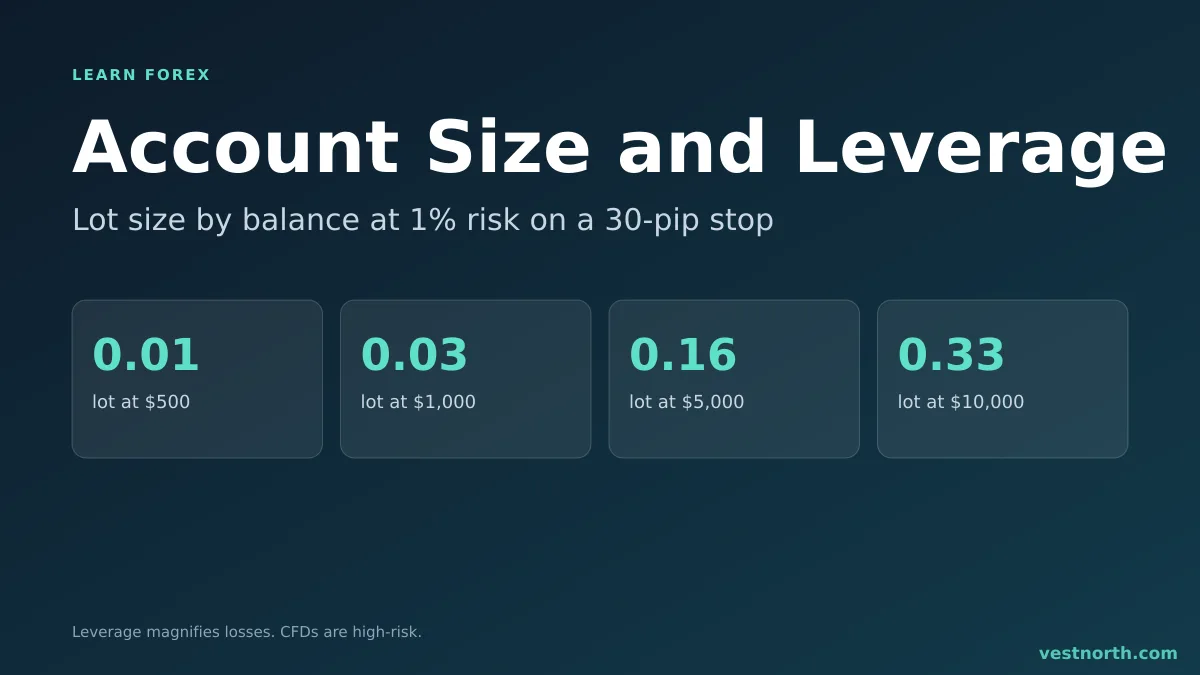
Position size by balance at 1% risk. Illustration with invented example figures, October 2026.
Two dials, not one
Beginners often treat leverage as the thing that controls risk. It controls something narrower: how much of your balance is held as margin while a trade is open. The loss on the trade comes from the position size and how far price moves, and the leverage label does not enter that sum.
- Leverage answers: how much margin does this position need?
- Position size answers: how many dollars do I lose per pip?
- Stop distance answers: how many pips can price move against me?
Multiply the last two and you have the loss if the stop is hit. For the full mechanics, see margin vs leverage and what is leverage.
Lot size by account balance
This table risks 1% of the balance on a 30-pip stop on EUR/USD. One pip on one standard lot (100,000 units) is about $10 on a US dollar account. All figures are rounded and use invented example prices.
| Balance | 1% risk | Money per pip needed | Exact lot size | Practical lot size |
|---|---|---|---|---|
| $200 | $2 | $0.067 | 0.0067 | Below 0.01, may not be possible |
| $500 | $5 | $0.167 | 0.0167 | 0.01 (risk about $3) |
| $1,000 | $10 | $0.333 | 0.033 | 0.03 (risk about $9) |
| $5,000 | $50 | $1.667 | 0.167 | 0.16 (risk about $48) |
| $10,000 | $100 | $3.333 | 0.333 | 0.33 (risk about $99) |
Round down, never up. The first row shows the real problem with tiny accounts: the exact lot size is smaller than the 0.01 lot minimum that many brokers use as their smallest step. Your broker’s minimum lot is listed in its contract specification. If the smallest allowed trade risks more than your plan allows, the options are a tighter stop, a smaller risk target you accept being slightly off, or a larger balance. Raising the leverage fixes none of these.
The lot size calculator and the position sizing guide run the same sum for any pair.
What leverage changes: the margin
Take the 0.02 lot position on EUR/USD at a price of 1.0800. That is 2,000 units, worth $2,160 in notional value. The margin required is the notional divided by the leverage.
| Leverage | Margin held | Share of a $500 balance |
|---|---|---|
| 1:30 | $72.00 | 14.4% |
| 1:100 | $21.60 | 4.3% |
| 1:500 | $4.32 | 0.9% |
Same trade, same pip value (about $0.20 per pip), same loss if the stop is hit. Higher leverage leaves more free margin. That sounds like a benefit, and it is only one if you leave the extra free margin alone. It is also the thing that makes it easy to open a second, third and fourth trade.
Available leverage differs by broker, entity and instrument, and some regulators cap it for retail clients. Check the figure for your own account type rather than assuming one. The leverage ratios explainer covers the common ratios.
How high leverage ruins a small account
The damage comes from the position that high leverage allows. Suppose a $500 account opens 0.5 lot on EUR/USD at 1.0800. That is 50,000 units, or $54,000 of notional value.
- Margin at 1:500: $108. The broker accepts the trade easily.
- Margin at 1:30: $1,800. The broker would refuse it, because the balance is too small.
- Pip value: about $5 per pip.
- A 100-pip move against the trade: a $500 loss, the whole account.
At 1:500 the position fits. At 1:30 it does not. This is the sense in which low leverage protects small accounts: not by lowering the risk of a correct position size, but by refusing positions that are far too large. When leverage is high, the limit becomes your own rule, and your plan has to do the job the margin requirement would otherwise do.
Before the account is wiped, a broker’s margin call and stop out levels usually close positions. Those levels vary by broker. See margin call and stop out and read your own broker’s terms.
Rules that work at any balance
- Fix the risk percentage first. Many traders use 0.5% to 2% per trade. See risk per trade.
- Choose the stop from the chart, then size the trade. Do not pick a lot size first and squeeze the stop to fit.
- Count total open risk. Three trades at 1% each on correlated pairs behave like one 3% trade. See correlation between pairs.
- Watch free margin, not just the margin level. A small share of the balance in use does not mean the risk is small.
- Leave a buffer. Do not use most of your free margin, so a normal move against you does not trigger a margin call.
- Test on a demo. A demo account shows how the numbers move before real money is involved.
Does a bigger account need more leverage?
No. A $10,000 account risking 1% on a 30-pip stop trades about 0.33 lot, which needs roughly $710 of margin at 1:50 and $71 at 1:500 on EUR/USD. Neither figure is a constraint. A larger balance gives more room to size trades small relative to the account, and to stay above the minimum lot step. The leverage setting stays a margin question.
Bottom line
Think of account size as the input to your risk budget and leverage as the margin rule the broker applies. Work out the money you will risk, divide by the stop distance, round the lot size down, and only then look at the margin. If the smallest tradable lot is already more risk than your plan allows, the balance is too small for that plan on that pair. Only trade with money you can afford to lose. CFDs are complex, high-risk instruments.
Frequently asked questions
How much leverage should a small forex account use?
There is no single right number. What matters is the position you actually open. If a 1% risk on your stop distance gives a 0.01 lot trade, the leverage setting barely changes the risk. It only changes how much margin is locked.
Does higher leverage mean more profit?
No. Higher leverage lets you open a larger position for the same margin, which magnifies both gains and losses. The risk is set by lot size and stop distance, not by the leverage label.
What is the smallest account size you can trade forex with?
It depends on the broker's minimum deposit and minimum lot size. A very small balance may not allow a position small enough to keep the risk at 1% of the account. Check the broker's contract specification before you deposit.
How do I work out lot size from my account balance?
Multiply the balance by your risk percentage, divide by the stop distance in pips to get the money per pip, then divide by the pip value of one lot. The lot size calculator does the sum for you.
Why did my small account blow up with low risk per trade?
Usually because several positions were open at once, or the stop was far wider than planned, or no stop was used. Total open risk across all trades is what drains an account.
Is a bigger account safer?
Not by itself. A large account with oversized positions can lose a large share of its balance just as a small one can. A bigger balance only gives more room to size trades small and still meet the minimum lot.