Margin vs Leverage in Forex: What Each One Means and How They Connect
Short answer: Margin is the money your broker locks from your balance to keep a trade open. Leverage is the ratio that decides how much margin that is. Required margin equals the position size divided by the leverage, so a $100,000 position needs about $3,333 at 30:1 and $200 at 500:1. Leverage sets the size of the deposit. Margin is the deposit itself.
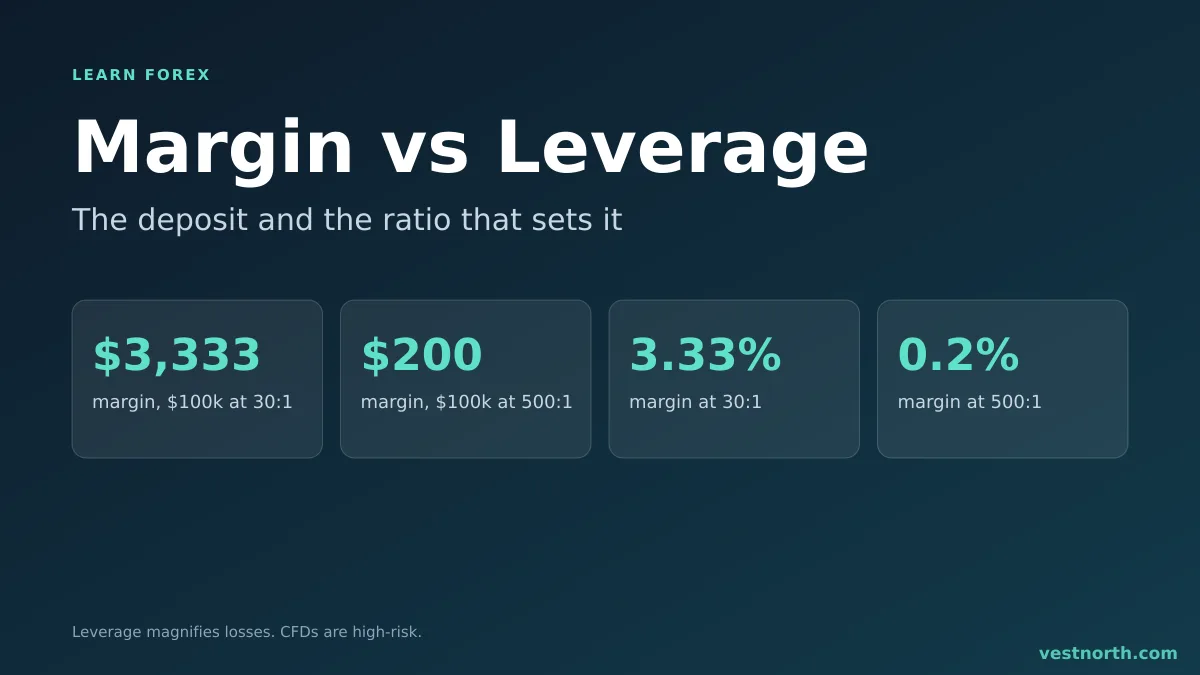
Margin and leverage in four numbers. Illustration, October 2026.
Two words, one relationship
Think of a rental deposit. The deposit is the margin: money held while you use something bigger than your deposit. Leverage is the rule for how big a deposit the landlord asks for. A 3.33% deposit is 30:1 leverage, and a 0.2% deposit is 500:1.
That conversion is the whole link between the two:
- Leverage 30:1 means margin of 1/30, about 3.33% of the position.
- Leverage 100:1 means margin of 1%.
- Leverage 500:1 means margin of 0.2%.
Our guides to what leverage is and what margin is cover each term alone. This page puts them side by side.
The formula
Required margin = (lots × contract size × price) ÷ leverage, converted to your account currency.
For EUR/USD, one standard lot is 100,000 euros. With the price at 1.1000, that is $110,000 of notional value on a USD account.
| Position | Notional value | Leverage | Required margin |
|---|---|---|---|
| 1.00 lot EUR/USD at 1.1000 | $110,000 | 30:1 | about $3,667 |
| 1.00 lot EUR/USD at 1.1000 | $110,000 | 100:1 | $1,100 |
| 1.00 lot EUR/USD at 1.1000 | $110,000 | 500:1 | $220 |
| 0.10 lot EUR/USD at 1.1000 | $11,000 | 30:1 | about $367 |
The figures are examples. Your broker’s contract specification shows the exact margin for each instrument, and some brokers set different leverage for different instruments or account sizes.
Margin terms you will see on a platform
- Balance: your deposits plus closed profit and loss.
- Equity: balance plus the floating profit or loss on open trades.
- Used margin: the total locked across open trades.
- Free margin: equity minus used margin.
- Margin level: equity divided by used margin, shown as a percentage.
Each broker sets its own margin call and stop out levels. Our margin call and stop out guide and the margin level page explain how they work. Read your broker’s terms for the real numbers, because they differ.
Same account, two leverage settings
Take an account with a $1,000 balance, one 0.10 lot EUR/USD buy at 1.1000 (notional $11,000), and no other trades.
| 30:1 | 500:1 | |
|---|---|---|
| Used margin | about $367 | $22 |
| Free margin at open | about $633 | $978 |
| Margin level at open | about 273% | about 4,545% |
| Profit or loss for a 50-pip move | about $50 | about $50 |
The profit and loss row is the same in both columns. Leverage did not change the risk of the trade. The position size did. A 0.10 lot moves about $1 per pip on a USD pair whatever the leverage is.
What changes is how much room the account has to open more trades. At 500:1 you can hold a position about 16 times larger than at 30:1 for the same margin, and a loss on that larger position can wipe out the account quickly. This is the real risk: high leverage lets you take a size the balance cannot absorb.
Margin level is not fixed at open. As the price moves against you, equity falls while used margin stays the same, so the percentage drops.
How leverage limits differ
Maximum leverage depends on the regulator and on the client category, and offshore entities may offer much higher ratios than regulated retail ones. Read the regulator’s own pages and your broker’s legal documents, because limits change. Our leverage ratios guide lists how ratios read.
Practical rules
- Choose the lot size from your stop distance and risk amount first, not from the leverage available. The lot size calculator does it.
- Check free margin before an entry, and leave a buffer so that a normal move does not push the margin level near the stop out level.
- Avoid stacking many trades in correlated pairs, which uses margin and concentrates risk. See correlation between pairs.
- Know that a stop loss can fill worse than expected in fast markets. Slippage can turn a planned loss into a larger one.
- Try the platform on a demo account and watch how used margin and margin level change as you add and close trades.
Bottom line
Leverage is the ratio, margin is the cash locked because of it. A higher ratio shrinks the margin per trade, which lets you open positions the account may not survive. Size each trade from your stop and your risk limit, keep free margin as a buffer, and read your broker’s margin call and stop out levels before you trade. Only risk money you can afford to lose. CFDs are complex, high-risk instruments.
Frequently asked questions
What is the difference between margin and leverage?
Margin is an amount of money your broker sets aside from your balance to hold a trade open. Leverage is the ratio between the trade size and that margin. Higher leverage means less margin per trade.
How do you calculate required margin?
Required margin = trade size (notional value in account currency) divided by leverage. A $100,000 position at 30:1 needs about $3,333; at 500:1 it needs $200.
Does higher leverage mean higher risk?
It allows a larger position for the same margin, so a given price move changes your balance by more. Risk depends on position size and stop distance, which you control.
Is margin a fee?
No. Margin is a deposit that stays in your account and returns to free margin when the trade closes. Spread, commission and swap are the actual costs.
What happens if my margin runs out?
When your margin level falls to the broker's margin call level, you may get a warning. At the stop out level the platform starts closing positions. The levels are set by each broker.
What is free margin?
Free margin is equity minus the margin already used by open trades. It is the amount available to open new positions or absorb losses.