What Is Margin Level in Forex and How Is It Calculated?
Short answer: Margin level = equity ÷ used margin × 100. It is the percentage your broker watches to decide whether you are safe, in margin call, or close to a stop out. With $2,000 equity and $500 of used margin the level is 400%. If floating losses cut equity to $1,000, it drops to 200%.
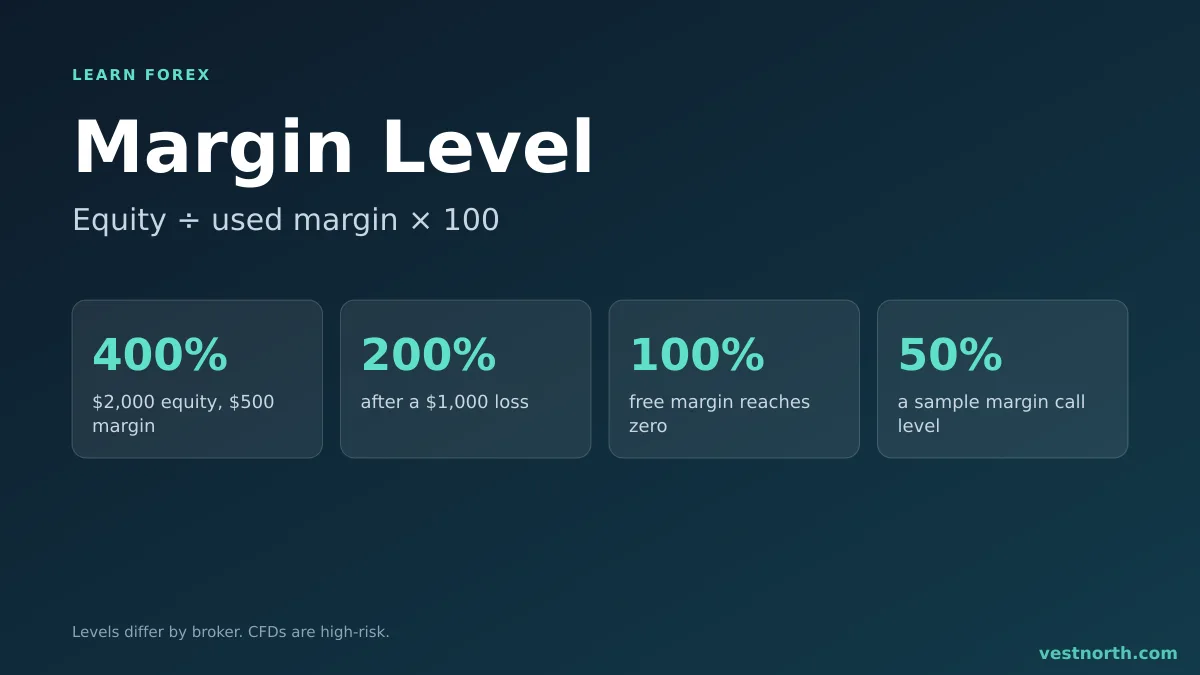
Margin level in numbers. Illustration with round figures, October 2026.
The formula and its parts
Margin level compares two amounts that your platform shows as separate rows:
| Term | Meaning |
|---|---|
| Balance | Deposits plus closed profits and losses |
| Equity | Balance plus the floating profit or loss on open trades |
| Used margin | Money the broker locks to keep your open trades going |
| Free margin | Equity minus used margin |
| Margin level | Equity ÷ used margin × 100 |
Used margin comes from the position size and the leverage you hold (see what margin is and what leverage is). Equity moves with every price tick.
How it moves: a worked example
You deposit $2,000 and open trades that lock $500 of margin. Nothing has moved yet, so equity equals balance.
| Floating result | Equity | Used margin | Free margin | Margin level |
|---|---|---|---|---|
| $0 | $2,000 | $500 | $1,500 | 400% |
| −$500 | $1,500 | $500 | $1,000 | 300% |
| −$1,000 | $1,000 | $500 | $500 | 200% |
| −$1,500 | $500 | $500 | $0 | 100% |
| −$1,750 | $250 | $500 | −$250 | 50% |
Used margin stayed at $500 the whole time. Only equity changed. At 100% free margin is zero and you cannot open new trades. Below that, brokers start applying their own warning and closing rules.
A profit works the other way. A floating gain of $500 lifts equity to $2,500 and the level to 500%.
Margin level and the margin call
The margin call line is a margin level set by the broker. When the level reaches it, you get a warning. The stop out line is lower. When the level reaches it, the platform begins closing positions.
Our reviews report these levels, which can change:
| Broker (per our reviews) | Margin call | Stop out |
|---|---|---|
| Vantage, standard accounts | 50% | 20% |
| Vantage, Premium Unlimited | 30% | 0% |
| AvaTrade, retail | see the review | 50% |
In the table above, a trader on a Vantage standard account reaches the 50% margin call line at the last row of the example. Read the full steps in margin call and stop out and in the Vantage review and AvaTrade review. Confirm the numbers for your own entity in its client agreement or help centre, because levels differ by entity and by account.
How many pips of room does a level give you?
Take the $2,000 account above, now holding one position of 0.5 lot of EUR/USD. A pip on 0.5 lot is about $5. With used margin of $500 and a 50% margin call line, the call comes when equity falls to $250.
- Loss needed: $2,000 − $250 = $1,750.
- Pips against you: $1,750 ÷ $5 = 350 pips.
Raise the position to 2 lots (about $20 per pip) and, ignoring that the margin would also rise, the same $1,750 is only 87.5 pips. Position size sets how many pips of room you have. Use the pip calculator to turn pips into money for your pair.
Margin level is not the same as risk per trade
A level of 800% looks very safe, yet one trade can still lose a large part of the account if it has no stop loss. The level only describes the whole account right now. It says nothing about how much you planned to risk. Plan the loss first with a stop loss and size the trade from it (see position sizing). Margin level then follows from those choices.
What changes the level
- Opening a new trade. Used margin rises, so the level falls straight away, even before price moves.
- Floating profit and loss. Equity moves, the level moves with it.
- Closing a trade. Used margin falls and the level rises.
- Depositing or withdrawing. Changes equity.
- Margin rates. Brokers can set higher requirements for some instruments or around news and weekends, which raises used margin without any change from you.
- Swaps and fees. They are added to or taken from equity (see what a swap is).
Common mistakes
- Reading a high level on a small position as proof the account is safe.
- Opening a new trade to “use up” free margin when the level is already falling.
- Adding funds to a losing account just to lift the level.
- Assuming every broker uses the same margin call and stop out lines.
Bottom line
Margin level is a single percentage that summarises how much cushion the account has. Watch it before you open a position, calculate how many pips it gives you, and compare it with your broker’s margin call and stop out lines. Smaller positions keep it high. Only deposit money you can afford to lose. CFDs are complex, high-risk instruments.
Frequently asked questions
What is margin level in forex?
Margin level is a percentage that compares your equity with the margin locked by open trades. The formula is equity divided by used margin, times 100.
What is a good margin level?
There is no single number, but the higher the better. A level far above your broker's margin call line means more room for price to move against you. Brokers set the margin call and stop out lines differently.
What margin level triggers a margin call?
It depends on the broker and entity. Our Vantage review reports 50% on standard accounts, and our reviews list stop out levels of 20% at Vantage and 50% for AvaTrade retail accounts.
What is the difference between margin level and free margin?
Free margin is an amount of money (equity minus used margin). Margin level is a percentage (equity divided by used margin). Both fall as floating losses grow.
What is the margin level when I have no open trades?
Most platforms show nothing or a blank, because used margin is zero and the formula would divide by zero. The percentage only appears once a position is open.
How can I raise my margin level?
Close or reduce positions so used margin falls, or add funds so equity rises. Using smaller lot sizes from the start keeps the level high.