Risk Per Trade in Forex: How to Set It, Work Out the Lot Size and See What a Losing Streak Does
Short answer: Risk per trade is the money you lose if your stop loss is hit, set before you enter. Most traders write it as a percentage of the account, for example 1% of $1,000 = $10. The percentage and the stop distance together decide the lot size. A small, fixed figure stops one trade or one bad week from wrecking the account.
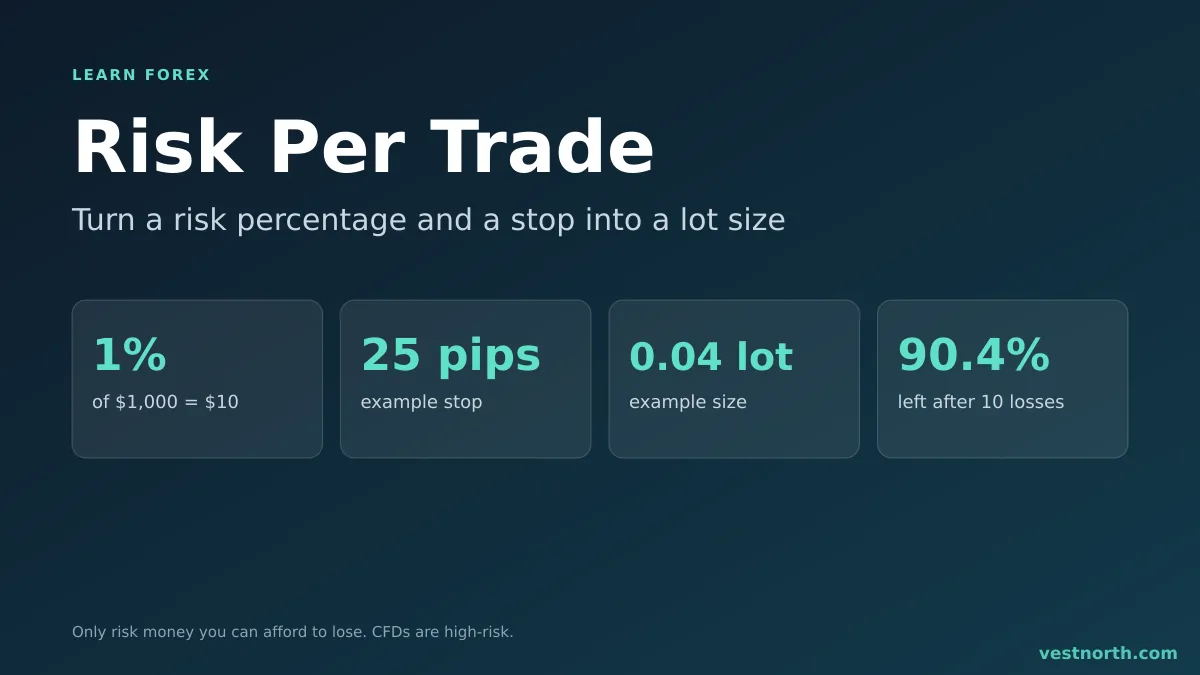
Risk per trade turns a percentage and a stop distance into a lot size. Illustration, October 2026.
The formula
Lot size follows from three numbers you choose or read from the chart:
Lot size = money at risk ÷ (stop distance in pips × value of one pip per lot)
The pip value depends on the pair and the account currency. For EUR/USD on a USD account, one pip on a 1.00 standard lot is about $10, on 0.10 lot about $1, and on 0.01 lot about $0.10. See pip value and the lot sizes page.
A worked example
Made-up trade on EUR/USD with a USD account of $1,000. Not a real trade.
- Risk rule: 1%, so $10.
- Stop distance: 25 pips.
- Lot size = 10 ÷ (25 × 10) = 0.04 lot.
- Check: 0.04 lot × $10 × 25 pips = $10.
Change only the stop to 50 pips and the lot size becomes 0.02. The money at risk stays at $10. This is why the stop comes from the chart and the lot size comes from the stop, never the other way round. The lot size calculator and the position sizing page do the same sum.
What a losing streak does
With a percentage rule, each loss is taken from a smaller balance. This table assumes every trade loses exactly the risk percentage and ignores spread and commission.
| Losses in a row | At 1% risk | At 2% risk | At 5% risk |
|---|---|---|---|
| 5 | 95.1% left | 90.4% left | 77.4% left |
| 10 | 90.4% left | 81.7% left | 59.9% left |
| 20 | 81.8% left | 66.8% left | 35.8% left |
Losses are not the only part of recovery. After a 40% loss, a trader needs a gain of about 67% to return to the start, because the gain applies to a smaller balance. The higher the risk percentage, the deeper the hole and the longer the climb. Whether a losing streak of 10 is likely depends on the strategy, and we have no verified figure to quote for any method.
What affects the right percentage
- Strategy hit rate. A method that loses more often than it wins needs a smaller risk per trade to survive the bad runs. Track your own record in a trading journal.
- Reward-to-risk ratio. A low ratio needs a high win rate. See risk reward ratio.
- Several trades open at once. Five positions at 1% each can all lose together, especially if the pairs move together. See currency correlation.
- Account size. A tiny account may not allow a small percentage. At $100 and 1% risk, the risk is $1, and a 25-pip stop needs 0.004 lot, below the minimum lot size at many brokers (check your own broker’s minimum). The alternative is a tighter stop, which raises the chance of a stop-out, or a smaller risk that the account cannot place.
- Leverage and margin. Risk per trade is not margin. A trade can have a small risk and still use a large share of free margin. See margin vs leverage and margin level.
- Costs. Spread, commission and swap come on top. See trading costs.
Where the plan breaks
- Moving the stop after entry. If you widen it, the real risk is above the figure you wrote down.
- Skipping the stop. Without a stop, risk per trade is undefined.
- Slippage and gaps. A stop can fill worse than set. See slippage and gaps.
- Sizing up after a win or down after a loss on impulse. That is a mood, not a rule. See trading psychology and overtrading.
- Ignoring total risk. A daily or weekly cap, written in the trading plan, limits the damage from a bad run.
How to set it up
- Choose a percentage you could lose repeatedly without changing your behaviour.
- Find the stop from the chart first, using levels or volatility such as ATR.
- Compute the lot size and round down, not up.
- Check the margin required against free margin.
- Write the planned loss in dollars before you click.
- Add up open risk across all trades and keep it inside your daily cap.
For more on the wider topic see risk management. Try the numbers on a demo account first.
Bottom line
Risk per trade is a decision made before the trade: the percentage of the account you accept losing if the stop is hit. The stop distance comes from the chart, and the lot size follows from it. Small percentages survive losing streaks, and larger ones make a bad run far more expensive. Only risk money you can afford to lose. CFDs are complex, high-risk instruments.
Frequently asked questions
What is risk per trade in forex?
It is the amount of money you lose if your stop loss is hit, usually written as a percentage of the account. A $1,000 account with a 1% rule risks $10 per trade.
How much should I risk per trade?
There is no correct number for everyone. Many educators suggest keeping it small, such as 1% or less, so that a losing streak does not damage the account. Pick a figure you could lose several times in a row without panic.
How do I calculate lot size from my risk?
Divide the money at risk by the stop distance in pips multiplied by the value of one pip per lot. For example, $10 at risk with a 25-pip stop and $10 per pip per standard lot gives 0.04 lot.
Does risk per trade include spread and commission?
Costs are on top of the stop distance. A trade stopped out also pays the spread and any commission, so the real loss is slightly larger than the planned figure.
What happens after several losses in a row?
The balance falls, and with a percentage rule the next trade is a little smaller. Ten losses in a row at 1% leave about 90.4% of the starting balance, not 90%, because each loss is a percentage of what is left.
Is risking more per trade a way to grow faster?
A higher percentage makes both gains and losses larger and makes losing streaks far more damaging. It also raises the chance of a margin call. We do not suggest it as a way to grow an account.