Forex Trading Costs Explained: What You Pay on Every Trade
Short answer: Most forex costs come from four places: the spread, a commission on some account types, the overnight swap, and slippage. Brokers may add account fees such as deposit, withdrawal or inactivity charges, which differ by broker. The first two are paid on every trade. On EUR/USD in a US dollar account, a 1.2 pip spread costs $12 per 1 lot, before any commission, swap or slippage. The sum of all of them is your real cost.
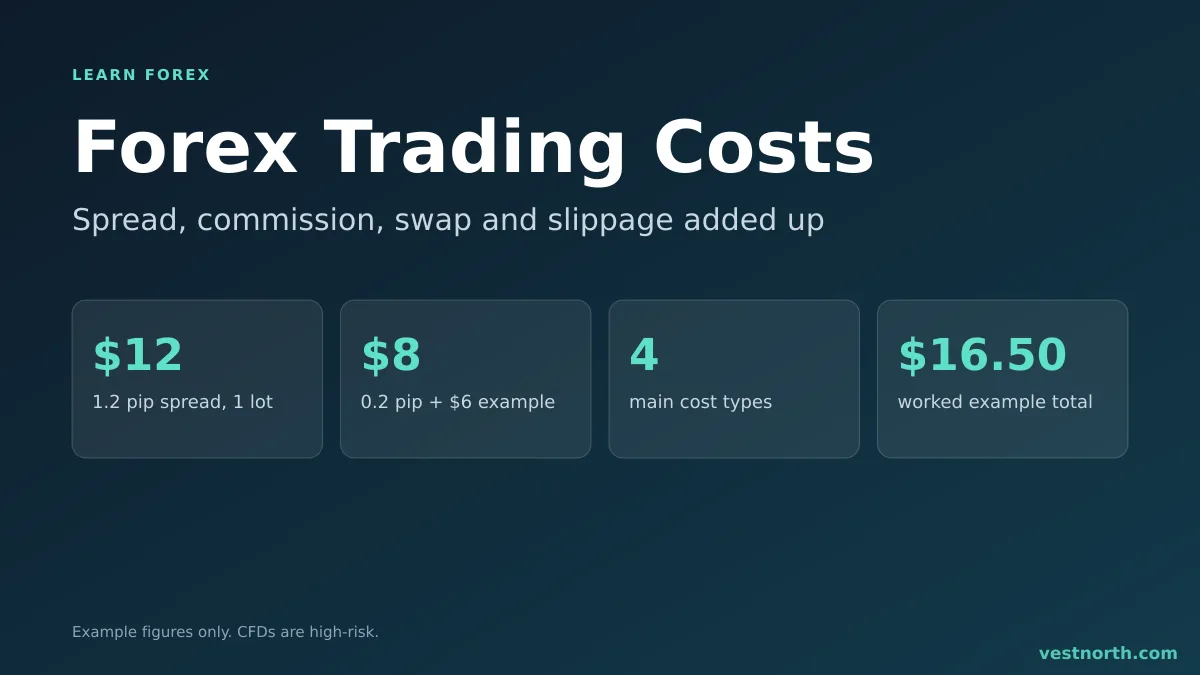
The four main trading costs. Illustration, October 2026.
The costs at a glance
| Cost | When you pay it | Where you see it | Who sets it |
|---|---|---|---|
| Spread | Every trade, built into the price | Gap between bid and ask | Broker (based on market liquidity) |
| Commission | Every trade, on some accounts | Statement line per lot | Broker |
| Swap | Positions held past the rollover time | Statement line per day | Broker rates, linked to interest rates |
| Slippage | When the fill differs from the quote | Entry or exit price | Market conditions |
| Account fees | Deposit, withdrawal, inactivity (if applicable) | Fee schedule | Broker or payment provider |
Spread
The spread is the gap between the price you can buy at (ask) and sell at (bid). You open a trade at a small loss equal to the spread and need the price to move that far just to break even. The basics are in what is a spread and bid and ask price.
Convert the spread to money with the pip value. On EUR/USD, one pip is $10 per lot, so:
| Spread | Cost on 1 lot | Cost on 0.1 lot | Cost on 0.01 lot |
|---|---|---|---|
| 0.2 pips | $2 | $0.20 | $0.02 |
| 1.2 pips | $12 | $1.20 | $0.12 |
| 3.0 pips | $30 | $3.00 | $0.30 |
Spreads are not fixed unless the broker says so. They tend to widen around major news and in the thin hours after the New York close. See forex trading sessions.
Commission
Some accounts quote a tighter spread and charge a fee per lot instead. Commission is often quoted per side or as a round turn (open plus close), and the two differ by a factor of two, so read which one the broker means. Brokers set their own figures, so use the number on your broker’s own fee page. The figures below are made up for the comparison.
| Account style | Spread (example) | Commission (example) | Cost on 1 lot EUR/USD |
|---|---|---|---|
| Spread only | 1.2 pips | none | $12 |
| Raw spread plus commission | 0.2 pips | $6 round turn | $2 + $6 = $8 |
On these example numbers the second account is cheaper by $4 per lot. A trader who opens one small trade a week may see little difference, while a scalper placing dozens of trades a day sees the gap add up quickly. More on the comparison is in spread vs commission.
Swap (overnight financing)
A position still open at the broker’s daily rollover time is charged or credited a swap. It reflects the interest rate gap between the two currencies, plus the broker’s markup. Swap can be negative or positive, and it differs for buy and sell positions on the same pair. Brokers publish their swap rates in the platform’s contract specification, and they change over time.
A rough sense of scale, using an invented rate: if the long swap on a pair is -$6 per lot per night, holding 1 lot for 10 nights costs $60 in swap. Many brokers apply a triple swap on one day of the week to cover the weekend. Which day depends on the instrument and the broker. See what is a swap in forex and forex rollover.
Day traders who close before rollover usually skip this cost. Swing traders should check the swap before holding.
Slippage
Slippage is the difference between the price you clicked and the price you got. It happens when the market moves between your order and the fill, typically at news releases, at the market open after a weekend and in thin markets. It can go against you or in your favour. It is not a fee, but it behaves like a cost on stop orders and market orders in fast conditions. Details are in slippage in forex.
Account-level fees
These are outside the trade itself, and they vary a lot between brokers and payment methods:
- Deposit and withdrawal fees: charged by the broker or by the payment provider (bank, card, e-wallet, crypto network). Check both.
- Currency conversion: if your account currency differs from your deposit currency, a conversion margin may apply.
- Inactivity fees: some brokers charge them after a stretch with no trading. Look in the client agreement for the length of time and the amount.
- Data or platform fees: rare for retail MetaTrader accounts, but they exist with some third-party platforms.
None of these can be estimated from general rules. Read the broker’s fee page and client agreement before depositing.
Putting it together: one trade, all costs
Take a swing trade on EUR/USD, 0.5 lot, held for 3 nights. All inputs are examples, not quotes from a real broker.
| Cost item | Input | Cost |
|---|---|---|
| Spread | 1.0 pip × $10 × 0.5 lot | $5.00 |
| Commission | $6 per lot round turn × 0.5 lot | $3.00 |
| Swap | -$4 per lot per night × 0.5 lot × 3 nights | $6.00 |
| Slippage (stop order filled 0.5 pip worse) | 0.5 pip × $10 × 0.5 lot | $2.50 |
| Total | $16.50 |
If the trade targets 40 pips (worth $200 on 0.5 lot), costs take about 8% of the gross target. If the target is 10 pips ($50), the same $16.50 takes a third. The shorter the target, the more costs matter. That is why a scalper must care about the spread far more than a position trader.
How to keep costs down
- Trade liquid pairs such as EUR/USD, where spreads are normally tighter than on exotic pairs.
- Avoid illiquid hours and the minutes around major news, unless your plan requires them.
- Compare the all-in cost for your own trading style, using the broker’s own published numbers rather than a headline “from 0.0 pips” figure.
- Check the swap before holding overnight, especially on trades planned for weeks.
- Use limit orders for entries where your strategy allows. See forex order types.
- Measure costs against your stop. If the spread is 20% of your stop distance, the setup is expensive.
Bottom line
Every trade has a price tag made of spread, commission, swap and slippage, plus account fees outside the trade. Convert each to money with the pip value, add them up for a typical trade, and compare that total with the move you expect. Low headline spreads can hide commissions, and a cheap trade can turn expensive after a week of negative swap. Only trade with money you can afford to lose, because leveraged CFDs can lose value quickly.
Frequently asked questions
What are the main costs of trading forex?
The spread, any commission per lot, overnight swap on positions held past the daily rollover, and slippage. Some brokers also charge fees for deposits, withdrawals or inactive accounts, so read the fee schedule.
Is forex trading free if there is no commission?
No. Accounts without commission usually build the cost into a wider spread. The cost is still paid on every trade, only inside the price.
How much does a 1.2 pip spread cost?
On EUR/USD with a US dollar account, a pip is worth $10 per 1 lot, so a 1.2 pip spread costs $12 per lot, or $0.12 on 0.01 lot.
Do I pay swap on every trade?
Only on positions still open at the daily rollover time. A trade opened and closed within the same trading day normally pays no swap. Swap can be a charge or a credit depending on the pair, direction and broker rates.
What is slippage and is it a fee?
Slippage is the difference between the price you expected and the price you were filled at. It is not a fee. It can cost you money or, less often, give you a better price.
How can I lower my trading costs?
Trade liquid pairs in busy sessions, compare the all-in cost of spread plus commission for the way you trade, use limit orders where the strategy allows, and avoid holding positions with a large negative swap.