What Is Rollover in Forex?
Short answer: Rollover is the daily cut-off when your broker carries open positions to the next value date. Positions still open at that moment get a swap, which is a charge or a credit. Trades opened and closed before the cut-off normally pay none. The time is set by the broker, and spreads often widen around it because few traders are active.
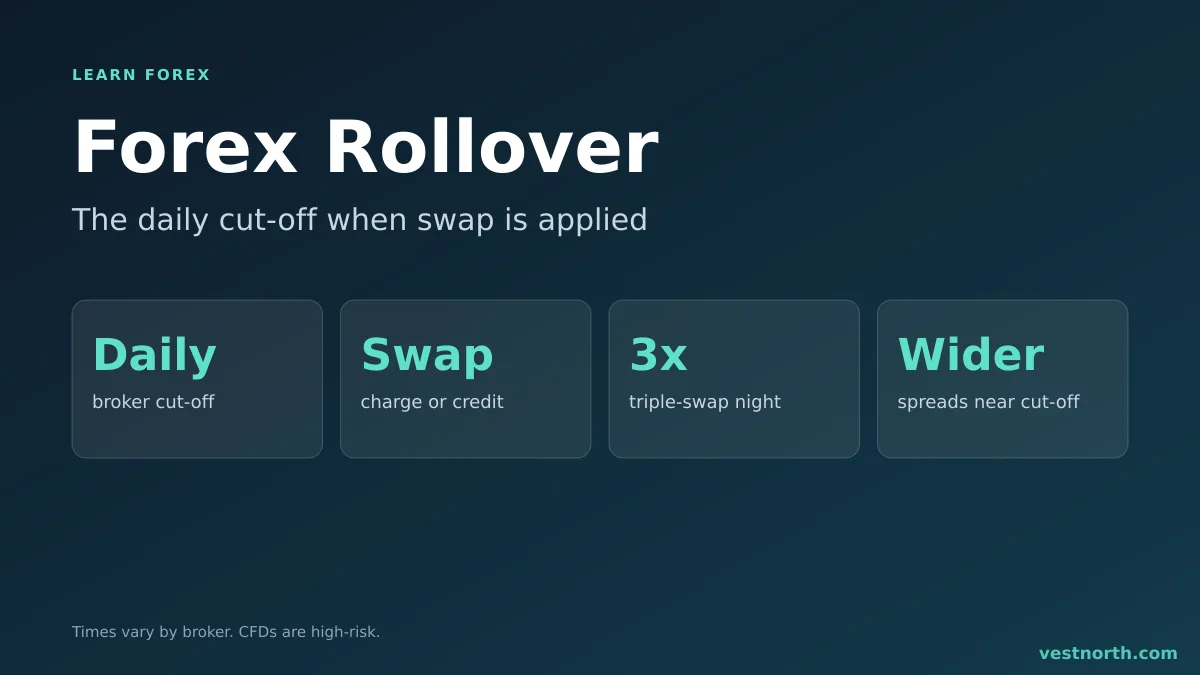
Rollover in brief. Illustration, October 2026.
What rollover means
Spot forex trades settle in theory two business days after the trade date. Brokers do not make you deliver currency, so instead they roll the position forward to the next settlement date each day you keep it open. The roll happens at a fixed time, the rollover time.
Because the position is effectively carried in one currency against another, the roll has an interest component. That is the swap. It reflects the interest rate gap between the two currencies plus the broker’s markup, and it can be positive or negative. What a swap is in forex covers the charge in detail, including swap-free accounts.
When does rollover happen?
There is no single official time. Each broker sets its own cut-off and shows it in the trading hours or contract specifications of the account. Two points hold for most retail brokers:
- The cut-off is usually linked to the New York close, around the end of the New York session and before the Sydney open. See forex trading sessions.
- The time in UTC can move by an hour when New York changes its clocks, and it may differ again from your platform’s server time.
Look up the time on your own account rather than copying one from a forum. A trade closed one minute before the cut-off and a trade closed one minute after can have different costs.
How the swap is charged
If a position is open at the cut-off, the broker adds the swap to the account for that night.
- A long (buy) and a short (sell) in the same pair can have different swaps.
- One can be a credit while the other is a charge, or both can be charges once the broker’s markup is included.
- The values are listed per instrument in the contract specifications and can change.
A simple illustration with a made-up number: if the swap on a buy is −$5 per lot per night, holding 0.2 lot for 3 nights costs 0.2 × $5 × 3 = $3. A swap can also be quoted in points or as a percentage, so convert it to money before you compare.
The triple swap
Because settlement is two business days ahead, the rollover on one weekday also has to cover Saturday and Sunday. Many brokers apply a triple swap on Wednesday for most forex pairs, which means a position held through that night pays for three nights. The day can differ for some instruments, such as metals or indices, so the contract specification is the reference.
If you plan to hold a position over a week, count the number of charges, not the number of calendar days. Five weeknights with a triple Wednesday are 7 charges in total, as in the example in the swap guide.
Why spreads widen at rollover
Right after the New York close, banks and many dealers are between sessions. Few orders are in the market, so liquidity is thin and brokers pass a wider spread to clients, often for a few minutes. Some platforms also show brief price spikes.
This has two effects:
- A tight stop loss can be hit by the wider gap between the bid and ask even if the chart barely moves. A sell is closed at the ask, so its stop can be triggered while the chart line, which usually shows the bid, has not reached it. See bid and ask price.
- Orders placed for this window can be filled worse than expected. See slippage in forex.
Many traders avoid opening new positions in the minutes around the cut-off for this reason.
What to do about rollover
A short checklist:
- Find the cut-off for your account in the broker’s trading hours and write it in your trading plan.
- Read the swap values for your pair and direction before you hold overnight.
- Check the triple-swap day for each instrument you trade.
- Avoid tight stops that sit inside a widened spread at the cut-off.
- Close before the cut-off if you want to day trade with no swap, or use a swap-free account where available and where the replacement fees suit you.
Swing traders who hold for days should treat the swap as part of the cost of the trade, next to the spread, as in the example above.
Common mistakes
- Assuming the rollover time is the same at every broker.
- Forgetting that the time shifts with daylight saving.
- Holding a large position through a triple-swap night without checking the amount.
- Placing a tight stop at the exact cut-off.
- Reading “rollover” and “swap” as two separate fees and counting the cost twice.
Bottom line
Rollover is the daily cut-off, and the swap is what you pay or receive if a position is open at that moment. The time, the amount and the triple-swap day all depend on your broker, so read them in the contract specifications before you hold a trade overnight. Expect wider spreads around the cut-off and keep stops clear of that window. Only trade with money you can afford to lose. CFDs are complex, high-risk instruments.
Frequently asked questions
What is rollover in forex?
Rollover is the daily point at which a broker moves open positions to the next trading day's settlement date. Positions still open at that time have a swap added to or taken from the account.
What time is forex rollover?
It is set by each broker and is usually tied to the New York close, so it can move by an hour when daylight saving changes. Check your broker's trading hours or contract specifications for the exact time on your platform.
Is rollover the same as swap?
The terms are often used together. Rollover is the daily event, and the swap is the amount credited or debited because of it. Many brokers use the two words for the same charge.
Do I pay rollover if I close my trade the same day?
Generally not. A swap applies to positions still open at the cut-off, so a trade opened and closed before it normally pays none. Confirm in your broker's terms.
Why do spreads widen at rollover?
Around the cut-off, between the New York close and the Sydney open, few participants trade. Liquidity is thin, so many brokers show wider spreads for a short time.
Why is there a triple swap on one day of the week?
Spot forex usually settles two business days later, so the rollover on one weekday also covers the weekend. Many brokers apply the triple charge on Wednesday for that reason, but some use a different day or rule for certain instruments.