What Is a Break Even Stop in Forex? When to Move It, How It Works and What It Costs You
Short answer: A break even stop is a stop loss moved to your entry price after the trade has gone into profit. If price then reverses, the trade closes at roughly zero instead of a loss. It lowers the chance of a losing trade, but it also exits many trades that would have recovered, so it is a trade-off and not a free safety net.
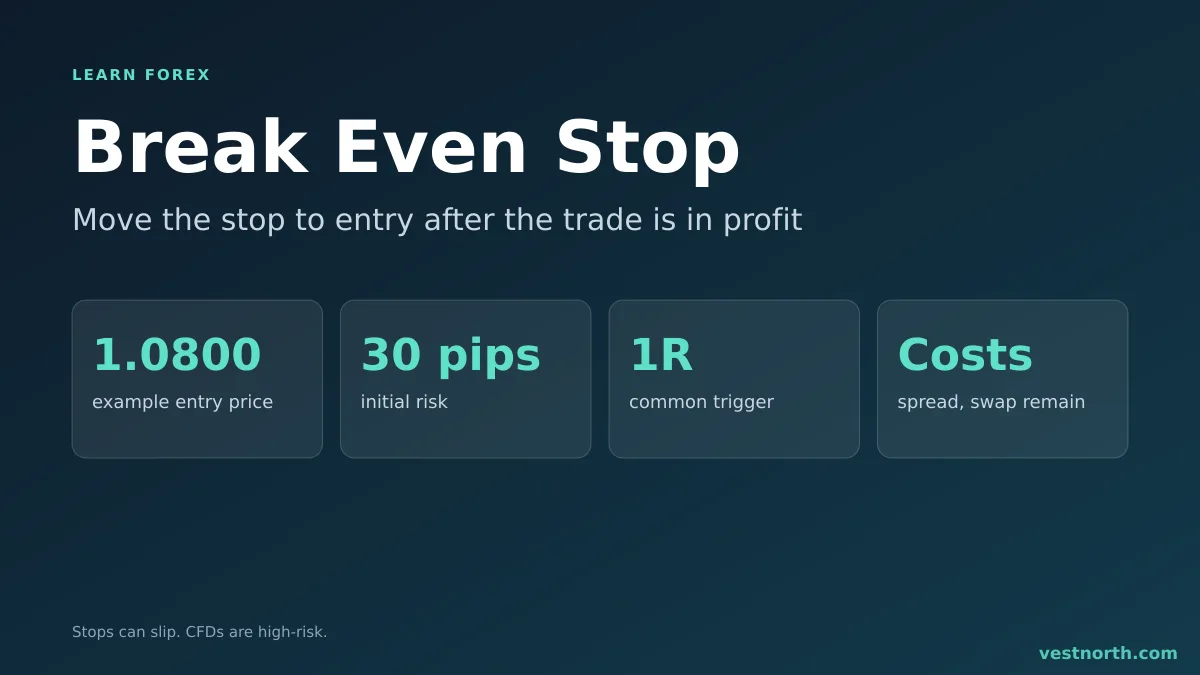
Break even stop on a long trade. Illustration, October 2026.
How a break even stop works
You open a trade with a stop loss that limits the loss if you are wrong. Once price has moved far enough in your favour, you edit the stop and place it at the entry price. From then on the worst case is a trade that closes near zero, not a full loss.
The stop is still an order that waits to be triggered. If price falls back to your entry, the stop becomes a market order and fills at the next available price. That price can be worse than the one you set, especially around news or a gap.
Worked example
You buy EUR/USD at 1.0800 with a stop at 1.0770 (30 pips of risk) and a target at 1.0890 (90 pips, 3 to 1). The figures are illustrative.
| Step | Price | What you do |
|---|---|---|
| Entry | 1.0800 | Stop at 1.0770, risking 30 pips |
| Price reaches 1.0830 | +30 pips (1R) | Move stop to 1.0800 |
| Price pulls back to 1.0800 | Stop triggers, trade closes near zero | |
| Alternative: price continues | 1.0890 | Target hit, +90 pips |
Moving the stop at +30 pips means the original 30-pip risk is gone. It also means a normal pullback of 30 pips ends the trade. Had you left the stop at 1.0770, the same pullback would not have stopped you out, and the trade could have reached the target.
When traders move to break even
There are no fixed rules. These are common approaches:
- After 1R. Price has moved a distance equal to the initial risk.
- After a structure break. Price breaks a recent swing high or low in your favour, as described in market structure.
- Before a news event. The trade is in profit and the economic calendar shows a release coming.
- After a partial profit. Part of the position is closed at the first target and the stop on the rest moves to entry.
Pick one rule, write it in your trading plan and apply it the same way each time. Changing the rule trade by trade makes your results hard to judge.
Costs that break even does not remove
A stop at the exact entry price does not mean a result of exactly zero:
- Spread. A long trade opens at the ask price, but the stop is triggered by the bid price. At entry you are already behind by the spread. See what is a spread.
- Commission. Some account types charge a fee per lot. See spread vs commission.
- Swap. A trade held over rollover can pay or earn a swap. See rollover.
- Slippage. The stop can fill at a worse price. See slippage.
Some traders place the stop a few pips beyond the entry to cover these costs. The right buffer depends on your pair and your account, so check your own costs before choosing a number.
The trade-off
A break even stop changes the shape of your results. You have fewer losing trades, and many of them become small scratch trades. You also lose some winners, because price often retests the entry before moving on.
Think about it with numbers. Suppose a setup would reach its 3R target in 4 of 10 trades without any stop adjustment, and in 3 of 10 with an early break even stop because one winner is shaken out. Without the adjustment you lose 6 trades at -1R and win 4 at +3R, which is +6R. With it, say 3 trades are stopped at -1R, 4 are scratched at 0, and 3 win at +3R. The result is +6R as well. Whether the stop helps depends on how many winners it shakes out, and the figures above are made up to show the arithmetic, not a statistic for any strategy. Test your own method on a demo account and record the outcomes in a journal.
Break even vs trailing stop
| Break even stop | Trailing stop | |
|---|---|---|
| Moves | Once, to entry | Continuously, behind price |
| Locks in profit | No | Yes, as it follows |
| Protects against | A full reversal to a loss | A reversal after a large gain |
| Main drawback | Early exit on pullbacks | Exit on normal noise if set too tight |
You can use both: move to break even at 1R, then trail the stop behind swing lows or highs.
Common mistakes
- Moving too soon. Moving the stop after a 5-pip gain on a pair that moves 80 pips a day usually closes the trade on noise. The ATR shows the normal range.
- Moving out of fear. If the move comes from nerves and not from your plan, you are managing emotions, not risk. See trading psychology.
- Forgetting the original risk. The first stop still decides your position size. Break even only helps after the trade has moved.
- Assuming zero risk. News gaps and weekend gaps can jump over your stop.
Bottom line
A break even stop moves the stop loss to the entry price after the trade has gone into profit, so a reversal ends near zero instead of a loss. It costs you the winners that pull back before continuing, and spread, commission and swap can still leave a small loss. Choose one clear rule for when to move it, write it in your plan and test it on a demo account. Only risk money you can afford to lose. CFDs are complex, high-risk instruments.
Frequently asked questions
What is a break even stop in forex?
It is a stop loss that has been moved from its original level to the entry price after the trade moves into profit. If price then falls back to the entry, the trade closes at about zero instead of a loss.
When should I move my stop to break even?
There is no single rule. Common choices are after price has moved a set multiple of the initial risk, such as 1R, or after price has broken a nearby swing high or low in your favour.
Does a break even stop guarantee no loss?
No. Spread, commission and swap can leave the trade slightly negative, and a gap or fast market can fill the stop at a worse price. See slippage.
Can a break even stop hurt my results?
Yes. Moving it too early can close a good trade on a normal pullback, and price may then continue in your original direction without you.
Is a break even stop the same as a trailing stop?
No. A break even stop moves once to the entry price. A trailing stop keeps following price by a set distance as the trade moves.
Should I put the stop slightly above the entry price?
Many traders add a few pips so that costs like spread and commission are covered. How many depends on your pair and broker costs, which you can read on the broker's own pages.