What Is a Price Spike in Forex? Causes, Costs and What It Does to Your Orders
A price spike is a fast move in price that often reverses almost as quickly. On a chart it appears as a long thin wick on a candle, where price shot up or down and came back. For a beginner the spike matters because it can touch a stop loss, widen the spread and fill an order at a worse price, all within seconds.
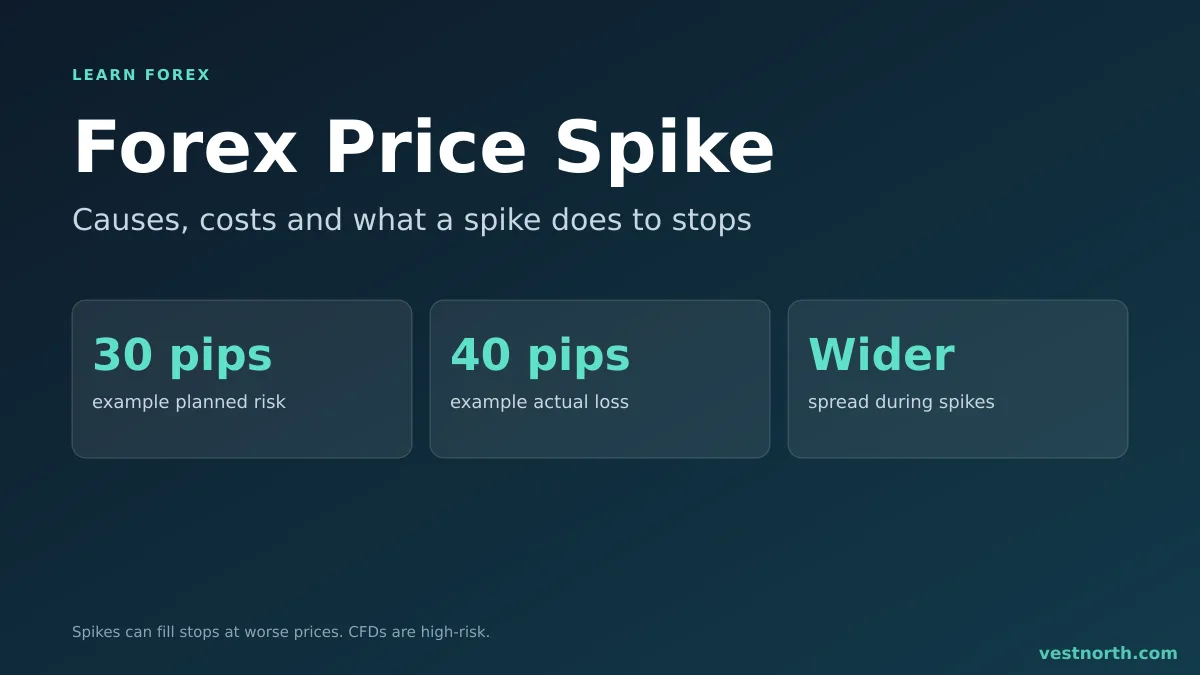
A spike in one picture.
What causes a spike
Price moves in a spike when there are few orders in the way, or when a large amount of buying or selling arrives at once.
- Scheduled news. Releases such as US jobs data or inflation figures can move major pairs by dozens of pips within seconds. The economic calendar guide shows how to see them in advance.
- Surprise headlines. A central bank statement, a political event or a sudden policy change can move price before anyone has time to adjust their orders.
- Thin liquidity. At the daily rollover and just after the weekly open, fewer orders rest in the market, so one large order moves price further. See trading sessions and forex rollover.
- Stop runs. Many traders place stops at the same obvious levels, such as just below a recent low. When price reaches that area, the stops fire as market orders and add to the move. Whether a specific spike was a stop run is hard to prove, so treat it as one possible explanation.
A spike differs from a gap. A gap leaves an empty space on the chart because no trades happened between two prices. A spike trades through every price on the way up and back, so the candle is continuous but its wick is long.
What a spike does to your orders
Stop loss
A stop loss becomes a market order when price touches its level. A spike lasting a few seconds is long enough for that. The trade closes, and the chart a minute later may show price back where it started. The loss is real even though the move was brief.
Spread
Liquidity providers widen their quotes when price is moving fast. The gap between bid and ask can grow from a normal figure to many times that for a short while. A wider spread also changes when a stop fires: a long position closes at the bid and a short position closes at the ask, and charts usually show only one of them. During a spike, the ask can reach a short position’s stop while the chart line does not. The spread guide covers the basics.
Slippage
Market orders and triggered stops fill at the next available price. In a spike that price can be several pips from the one you saw. This is slippage, and it can work for or against you.
A worked example
The prices below are made up to show the arithmetic.
- You buy EUR/USD at 1.0800 with a stop loss at 1.0770. Your planned risk is 30 pips.
- A data release lands. Within seconds, price drops to 1.0752, then returns to 1.0795.
- The stop was touched on the way down. It fills near 1.0760, a little worse than planned. The loss is about 40 pips, not 30.
- Price is back near your entry, but you are no longer in the trade.
On a 0.10 lot, where a pip is worth roughly $1, the plan was about $30 and the result about $40, before spread and any commission. On a 1.00 lot the same event costs about $400. Position size decides how much a spike hurts. The forex position sizing guide and the lot size calculator show how to size from your stop distance.
Ways traders handle spike risk
- Know the release times. Check the calendar before you open a trade, and note the time in your broker’s server time.
- Trade smaller around big releases, or stay out until the first few minutes have passed.
- Give the stop some room. A stop placed one pip beyond a clean level is easy to hit. Placing it beyond the level plus normal noise reduces the chance of being clipped, though a wider stop means a smaller position for the same risk.
- Avoid market orders at the moment of release. The spread and slippage are at their worst.
- Mind your leverage. A spike against a heavily leveraged position can push the account toward the stop out level. The margin call and stop out guide explains the levels.
None of these removes the risk. They reduce how much a spike can cost.
Is a spike a trading signal?
Some traders try to trade the reversal after a spike, betting that price will return. Others treat a spike through a level as the start of a breakout. Both can fail. A spike that reverses today may be the first part of a larger move tomorrow. Read how price behaved after the news before taking a view, and use a demo account to practise before risking money.
Related chart patterns and levels: double tops and bottoms and swing highs and lows.
Bottom line
A price spike is a quick move in price that often reverses, most often around news, rollover and the weekly open. It can close a stop loss, widen the spread and fill an order at a worse price in a few seconds. Know when releases are due, size positions so one spike cannot hurt much, and risk only money you can afford to lose. CFDs are complex, high-risk instruments.
Frequently asked questions
What is a price spike in forex?
A spike is a sharp, fast move in price, often followed by a quick return toward the old level. On a chart it shows as a long candle wick, sometimes with a body that is much smaller.
What causes forex price spikes?
The usual causes are scheduled news releases, surprise central bank or political headlines, and thin liquidity such as the rollover hour or the weekly open. A large order hitting few resting orders can also move price quickly.
Can a spike trigger my stop loss?
Yes. If price touches your stop level, even for a moment, the stop becomes a market order. A brief spike can close your trade, after which price returns to where it was.
Why does the spread widen during a spike?
Liquidity providers pull or widen their quotes when price moves fast, so the gap between bid and ask grows. It usually narrows again once the market settles.
How can I reduce spike risk?
Check the economic calendar, trade a smaller size around major releases, place stops with room beyond obvious levels, and avoid entering at the moment of a release. None of these removes the risk.