What Is the US Dollar Index (DXY)? What It Measures and How Forex Traders Use It
Short answer: The US Dollar Index (DXY) tracks the US dollar against a basket of six currencies: the euro, yen, pound, Canadian dollar, Swedish krona and Swiss franc. The euro has by far the biggest weight, so the index mostly mirrors EUR/USD. Traders use it as a quick read on overall dollar strength, but it does not tell you what a specific pair will do.
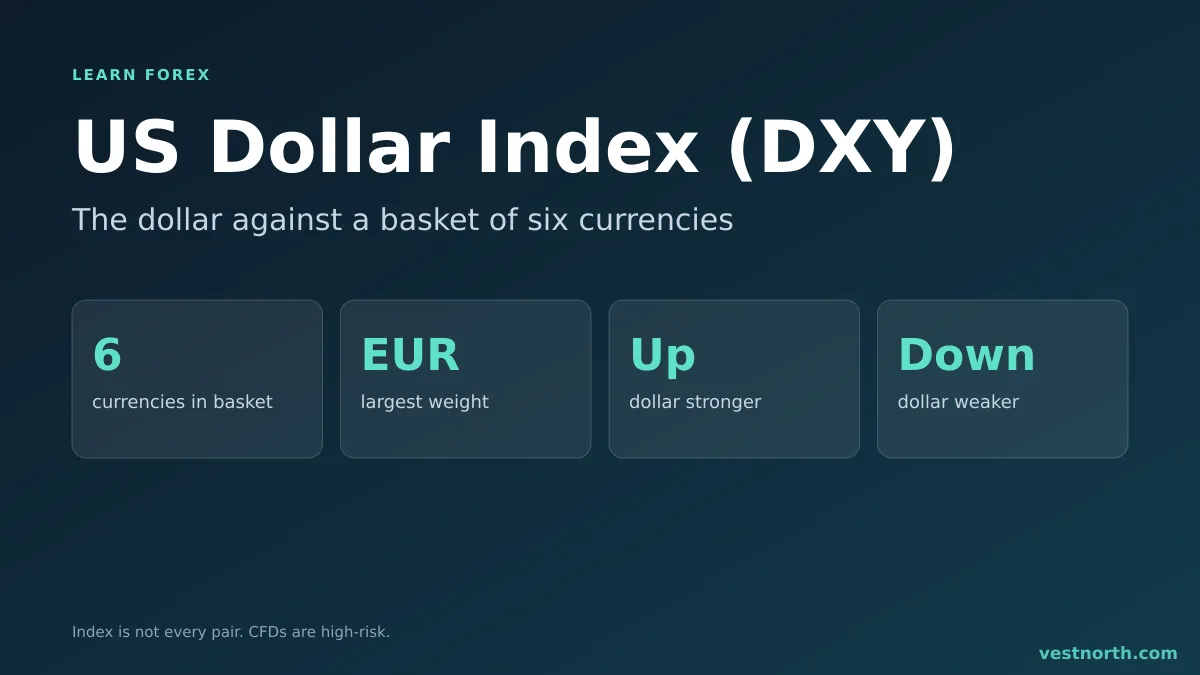
What the US Dollar Index measures. Illustration, October 2026.
What the DXY measures
The DXY is a single number that shows how the dollar is doing against six other currencies at once. When the dollar strengthens against most of them, the index goes up. When it weakens, the index goes down.
The six currencies are:
- Euro (EUR)
- Japanese yen (JPY)
- British pound (GBP)
- Canadian dollar (CAD)
- Swedish krona (SEK)
- Swiss franc (CHF)
Each currency has a fixed weight in the calculation. The euro carries the most, which is why the DXY and EUR/USD often move in opposite directions. We have not verified the exact current weights for this article, so look them up with the index provider before relying on any figure you read online.
How to read the index
You do not need to memorise the level. What you read is the direction and the change.
- DXY rising: the dollar is gaining against the basket on average.
- DXY falling: the dollar is losing ground on average.
- DXY flat: the dollar is not showing a clear lead.
The number itself has no special meaning on its own. A move from 103.0 to 104.0 is a rise of about 1%. The levels in this paragraph are examples, not market data.
What a rising DXY does to your pairs
How a stronger dollar shows up depends on whether the dollar is the base currency (first) or the quote currency (second) in the pair. See what is a currency pair.
| Pair | USD position | When the DXY rises, the pair usually |
|---|---|---|
| EUR/USD | Quote | Falls |
| GBP/USD | Quote | Falls |
| USD/JPY | Base | Rises |
| USD/CAD | Base | Rises |
| USD/CHF | Base | Rises |
“Usually” matters. These pairs also respond to their own news. If the Bank of Japan surprises the market, USD/JPY can fall on a day when the DXY rises.
What moves the dollar
Several factors move the dollar index, and they overlap:
- Interest rates. Expectations about US rates compared with other central banks are a major driver. See interest rates and forex.
- Economic data. Jobs, inflation and growth releases. Plan for them with the economic calendar.
- Risk sentiment. In stressed markets the dollar is often bought as a safe haven, though this is a pattern and not a rule. See market sentiment.
- Moves in the other currencies. Because the euro is so heavy, a euro-specific event can move the DXY with no change in the dollar’s underlying story.
How traders use the DXY
- Context. Before trading EUR/USD, GBP/USD or gold, look at whether the dollar is trending or ranging.
- Confirmation. A signal on a USD pair is sometimes taken more seriously if the DXY points the same way. This is a judgement call, not a rule.
- Correlation checks. If you hold several USD trades, a DXY move hits them all together. See correlation between pairs and risk management.
- Chart analysis. Traders draw support and resistance and trend lines on the DXY like any other chart.
Limits of the DXY
- Only six currencies. It leaves out the Australian dollar, New Zealand dollar, Mexican peso, Chinese yuan and others. A dollar move against those may not show up.
- Euro-heavy. Much of what looks like dollar news is euro news.
- Fixed basket. The weights do not follow current trade or trading volumes. Alternative dollar indexes with more currencies exist and can give a different reading.
- Not a tradable price on every account. Some brokers list a DXY or US Dollar Index CFD and some do not, with different spreads, hours and contract sizes. Check your broker’s own instrument list and costs before trading it.
A simple routine
- Check the DXY daily chart: is it trending, ranging or at a known level?
- Check the calendar for US releases and central bank events.
- Then look at your pair and decide whether the DXY adds anything to your plan.
Write the rule in your trading plan so you apply it the same way each time, and test it on a demo account.
Bottom line
The DXY is one number for the dollar against six currencies, and it is dominated by the euro. A rising index usually means falling EUR/USD and GBP/USD and rising USD/JPY, but each pair also has its own news. Use it for context, not as a signal on its own, and remember what the basket leaves out. Only risk money you can afford to lose. CFDs are complex, high-risk instruments.
Frequently asked questions
What is the US Dollar Index (DXY)?
It is an index that measures the value of the US dollar against a basket of six major currencies: the euro, Japanese yen, British pound, Canadian dollar, Swedish krona and Swiss franc.
Which currency has the biggest weight in the DXY?
The euro has by far the largest weight, so the index moves mostly with EUR/USD. Check the index provider for the current weights, which we have not verified here.
Does a rising DXY mean every USD pair rises?
No. A rising DXY means the dollar is stronger against the basket on average. EUR/USD and GBP/USD tend to fall, while USD/JPY and USD/CAD tend to rise, because the dollar is the base or the quote currency in different pairs.
Can I trade the DXY directly?
Some brokers offer a DXY or US Dollar Index CFD, but not all do, and the contract name, spread and trading hours differ by broker. Check your broker's own instrument list.
Why is the Australian dollar not in the DXY?
The basket was set long ago and includes only six currencies. It leaves out currencies that matter to many traders today, such as the Australian dollar and the Chinese yuan.
Is the DXY the same as the dollar's value against all currencies?
No. It covers six currencies with fixed weights. A broader dollar index with more currencies can give a different picture.