What Is Forex Market Sentiment? How Traders Read It and Where It Misleads
Short answer: Market sentiment is the collective mood of traders toward a currency or the whole market. It shows up in price behaviour, in positioning data and in whether traders are chasing risk or running from it. Sentiment can add context to a chart, but it says little about timing, so it works as a filter and not as a stand-alone entry signal.
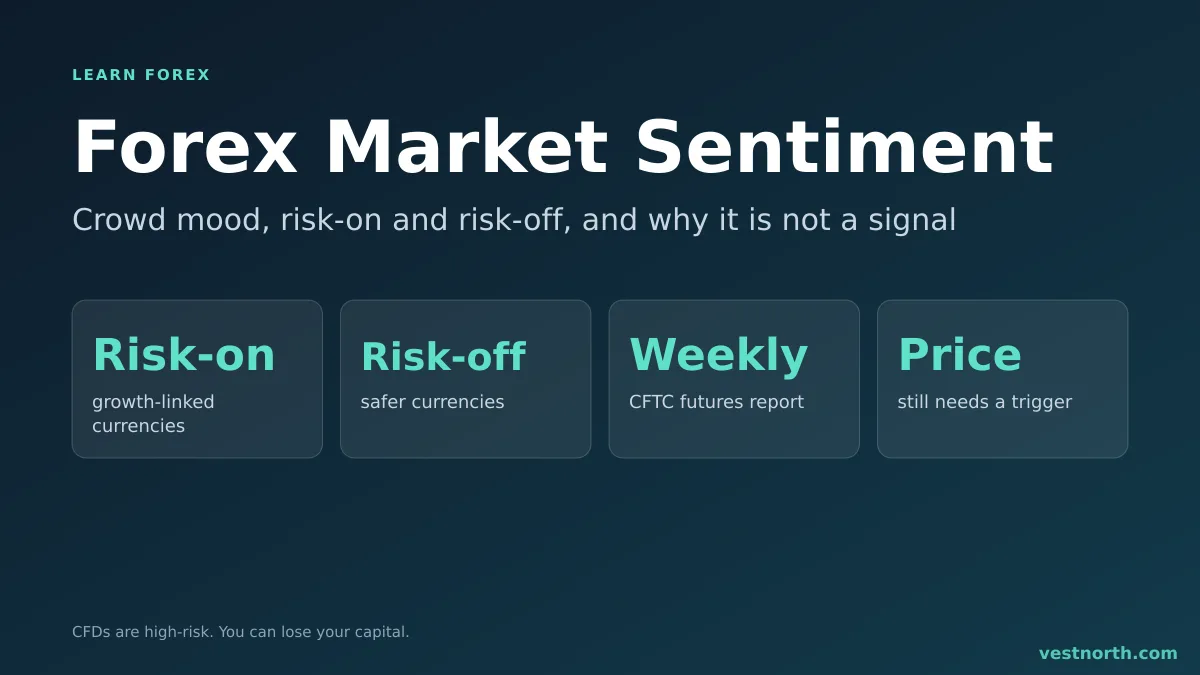
Sentiment in four ideas. Illustration, October 2026.
What sentiment actually measures
Prices move because buyers and sellers act on what they expect. Sentiment is the sum of those expectations. When most participants expect a currency to strengthen, the mood is bullish. When they expect it to weaken, the mood is bearish.
Two things are easy to confuse here:
- Opinion: what traders say they think, such as in a survey.
- Positioning: what traders have actually done with money, such as open long or short positions.
Positioning is harder to fake than opinion, but it covers only the group being counted. No public source tells you what the entire forex market holds, because the market has no central exchange.
Risk-on and risk-off
The broadest sentiment idea in forex is the swing between risk-on and risk-off.
| Mood | What traders tend to do | Currencies often linked to it |
|---|---|---|
| Risk-on | Buy growth-linked and higher-yielding assets | AUD, NZD, CAD |
| Risk-off | Reduce risk and move toward currencies seen as safer | JPY, CHF, often USD |
The links are tendencies, not rules. The yen strengthened in many past risk-off episodes, but there are periods when it did not, for example when interest-rate differences dominated. Check how a pair has actually behaved on your own chart before you assume a relationship holds.
Risk-off moves are often fast, with wider spreads and larger candles. If you hold positions through them, read about slippage and volatility.
Common ways traders read sentiment
Price action itself
The chart already contains sentiment. A currency that keeps making higher highs and higher lows reflects buyers willing to pay more. Long rejection wicks near a level show a push that was refused, which is the idea behind a pin bar. Many traders consider price the cleanest sentiment reading because it needs no outside data.
Positioning reports
The US Commodity Futures Trading Commission publishes a weekly Commitments of Traders report that shows how different groups are positioned in currency futures. It is published with a delay of a few days, so it describes where positions were, not where they are now. Futures are also not spot forex, so the picture is indirect.
Broker client positioning
Some brokers display the share of their clients that are long or short a pair. This is a snapshot of that broker’s clients only. Retail client bases differ between brokers, and the data can look very different from one platform to the next. We have not verified how any broker builds this figure, so check the broker’s own explanation before relying on it.
News and calendar reactions
How a currency reacts to news is itself a reading. A strong data release that fails to lift the currency suggests the good news was already expected. The economic calendar shows when those tests happen, and news trading covers the risks of trading them.
The contrarian idea
A contrarian trader looks for crowded positioning and leans the other way. The reasoning is simple: if nearly everyone is already long, few buyers remain, and a small disappointment can trigger selling.
The weakness is timing. A crowded trade can stay crowded for weeks while the trend continues, and a contrarian who sells early takes repeated losses. Contrarian signals are usually paired with a price trigger, such as a break of structure or a reversal candle at a level, and a defined stop.
A worked example
Suppose EUR/USD has risen for three weeks and a positioning source shows most traders long. A contrarian idea says a drop is more likely than usual. That alone is not a trade. A more disciplined reading could look like this:
- Mark the nearest support or resistance level above price.
- Wait for a rejection candle at that level, not just for the crowd to be long.
- Place the stop beyond the rejection high and size the position from it, using the lot size calculator.
- Skip the trade if the stop is too wide for your risk limit.
If price instead breaks through the level, the sentiment reading was early and the plan has a defined exit.
Where sentiment misleads
- Small sample. Broker positioning covers one broker’s clients, not the market.
- Lag. Weekly reports describe the past.
- Trends outlast extremes. A reading that looks extreme can become more extreme.
- Confirmation bias. Traders who already want to sell tend to notice the data that agrees with them. A trading journal helps you check whether sentiment readings actually helped.
- Emotion. Following the crowd out of fear of missing out is a mood problem of its own. See trading psychology.
Bottom line
Market sentiment is the crowd’s mood, read from price action, positioning data and news reactions. Risk-on and risk-off are the broadest swings, but the currency links are tendencies and can break. Use sentiment as context, wait for a price trigger, set a stop and size the position before entering. Practise the process on a demo account first. Only trade money you can afford to lose. CFDs are complex, high-risk instruments.
Frequently asked questions
What is market sentiment in forex?
It is the overall attitude of traders toward a currency or the market as a whole: bullish if most expect a rise, bearish if most expect a fall. It shows up in price action, positioning data and how currencies react to news.
What does risk-on and risk-off mean?
Risk-on describes periods when traders favour higher-yielding or growth-linked assets and currencies such as AUD and NZD. Risk-off describes periods of caution, when traders often move toward currencies seen as safer, such as JPY and CHF.
Where can I see forex sentiment data?
Common sources are the weekly Commitments of Traders report from the US CFTC, some brokers' client positioning displays, and survey-based indices. Each measures a different group of traders, so they can disagree.
What is contrarian trading?
Contrarian traders look for crowded positioning and lean the other way, on the idea that when almost everyone is already long there are few buyers left. It can fail for long periods in a strong trend.
Is sentiment a good entry signal on its own?
No. Sentiment describes the crowd, not the timing. Most traders combine it with price structure, a stop loss and position sizing instead of trading it alone.
Is broker client positioning the same as the whole market?
No. It covers only that broker's clients, who are a small and unusual slice of the market. Treat it as one data point, not a map of what big institutions are doing.