Forex Volatility Explained for Beginners
Short answer: Volatility is how far and how fast price moves, and it has no direction. You can measure it as the average candle or daily range in pips. When volatility rises, a stop loss must be wider to avoid normal swings, so for the same money at risk the lot size must be smaller. Spreads and slippage can also grow in volatile conditions.
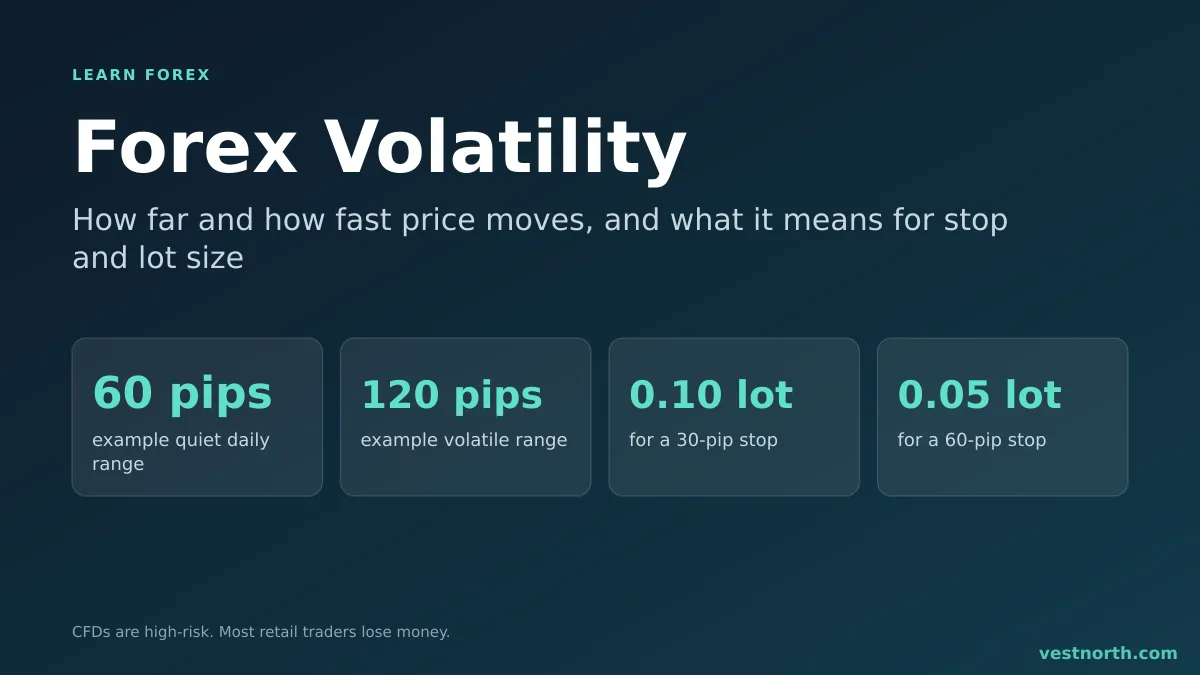
The same risk in dollars gives a different lot size when the average range doubles. Illustration, October 2026.
What volatility means
A pair is volatile when its price moves a lot over a given period. If a pair travels 120 pips on an average day and another travels 60 pips, the first is twice as volatile on that measure. Volatility says nothing about whether price will rise or fall. A pair can drop 150 pips in a day and be highly volatile, and the same applies to a rise.
Volatility changes over time. A pair that was quiet for a week can move more in an hour of news than in the days before. For that reason, a number you measured last month may not describe today.
How to measure it
Three simple ways, from easy to more detailed:
- Candle range. Take the high minus the low of each candle and average the last 10 or 20. On a daily chart this gives the average daily range in pips.
- Average True Range (ATR). An indicator that averages the range of recent candles and includes gaps between one candle’s close and the next open. Most trading platforms have it built in. Its default setting is 14 periods.
- Comparison. Look at today’s range against the recent average. A day that has already moved far beyond the average is unusually volatile.
The results are in pips or points, so you can use them directly when choosing a stop distance. The pip calculator turns pips into money for a given lot size.
What makes volatility rise or fall
- Scheduled news. Central bank decisions, inflation data and jobs reports can move price within seconds. The economic calendar lists when they land.
- Sudden events. Unscheduled news can produce a price spike with little warning.
- Sessions. Trading is usually busier when London and New York overlap and quieter outside main hours. See forex trading sessions.
- Weekend gaps. Price can open far from Friday’s close, as covered in what is a forex gap.
Volatility and your costs
High volatility changes the cost of trading, not only the opportunity:
- Spreads may widen when liquidity is thin or news is due. The spread guide explains why.
- Slippage is more likely, because a stop or pending order fills at the next available price. Slippage covers how it works in both directions.
- Margin. Larger swings move the floating profit or loss faster, which brings a margin call and stop out closer on a highly leveraged account.
A worked example
This is a made-up case. You accept risking 1% of a $3,000 account, which is $30, on a trade. One pip is worth about $1 on a 0.10 lot of a USD-quoted pair.
| Market | Average daily range | Stop loss chosen | Lot size for $30 risk |
|---|---|---|---|
| Quieter | 60 pips | 30 pips (half the range) | 0.10 lot |
| More volatile | 120 pips | 60 pips (half the range) | 0.05 lot |
The stop in both cases is half the average daily range, an arbitrary rule used here to keep the example simple. The point is the effect: when the range doubles, the stop doubles, and the lot size halves to keep the risk at $30. Using 0.10 lots with a 60-pip stop would risk about $60, or 2% of the account. Forex position sizing and the lot size calculator show the full method.
Common mistakes
- Using a fixed 10-pip stop in every market condition. A stop that is smaller than normal price noise is hit often.
- Keeping the same lot size when volatility rises.
- Trading through a major release without checking the calendar.
- Reading high volatility as a signal that price will keep moving in the same direction.
Bottom line
Volatility is the size and speed of price moves in pips. Measure it with the average range or ATR, set the stop beyond normal noise, and let that distance decide the lot size. Expect wider spreads and slippage around news. Risk only money you can afford to lose. CFDs are complex, high-risk instruments.
Frequently asked questions
What is volatility in forex?
Volatility describes how much and how fast price moves. A pair that moves 120 pips a day is more volatile than one that moves 60 pips a day. It says nothing about direction.
How do you measure forex volatility?
The simplest way is the average range of recent candles in pips. The Average True Range (ATR) indicator does this calculation for you and also counts gaps between candles.
What causes high volatility in forex?
Scheduled news such as central bank decisions and jobs reports, surprise events, and busy trading sessions. Volatility is often lower outside the main trading hours.
Is high volatility good for traders?
It gives price more room to move in either direction, and it also raises the chance of stop-outs, wider spreads and slippage. It increases risk as much as opportunity.
How does volatility affect stop loss and lot size?
A volatile market needs a wider stop to avoid being hit by normal swings. With the same money at risk, a wider stop means a smaller lot size.
Does volatility affect spreads?
It can. Spreads may widen around major news or when liquidity is thin, which raises the cost of entry and can trigger stops at worse prices.