Forex News Trading for Beginners: How It Works, the Risks and Common Methods
Short answer: News trading means trading around scheduled releases such as central bank rate decisions, inflation reports and jobs data. Price can move many pips in seconds, spreads widen and orders can slip to worse prices. The three common approaches are to avoid the release, to trade the move after it settles, or to take a position before it. The first two carry less risk than the third.
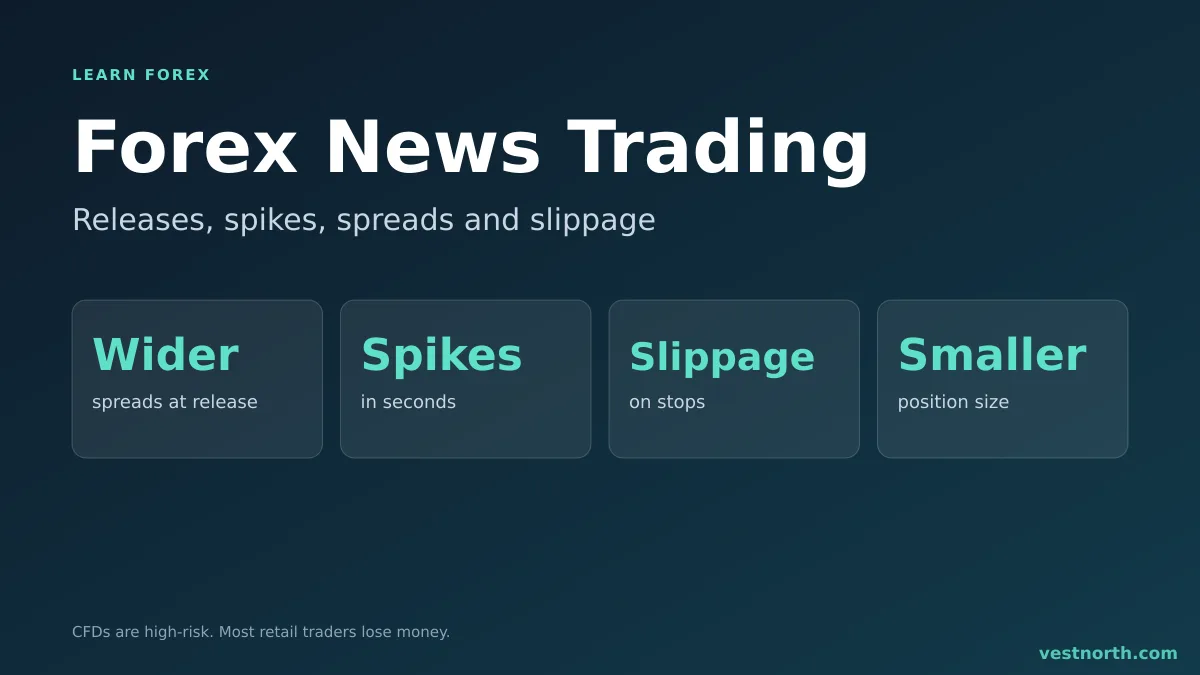
News releases and the market’s reaction. Illustration, October 2026.
What counts as news
Scheduled releases are listed in advance on an economic calendar. The ones traders watch most:
| Release | What it measures | Currencies most affected |
|---|---|---|
| Central bank rate decision | The policy interest rate and the bank’s guidance | The bank’s own currency |
| Inflation (CPI) | Change in consumer prices | The currency of the country reporting |
| Employment reports | Jobs added or lost, unemployment | The currency of the country reporting |
| GDP | Growth of the economy | The currency of the country reporting |
| Central bank speeches and minutes | Hints about future policy | The bank’s own currency |
Calendars usually mark each release as low, medium or high impact. That is a guess about how much price may move, not a measurement.
Why price reacts
A release is compared with a forecast. If the figure matches the forecast, the market has often already priced it in. The reaction is driven by the surprise, the gap between the result and the forecast, and by what it suggests about interest rates. The reaction is not always logical, and price can move one way on the first second and reverse a minute later.
What happens to your order
Three things tend to happen around a major release:
- Wider spreads. Quotes thin out and the gap between bid and ask can grow. Read what a spread is before trading a release.
- Fast spikes. A spike can move many pips in a few seconds and partly reverse.
- Slippage. With few quotes available, orders fill at the next available price. Slippage applies to stop losses as well as entries, and a stop is not a guaranteed exit.
Some brokers set their own rules for pending orders near news. We have not verified any broker’s rules here, so read your broker’s order execution policy before you trade a release.
Three common approaches
- Stay out. Close or avoid trades a few minutes before and after a high-impact release. It is the simplest rule and removes the spread and slippage cost.
- Trade after the dust settles. Wait for the first spike to finish, then look for a breakout or pullback once the spread has returned to normal. Entries come later, but with fewer fills at odd prices.
- Trade the release. Take a position before the release, or place pending orders on both sides. This approach has the largest costs and the highest chance of being filled badly, and it needs small size.
A worked example of the risk
Invented numbers for illustration. A trader wants to risk 1% of a 2,000 USD account, which is 20 USD, on EUR/USD ahead of a jobs report. With a normal 10-pip stop, the position is 0.2 lots, which is about 2 USD per pip, so a 10-pip loss costs 20 USD.
If the spread widens from 1 pip to 8 pips and the stop fills 6 pips further away, the loss is 16 pips, not 10, before counting the wider spread. At 2 USD per pip, 16 pips cost 32 USD, which is 1.6% of the account instead of 1%.
| Item | Normal conditions | Around the release |
|---|---|---|
| Spread | 1 pip | 8 pips (illustrative) |
| Stop distance | 10 pips | 10 pips |
| Slippage | 0 | 6 pips (illustrative) |
| Loss at 2 USD per pip | 20 USD | 32 USD, plus the wider spread |
Use the lot size calculator to size from the stop, then cut that size well below your usual amount if you trade near a release.
Ways to limit the risk
- Check the calendar before the session and note the time zone.
- Cut the position size, or skip the trade, before high-impact releases.
- Do not add leverage because a move looks obvious.
- Do not move a stop loss further away during the event.
- Try the method on a demo account, remembering that demo fills are often cleaner than live fills.
Bottom line
News trading offers large moves, but the same events bring wider spreads, spikes and slippage that can turn a planned 1% loss into a larger one. Most beginners do better by marking releases on the calendar, staying flat around the big ones and trading the calmer market afterwards. If you do trade a release, use a much smaller size than usual. Only risk money you can afford to lose. CFDs are complex, high-risk instruments.
Frequently asked questions
What is news trading in forex?
It is trading around scheduled economic releases, such as central bank rate decisions, inflation and jobs data. Traders either take a position before the release, trade the first reaction, or wait until the market settles.
Is news trading good for beginners?
It is one of the riskier ways to trade. Price can jump in both directions within seconds, spreads widen and orders can fill at worse prices. Many beginners are better off learning to stay out of the market around major releases first.
Why do spreads widen during news?
Liquidity providers pull or widen their quotes when price can move sharply, so the gap between bid and ask grows. Your broker's spread may be wider for a short time. Check the broker's own terms for how it treats news events.
What is slippage on news?
Slippage is a fill at a price different from the one you requested. During a fast move there may be no quote at your price, so a stop loss can fill further away than set. See the slippage guide.
Where do I find release times?
An economic calendar lists the time, currency and expected impact of each release. Check which time zone it uses before you rely on the times.
Can I just use a tight stop loss on news?
A tight stop can be hit by the first spike and then price may go your way. A stop is not a guaranteed exit either, because it can slip. Smaller position size is the safer control.