What Is a Forex Broker?
Short answer: A forex broker is the company that gives retail traders an account, a platform and currency prices. It earns from the spread, commissions and swaps. Who protects your money depends on the regulator and the legal entity that holds your account, not on the broker’s name or marketing.
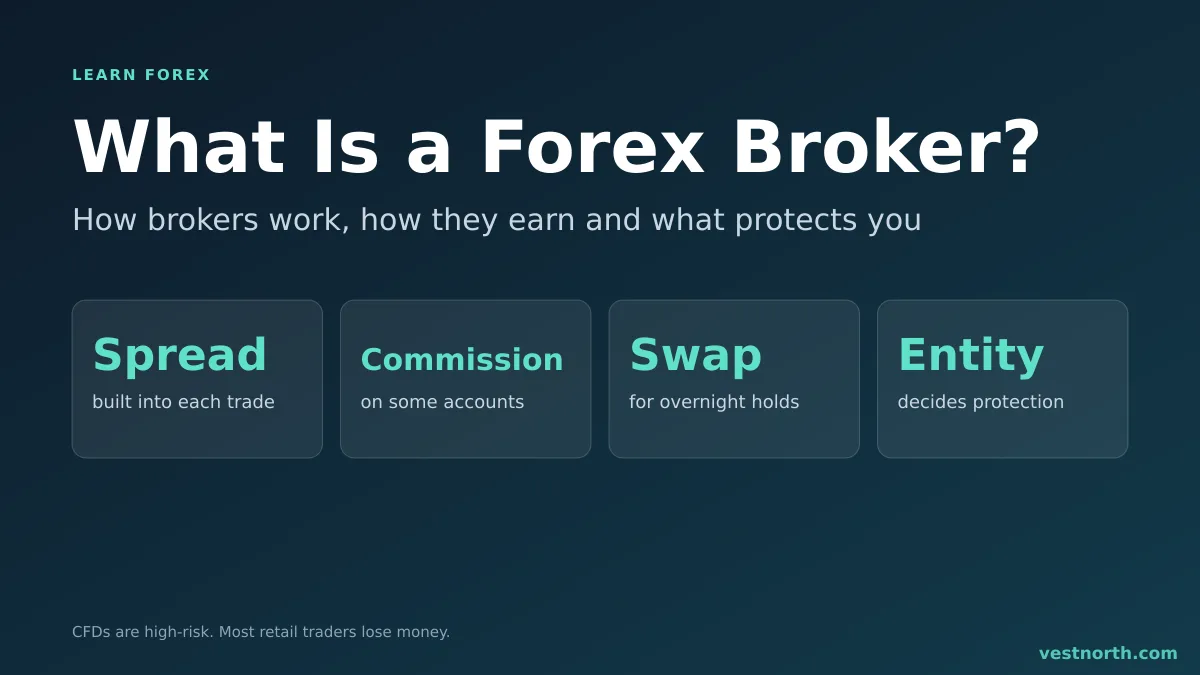
How a retail forex broker works. Illustration, October 2026.
What a broker does
Individuals cannot trade directly on the interbank currency market. A broker connects them to prices and handles the trade:
- Opens an account and takes your deposit.
- Provides a trading platform with live prices.
- Executes your orders, either by matching them with liquidity providers or by taking the other side itself.
- Holds your open positions and charges or credits swaps.
- Processes withdrawals.
How brokers make money
| Source | How it works |
|---|---|
| Spread | The difference between the bid and ask price, built into every trade |
| Commission | A fixed fee per lot, charged on some account types |
| Swap | A charge or credit for holding a position past rollover |
| Other fees | Inactivity, currency conversion, withdrawal fees on some methods |
| Client losses | Only for brokers that take the other side of trades |
The last row is the reason to read how a broker handles orders. If it is the counterparty, your loss can be its gain. Many regulators require such conflicts to be disclosed in the risk warning and client agreement.
Market maker, STP and ECN
Brokers describe their execution model with three common labels.
- Market maker: the broker sets its own prices and is the counterparty to your trade.
- STP: the broker says it passes your order on to a liquidity provider.
- ECN: the broker says it offers raw spreads with a separate commission.
The labels are marketing terms. Our guide to ECN vs STP brokers shows that even brokers that sell Standard STP and Raw ECN accounts can state in the client agreement that they may act as principal. The real information is in the execution policy and agreement for your account.
Regulation and legal entities
A licence matters, but the details matter more.
- Which regulator? Strict regulators publish registers where you can check a licence number. Others offer little protection.
- Which legal entity holds your account? Large brokers run several companies. The one that serves clients in your country may be a different company from the one with the famous licence.
- What protection does that entity give? Compensation schemes, negative balance protection and segregated client funds vary by entity and rules.
For examples of how to read this, see our Vantage, VT Markets, Titan FX and EBC legitimacy guides. Each one names the entity and says what the account does and does not include.
What to check before you open an account
- The licence number, found in the broker’s legal documents and on the regulator’s own register.
- The legal entity named in the client agreement for your country.
- Whether the broker accepts clients from your country at all.
- Minimum deposit, spreads, commission and swaps for the account you plan to use.
- Withdrawal methods, limits and times. Our Exness withdrawal guide shows the kind of detail to look for.
- Whether negative balance protection applies to your entity.
Our methodology page explains how we collect these facts from official sources, and how to choose a forex broker gives a step-by-step checklist.
Red flags
- A broker that cannot show a licence number you can verify on a register.
- Claims that you cannot lose, or promises of fixed returns.
- Pressure to deposit more or to accept a bonus quickly.
- A company name in the footer that differs from the one in the client agreement.
Other broker reviews with a different entity setup: CMC Markets (Bermuda entity for international clients), GTC (six named entities) and DB Investing (FSA Seychelles).
Bottom line
A forex broker is a licensed trading firm that provides your account, platform and prices, and earns from the cost of each trade. Choose by licence, legal entity and costs rather than by advertising, and read the client agreement before you deposit. A regulated broker does not protect you from trading losses. Only trade with money you can afford to lose. CFDs are complex, high-risk instruments.
Frequently asked questions
What is a forex broker?
A forex broker is a company that provides retail traders with an account, a trading platform and access to currency prices. You send orders to the broker, which executes them according to its terms.
How do forex brokers make money?
Mainly through the spread, a commission on some accounts, and swaps charged on positions held overnight. Brokers that act as the counterparty can also earn when clients lose, which is why conflicts of interest matter.
What is the difference between a market maker and an ECN broker?
A market maker takes the other side of your trade through its own dealing desk. A broker that markets an ECN or STP model says it passes orders to liquidity providers. The label does not prove how an order is filled, so read the execution policy.
Is a forex broker the same as a bank?
No. A broker is a trading firm with a licence from a financial regulator, not a bank. Your funds are not insured like a bank deposit unless a specific compensation scheme covers them.
How do I check that a forex broker is regulated?
Find the licence number in the broker's legal documents, then search for it on the regulator's own public register. Also confirm which legal entity holds your account, because protections differ by entity.
Can a regulated broker still lose my money?
Regulation reduces some risks but does not remove trading risk or guarantee that funds are returned in every case. Trading losses are not covered by any scheme, and most retail CFD accounts lose money.