GTCFX (GTC) Review 2026: Entities, Accounts, Fees and Risks
Advertiser disclosure: we may earn a commission if you open an account through our links. It does not affect our assessment. How we make money
Risk warning: CFDs are complex instruments and come with a high risk of losing money rapidly due to leverage. Most retail investor accounts lose money when trading CFDs. Consider whether you understand how CFDs work and whether you can afford to take the high risk of losing your money. Nothing on this site is financial advice.
Note for India: GTC is not authorised by the Reserve Bank of India to offer forex trading to Indian residents. Under FEMA, Indian residents may trade forex only in permitted currency pairs, through RBI-authorised persons, recognised Indian exchanges or RBI-authorised platforms. If you open an account with an offshore broker, you do so at your own risk. RBI Alert List
GTC does not accept clients from your country, so we don't link to it here. See other brokers, and always check that a broker is authorised where you live.
Experienced traders outside the restricted countries who want a commission-free Standard account or an ECN account on MT4 or MT5 and accept that the contracting entity may be offshore
Anyone who needs to know their regulator and compensation scheme before signing up, or who lives in the US, Japan, Australia or another country GTCFX lists as not served
Leverage up to 1:2000, a licence that covers only one entity, and official pages that disagree on the regulators, the minimum deposit and execution speed
Short answer: GTCFX is a CFD brand that says it has operated since 2012 and is headquartered in Dubai. It is not one company. Its regulation page names six separate entities in six jurisdictions, and the one that holds your account depends on where you live. The accounts page lists a Standard account with no minimum deposit and no commission and an ECN account from $3,000 with $5 per lot commission, with leverage up to 1:2000 on Standard for two of the entities.
How this review was made: we read the international GTCFX website (the en-intl pages), including its regulation page, account types, deposit page, restricted countries list and legal documents, and we checked the Vanuatu and Australian licences against the regulators’ own lists, as of October 2026. We could not open the Client Agreement or the help centre articles, and we have not opened a live account. Where GTCFX’s pages disagree, we show both versions.
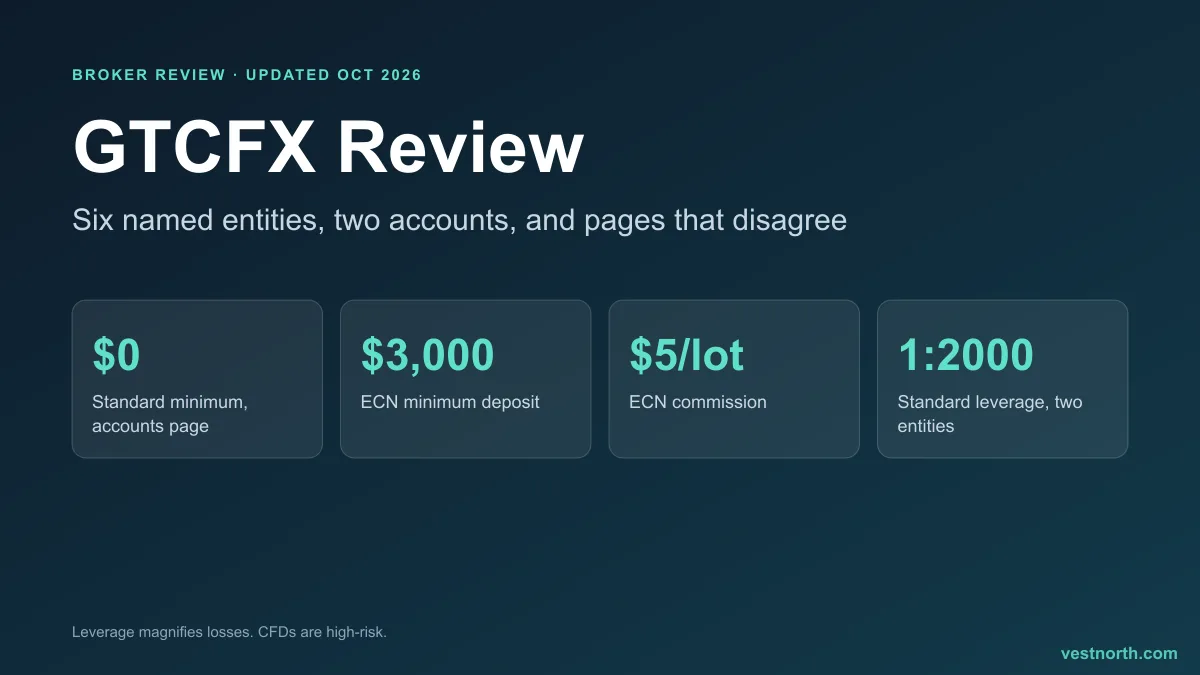 GTCFX in four numbers. Source: GTCFX account types page, October 2026.
GTCFX at a glance
| Brand history | “Since 2012”, headquartered in Dubai, serving “more than 100 countries” per its About page |
| Entities named | South Africa, Vanuatu, Comoros (Anjouan), Australia, Mauritius, Cambodia |
| Account types | Standard and ECN, swap-free option on Standard on request |
| Minimum deposit | Standard: none on the accounts page, $50 on the listed payment methods. ECN: from $3,000 |
| Commission | None on Standard. $5 per standard lot on ECN |
| Spreads | Average 1.0 pip on Standard, raw from 0.0 pips on ECN |
| Leverage | Up to 1:2000 Standard and 1:500 ECN, for GTC Global Ltd and GTC Global Trade Capital Co. clients |
| Platforms | MetaTrader 4, MetaTrader 5, WebTrader, GTC Go app |
| Deposit and withdrawal fees | None charged by GTCFX, third-party fees can apply |
| Not served | USA, Japan, Australia, Russia, Ukraine, Israel, Afghanistan and others (list below) |
Pros and cons
Pros
- Standard account with no minimum deposit and no commission, per the accounts page
- ECN account with raw spreads from 0.0 pips and a stated $5 per lot commission
- MT4, MT5, a browser platform and a mobile app, with MAM, PAMM and API listed
- GTCFX charges no fee of its own on deposits or withdrawals
- Two of the six named licences, Vanuatu and Australia, show up on regulator lists we could open
- A long restricted-countries page with named lists, instead of a vague footer
Cons
- No single regulator: six entities, each licence applies only to its own entity
- The Comoros licence has no register link on the site ("coming soon"), and we could not open the other registers
- Leverage up to 1:2000 magnifies losses fast
- The About page lists the UK FCA as a regulator, but the regulation page names no FCA entity
- The commission basis ($5 per lot, per side or round trip) is not stated on the accounts page
- We could not find margin call, stop out or withdrawal time figures in the pages we read
Is GTCFX safe and legit?
GTCFX says it operates “through a network of separately incorporated entities and affiliates” and that each licence applies only to the entity that holds it. The regulation page (last reviewed May 2026) lists six (source):
| Entity | Regulator | Licence | Type |
|---|---|---|---|
| GTC Global SA (Pty) Ltd | FSCA, South Africa | FSP 51545 | Financial Services Provider |
| GTC Global Trade Capital Co. Limited | VFSC, Vanuatu | 40354 | Principal’s Dealer Licence |
| GTC Global Trading LTD | Anjouan Offshore Finance Authority, Comoros | L16283/GTC | Brokerage Licence |
| GTC Global (Australia) Pty Ltd | ASIC, Australia | AFSL 496371 | Australian Financial Services Licence |
| GTC Global Ltd | FSC, Mauritius | GB22200292 | SEC-2 Investment Dealer |
| GTCFX Co., Ltd. | SERC, Cambodia | 043 N.M.K./A.B./Ch.U. | Derivative Broker (validity 8 October 2026 to 7 October 2028) |
What we could check. The Vanuatu Financial Services Commission licensee list shows GTC GLOBAL TRADE CAPITAL CO. LIMITED, number 40354, class A, B, C, status Active, with a licence date of 21 November 2022 (source). ASIC’s AFS licensee dataset on data.gov.au (October 2026 file) lists GTC GLOBAL (AUSTRALIA) PTY LTD, licence 496371, start date 7 July 2017. Its licence conditions cover general advice and dealing in derivatives and foreign exchange contracts, to retail and wholesale clients (source).
What we could not check. The Mauritius FSC website returned a 403 error, and we did not get a usable result from the FSCA and SERC registers, so we could not confirm those three licences. For the Comoros licence, the regulation page itself shows “Register link coming soon” instead of a link.
Which entity holds your account? GTCFX says “the applicable entity depends on client residence, eligibility and applicable law”, and that it will name the contracting entity before you submit an application and in the Client Agreement. We could not read the Client Agreement. The accounts page says the 1:2000 and 1:500 leverage figures apply only to clients of GTC Global Ltd (Mauritius) and GTC Global Trade Capital Co. (Vanuatu), and the restricted countries page says its list applies to those two entities. That suggests the international site mainly serves clients through those two offshore entities. We could not confirm this from a document, so ask support which entity you would contract with and get it in writing.
The Australian licence. The ASIC-licensed entity exists, but the international website’s footer says its services are not available to residents of Australia, and the restricted countries page lists Australia as not served by the Vanuatu and Mauritius entities. Do not assume ASIC protection applies to an account you open through this site.
The FCA claim. The About page says client funds are held under “FSCA, VFSC, FCA, ASIC, and FSC” and show an “FCA, UK” badge with the line “five regulated entities worldwide”. The regulation page lists six entities and no FCA entity. It adds Comoros and Cambodia instead. We did not find an FCA licence number anywhere on the site, and the FCA register is a script-driven page we could not search, so we could not confirm any FCA authorisation. Treat the FCA badge as unverified.
What this regulation does not give you. A Vanuatu, Mauritius, Comoros or Cambodia licence does not bring the UK FSCS, the Financial Ombudsman Service, an ASIC complaints scheme or the EU leverage caps that come with FCA, ASIC or CySEC retail licences. The regulation page lists no investor compensation scheme for any entity.
Client money and protection claims. GTCFX says client funds are held in segregated bank accounts at “top-tier” banks, separate from company operating capital, and that in an insolvency client money is “fully shielded from creditors” (source). Those are the company’s statements. We could not read the Client Agreement that would set out how each entity treats client money.
Negative balance protection. The regulation page says “Your maximum loss is capped at your account balance”, and the accounts page lists negative balance protection as included. The risk warning in the footer of the same site says “losses may exceed your initial investment”. The two statements conflict, so read the Client Agreement for your entity before you rely on the cap. Our guide to margin call and stop out explains how losses can go beyond a balance when a market gaps.
Accounts, spreads and costs
GTCFX lists two accounts on its accounts page (source):
| Standard | ECN | |
|---|---|---|
| Minimum deposit | None (“$0”) | From $3,000 |
| Spread | Average 1.0 pip | Raw, from 0.0 pips |
| Commission | None | $5 per standard lot |
| Leverage | Up to 1:2000 | Up to 1:500 |
| Swap-free option | Available on request | No |
| Pitched at | Everyday trading | Active traders, scalpers, EAs |
Both accounts include, per the page, no dealing desk intervention, no requotes, no rejections, no trading restrictions, negative balance protection (see above), MAM, PAMM and API access. Every account has a limit of 300 active orders (open positions and pending orders combined), which can be reduced based on account risk.
What a trade costs. On the ECN account, a 1 lot trade pays the spread plus $5 commission. If the $5 is charged on each side, the round trip is $10 per lot, and if it covers the round trip, it is $5. The accounts page does not say which, so the example below shows both. On EURUSD, one standard lot moves about $10 per pip, so a 0.1 pip spread costs about $1:
| ECN, 1 lot EURUSD | $5 per round trip | $5 per side |
|---|---|---|
| Commission | $5 | $10 |
| Spread at 0.1 pip (about $10 per pip) | about $1 | about $1 |
| Total | about $6 | about $11 |
The 0.1 pip figure is an illustration, not a quoted spread. GTCFX shows “from 0.0 pips” and gives no average ECN spread. Use our pip calculator to price your own size, and read spread vs commission if you are comparing the two models.
On Standard there is no commission, so the cost sits in the spread, which the page averages at 1.0 pip. At about $10 per pip on one standard lot, that is about $10 per lot. GTCFX does not publish the instrument-by-instrument spread or swap tables on the pages we read. Swaps (overnight financing) are charged on positions held past the daily rollover.
Speed claims differ by page. The accounts page says “<30ms” execution, the About page says “< 10ms NDD”, and the GTC Go app page shows “Execution 38 ms”. Each is a company marketing figure with no method behind it.
Minimum deposit
The official pages give three answers:
- The accounts page says Standard has no minimum deposit and ECN needs deposits from $3,000.
- The deposit page lists a $50 minimum for Visa and Mastercard, USDT, Apple Pay and Google Pay, and Skrill and Neteller (source). Its card widget separately shows “lowest $0”.
- The Deposit and Refund Policy says method-specific terms shown in the client portal decide limits for each channel, and that those terms prevail over the general policy for that method (source).
In practice, a Standard account may have no account minimum but still need $50 or more to clear a payment method. We could not confirm bank transfer or other method minimums. Check the amount on your payment screen before you send money.
Leverage
The accounts page says Standard goes up to 1:2000 and ECN up to 1:500, and attaches a note that this applies only to clients of GTC Global Ltd and GTC Global Trade Capital Co. (source). The forex page shows a “Leverage 1:” counter without a figure we could read. We did not find leverage tiers by instrument, margin call or stop out levels, or a rule that cuts leverage around news events, and the FAQ page only links to a “How do I change my leverage setting?” article that we could not open.
At 1:2000, a 0.05% move against a position wipes out its margin, so the practical risk is how fast a small price change eats an account. Our guide to what leverage is and the page on forex leverage ratios cover how to size positions. Clients under other entities, including an ASIC-regulated one, may face lower caps, and we could not see those limits.
Deposits and withdrawals
Methods. The deposit page lists Visa and Mastercard, international bank transfer, Skrill and Neteller, USDT on TRC20, Apple Pay and Google Pay, and says funds arrive instantly with “10+ payment methods” (source). Which methods you see depends on your country, since the policy says a method shown to one client may not be available to another.
Fees. GTCFX says it charges nothing on deposits and withdrawals. The Deposit and Refund Policy adds that “free” or “$0” means only that the company charges no processing fee of its own, and does not cover third-party bank, card or network fees or currency conversion (source).
Withdrawals. The deposit page says funds are “always returned to the verified source of deposit”. We did not find a withdrawal processing time or a per-method withdrawal minimum on the pages we read, so we cannot give one. The policy says the company may ask for identity, address, payment-method ownership, source of funds or source of wealth before a payment, and may delay, reject or hold a payment for legal or risk reasons.
Refund of an unused deposit. The policy says you can ask for a refund up to 23:59 UTC on the first business day after the deposit shows as credited, provided the deposit has not been used for any trade, conversion, copy-trading allocation or other account activity. A complete refund request is normally reviewed within five business days. After that, or after any use of the account, the request is treated as a withdrawal under the Client Agreement. A refund or withdrawal can also cancel a bonus, rebate or promotion under that offer’s terms.
Platforms, instruments and tools
Platforms. GTCFX offers MetaTrader 4 and MetaTrader 5 for Windows, macOS, iOS and Android (MT5 page), a browser WebTrader, and its own GTC Go app, available on the App Store and Google Play (source). The MT5 page says 38+ built-in indicators and 21 timeframes, and the MT4 page says 9 timeframes. The accounts page also lists free VPS hosting, signals and analysis, API access and a dedicated manager, with no conditions stated. We could not find the terms for the free VPS.
Instruments. The site groups its markets as forex, energy, indices, metals, shares and futures CFDs. The accounts page says “6+ trading markets”. The forex page header says “70+ Pairs”, while its live table says it lists 96 instruments, and the GTC Go app page claims “27,000+ instruments”. The About page says “100+ markets”. These do not match, so check the symbol list inside the platform you plan to use.
Copy trading and bonuses. The site has a copy trading page and a promotions page. The promotions page did not return readable offer terms to us, so we say nothing about any bonus. If you take one, read the conditions on withdrawals and volume first, and remember a refund can cancel it.
Is GTCFX available in my country?
The restricted countries page, which says it applies to GTC Global Ltd and GTC Global Trade Capital Co. Limited, has three lists (source):
- Prohibited (3): North Korea, Iran, Myanmar.
- Service restriction (7): Afghanistan, Russia, Ukraine, Israel, USA, Australia, Japan.
- High risk (16): residents face enhanced due diligence and “may not be accepted”. Examples include Iraq, Kenya, Kuwait, Lebanon, Nepal, Syria, Venezuela and Yemen.
The regulation page separately says GTCFX does not serve residents of the United States, Japan or any place where doing so would conflict with local law. The note on the restricted page says other entities may have different rules, and that support will confirm which entity, if any, can serve your country. We do not recommend offshore brokers to US residents or to anyone barred by local law.
GTCFX alternatives
| If you want… | Compare |
|---|---|
| A broker with a clearly named global entity and published fee tables | Vantage review |
| Another offshore broker with Standard and raw-spread accounts | Titan FX review |
| A very low deposit and cent accounts | Exness review |
| Retail protection from a tier-1 regulator | A broker licensed by the FCA or ASIC for retail clients in your country |
Not sure how to weigh them? Our guide on how to choose a forex broker covers entity, regulator and cost checks, and ECN vs STP explains the two pricing models.
Bottom line
GTCFX offers two clearly priced accounts: Standard with no commission and a 1.0 pip average spread, and ECN from $3,000 with raw spreads and $5 per lot commission. It supports MT4, MT5 and its own app, and it names six licensed entities, two of which we could match on regulator lists.
The same pages show where to be careful. The licence belongs to one entity at a time, the entity you get depends on where you live and is likely to be offshore, and the About page lists a UK FCA authorisation that the regulation page does not back. The minimum deposit, speed and negative balance statements also conflict.
Our recommendation: consider it only if you are an experienced trader who has asked support for your entity in writing, confirmed the deposit minimum and ECN commission basis on your payment screen and client agreement, and keeps leverage far below 1:2000. Practise on a demo account first, and only deposit money you can afford to lose.
Note for India: GTC is not authorised by the Reserve Bank of India to offer forex trading to Indian residents. Under FEMA, Indian residents may trade forex only in permitted currency pairs, through RBI-authorised persons, recognised Indian exchanges or RBI-authorised platforms. If you open an account with an offshore broker, you do so at your own risk. RBI Alert List
GTC does not accept clients from your country, so we don't link to it here. See other brokers, and always check that a broker is authorised where you live.
Frequently asked questions
Is GTCFX legit?
GTCFX names six separate entities on its regulation page, in South Africa (FSCA), Vanuatu (VFSC), Comoros (AOFA), Australia (ASIC), Mauritius (FSC) and Cambodia (SERC). We confirmed the Vanuatu entity as Active on the VFSC list and the Australian entity on ASIC's licensee dataset. We could not confirm the others. Each licence covers only its own entity, and clients of the international site are likely to sit with an offshore one.
What is the GTCFX minimum deposit?
The accounts page says the Standard account has no minimum deposit and the ECN account needs deposits from $3,000. The deposit page lists a minimum of $50 for cards, USDT, Apple Pay, Google Pay, Skrill and Neteller, so a Standard account may need at least $50 in practice. Check the figure on your payment screen.
How much commission does a GTCFX ECN account charge?
The accounts page says $5 per standard lot on ECN and no commission on Standard. It does not say whether the $5 applies per side or per round trip, so ask support before you rely on a cost estimate.
What is the maximum leverage at GTCFX?
The accounts page says up to 1:2000 on Standard and up to 1:500 on ECN, and adds that this applies only to clients of GTC Global Ltd and GTC Global Trade Capital Co. Clients of other entities may get lower limits, which we could not see on the pages we read.
Does GTCFX charge deposit and withdrawal fees?
GTCFX says it charges no fee of its own on deposits and withdrawals. Its Deposit and Refund Policy adds that a method labelled free does not cover third-party bank, card, crypto network or currency conversion charges.
Does GTCFX offer negative balance protection?
The regulation page and the accounts page both say negative balance protection is included. The risk warning on the same site says losses may exceed your initial investment, so read the Client Agreement for your entity to see which statement applies to you.
Which countries does GTCFX not accept?
For GTC Global Ltd and GTC Global Trade Capital Co. Limited, the restricted countries page lists Afghanistan, Russia, Ukraine, Israel, the USA, Australia and Japan as not served, and North Korea, Iran and Myanmar as prohibited. It also lists 16 high-risk countries that face enhanced checks. Other entities may follow different lists.
Sources
- GTCFX: Regulations
- GTCFX: Account types
- GTCFX: Deposit
- GTCFX: Deposit and Refund Policy
- GTCFX: Restricted Countries
- GTCFX: Risk Disclosure
- GTCFX: Terms and Conditions (website)
- GTCFX: About us
- GTCFX: FAQs
- GTCFX: MetaTrader 4
- GTCFX: MetaTrader 5
- GTCFX: GTC Go app
- GTCFX: Forex CFDs
- Vanuatu Financial Services Commission: Financial Dealers licensee list
- ASIC: AFS Licensee Dataset (data.gov.au)
Sources checked on October 27, 2026. Broker terms change often: confirm the current conditions on the broker's own site before you open an account.