Forex Liquidity Explained: What It Is and Why It Changes Your Spread and Fills
Short answer: Liquidity is how easily you can buy or sell a currency pair without moving its price. When it is high, the spread is tight and orders fill close to the price you clicked. When it is low, spreads widen and slippage becomes more likely. Liquidity changes through the day, is usually deepest on major pairs, and thins out around rollover, holidays and big news.
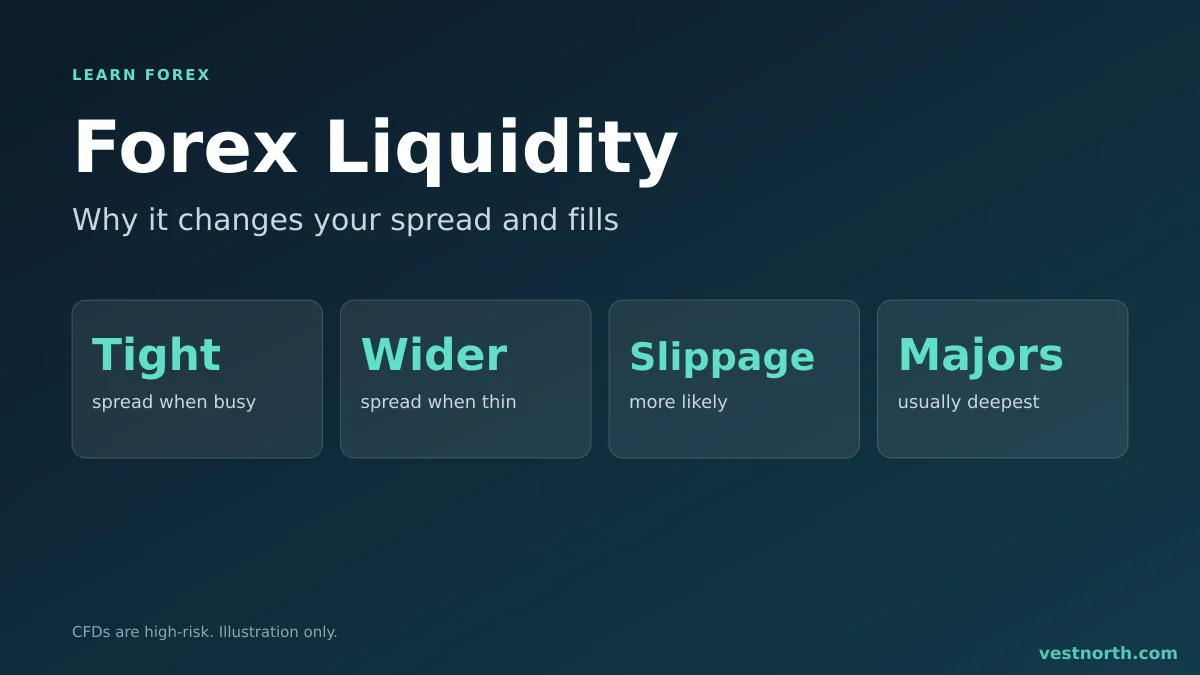
Liquidity in four ideas. Illustration, October 2026.
What liquidity means for a retail trader
Imagine selling a used car. If ten buyers are in the car park, you sell fast at a fair price. If one buyer turns up at midnight, you either wait or accept a low offer. Liquidity is the number of ready buyers and sellers, and the price you get depends on it.
In forex there is no single exchange where every order sits. Banks, dealers and other liquidity providers all quote prices, and your broker passes you a price built from its own feed. That is why two brokers can show slightly different quotes for the same pair at the same second. Our guide to what a forex broker does and the ECN vs STP page explain how brokers source those prices.
The three signs of good liquidity
- A tight spread. The gap between bid and ask is small. See bid and ask price if the terms are new.
- Small price steps. The price moves in small increments rather than jumping several pips at a time.
- Fills near your price. Market orders execute at or very close to the quote you saw.
How liquidity changes your costs
The spread is the most visible cost, and it moves with liquidity. The figures below are made-up examples to show the effect. They are not quotes from any broker.
| Condition | Example EUR/USD spread | Cost of 1.00 lot (about $10 per pip) |
|---|---|---|
| Busy session | 0.8 pips | about $8 |
| Quiet hours | 1.5 pips | about $15 |
| Seconds after a major news release | 4.0 pips | about $40 |
Same trade, same pair, and the entry cost differs fivefold. If you trade very short term, this matters most. Our scalping vs swing trading page explains why small targets are hit hardest by wide spreads, and the trading costs guide adds swap and commission.
Liquidity and slippage
A market order fills at the best price available at that moment. With thin liquidity, the best price may be several pips away from the one on your screen.
Worked example: you click buy EUR/USD with the price at 1.1000. Liquidity is thin, and the next available offer is 1.1003. You fill at 1.1003, which is 3 pips of slippage. On 0.50 lot (about $5 per pip) that is about $15 more than expected. Our slippage guide covers positive and negative slippage and how order types limit it.
Stop orders are exposed too. A stop loss becomes a market order once the price touches it, so in thin trading it can fill beyond the level you set.
When liquidity is usually thin
- Around the daily rollover. Many brokers widen spreads for a short window at the end of the trading day. See forex rollover.
- Weekend opens and holidays. Fewer participants are active, and the first prices after a gap can be far from Friday’s close. See forex gaps.
- Major news. Quotes can be pulled for moments, then return wider. Check the economic calendar before you trade.
- Between sessions. Activity changes as Tokyo, London and New York open and close. The trading sessions page shows the overlaps.
- Exotic pairs. Fewer participants trade them, so spreads are wider all day.
How to check liquidity before you trade
- Compare the live spread with the typical spread listed by your broker for that pair. If it is far wider, wait.
- Avoid entering in the minutes before and after high-impact news unless you accept the risk.
- Prefer major pairs while you learn. Read the currency pair guide to see which pairs are majors.
- Use limit orders where you can, because they cap the price you accept. See forex order types.
- Look at a candle chart for sudden long wicks, which often mark thin moments. The candlestick basics page explains wicks.
A note on “order book” views
Some platforms show a depth of market window with bids and offers at several levels. For spot forex this reflects the data your broker or its liquidity provider chooses to show, not the whole market. Treat it as a hint about that broker’s feed, not as proof of how much real volume sits at a price. We did not check any specific broker’s depth feature for this page.
Bottom line
Liquidity decides how tight your spread is and how close your fill lands to the price you clicked. It is deepest on major pairs in busy sessions and thinnest around rollover, holidays and news. Check the live spread before each entry, size positions with the slippage risk in mind, and use position sizing to keep losses within your limit. Only risk money you can afford to lose. CFDs are complex, high-risk instruments.
Frequently asked questions
What is liquidity in forex?
Liquidity is how easily you can buy or sell a currency pair without moving its price. When many buyers and sellers are active, orders fill close to the quoted price.
Why does liquidity change the spread?
When fewer participants quote prices, the gap between the bid and the ask usually widens. Spreads on the same pair can be tight in busy hours and wider in quiet ones.
When is forex liquidity lowest?
Typically around the daily rollover, on weekends and holidays, and in the minutes around major news. Each broker's own hours and conditions apply.
Does forex have an order book?
There is no single central order book for spot forex. Prices come from many banks and liquidity providers, and your broker shows you its own feed. Some platforms show a depth of market view, but it reflects only that broker's data.
How does low liquidity cause slippage?
With thin liquidity, there may not be enough orders at your price, so the order fills at the next available one. The difference between the expected and actual price is slippage.
Which pairs are the most liquid?
Major pairs such as EUR/USD and USD/JPY usually trade with the most activity and the tightest spreads, while exotic pairs are thinner. Check your broker's spread table for the real figures.