What Is a Stop Hunt in Forex? What the Term Means, What Is Provable and How to Place Stops Better
Short answer: A stop hunt is a quick move through an obvious level that triggers stop losses, then reverses. The term describes how it feels: you are stopped out and price goes your way afterwards. Some of these moves are ordinary market behaviour around levels where many orders sit. Whether a particular broker does it on purpose cannot be proven from a chart. What you can control is where the stop goes and how big the position is.
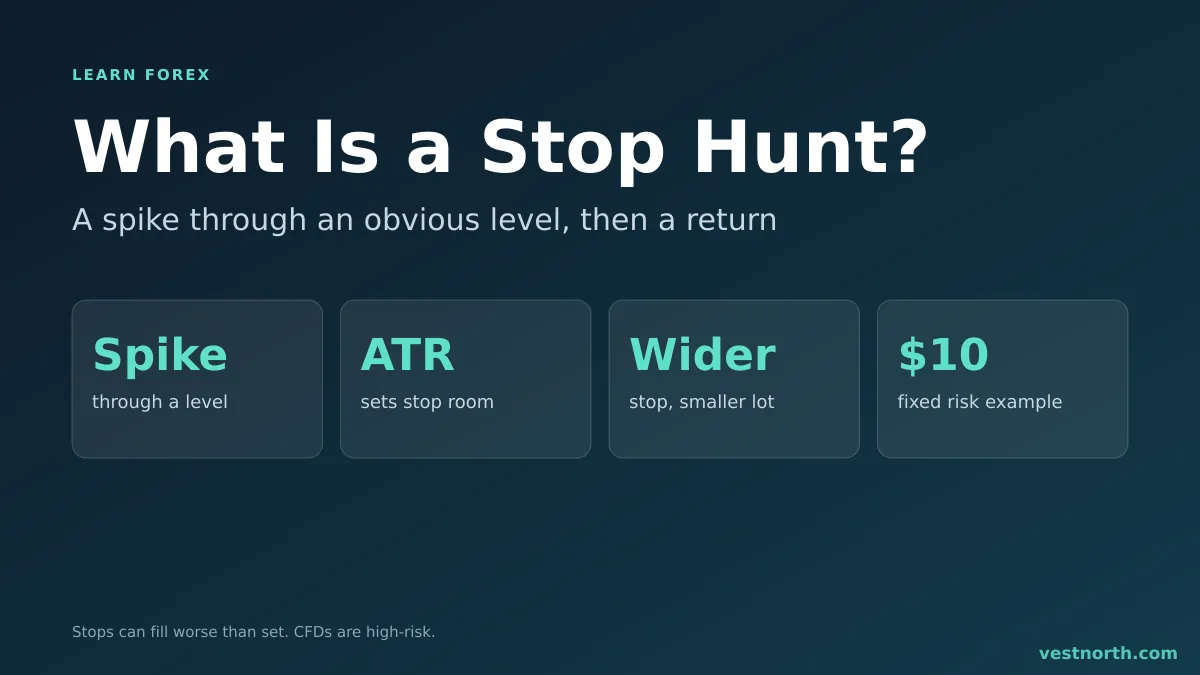
A stop hunt as traders describe it: a spike through a level, then a return. Illustration, October 2026.
Why price can spike through obvious levels
A stop loss is an order. When price touches it, the order becomes a market order and the position closes at the next available price. If many traders have stops in the same area, the orders can trigger one after another.
Obvious places to find them:
- just under a recent low or just over a recent high;
- just beyond a round number such as 1.1000;
- just past a trend line or a support and resistance level that many traders draw;
- right at the edge of a range.
Breakout traders also put pending orders in the same places. When price goes through, those orders fill together, which can add fuel to the move for a few candles. Then the buying or selling dries up and price falls back inside. This is the same shape as a fakeout.
What is provable and what is not
| Claim | Can a chart prove it? |
|---|---|
| Price went through a level and returned | Yes |
| Many stops probably sat at that level | Reasonable, but a guess |
| The spike was caused by stop orders | Not from a chart alone |
| A specific broker moved its price to hit your stop | Not from a chart alone |
Reports that a broker widens spreads or shifts prices to trigger clients’ stops are serious. If you suspect it, compare the same moment on a second data source, save screenshots with times, read the broker’s order execution policy, and check the regulator’s register for the entity that holds your account. We have not traded real money with any broker and do not make claims about any broker on this page.
Wide spreads at certain times are normal and documented. See spread, trading sessions and rollover. A spread widening at the end of the US session can trigger a stop on a sell position, because the stop on a sell is triggered by the ask price.
A worked example
This uses made-up prices on EUR/USD. It is not a real trade.
- Support sits at 1.0800 after three touches.
- You buy at 1.0820 and place a stop at 1.0795, just under support. That is 25 pips of risk.
- A news spike drops price to 1.0788 for two candles, then it returns to 1.0850.
- Your stop at 1.0795 triggered. Loss: 25 pips plus slippage.
Now compare a stop placed beyond the spike, at 1.0770. That is 50 pips from entry. To keep the same money at risk, the lot size has to halve. With a $1,000 account and a 1% rule ($10): 25 pips needs about 0.04 lot, 50 pips needs about 0.02 lot. The wider stop survives the spike. The trade makes half as much when it works. That is the trade-off. The lot size calculator does this arithmetic.
Placing stops with less noise
- Use volatility, not a guess. The average true range shows how far price usually moves per candle. Many traders put the stop one or two ATR values from entry or beyond the nearest level.
- Avoid the exact level. A stop one pip below a round number or an old low is exposed to the same orders everyone else has.
- Resize, do not squeeze. A wider stop needs a smaller position. See position sizing and risk per trade.
- Avoid thin times and news. Check the economic calendar before entering, because spikes cluster around releases.
- Wait for a close. Some traders use a candle close beyond the level as the exit rule instead of a hard stop. That takes discipline and exposes you to a larger loss in a fast move, so the account must be able to afford it.
- Know the order types. A stop loss normally fills at the next available price, so fast markets can fill worse than your level. A guaranteed stop, where a broker offers one, fills at the set price but may carry a cost and conditions.
Check the broker’s own documents
Order execution policies, spread information and stop-out levels are published by each broker. Read the policy for the legal entity that holds your account, and see how stop out works on your account type. Our methodology page explains how we use official documents for broker pages.
Bottom line
A stop hunt is a spike through an obvious level that triggers stops and then reverses. Some of it is simple market behaviour, and a chart alone cannot show intent. Place stops using volatility instead of exact levels, shrink the lot size when you widen a stop, and avoid entries right before news. Only risk money you can afford to lose. CFDs are complex, high-risk instruments.
Frequently asked questions
What is a stop hunt in forex?
A stop hunt is a quick move through an obvious price level that triggers many stop losses, after which price returns. Traders use the term when they are stopped out just before the market goes their way.
Do brokers hunt stops?
We cannot say, and we have not tested any broker. Some stop-outs are plain market behaviour around obvious levels. A regulator's register and the broker's order execution policy are the places to check how orders are handled.
Why do prices spike through round numbers and old highs?
Many traders place stops and pending orders at the same obvious levels. When price reaches them, orders trigger together and can push price a little further before it settles.
How can I avoid being stopped out by a spike?
Place the stop beyond the level with room for normal noise, for example using the average true range, and reduce the lot size so the wider stop still risks the same amount.
Is a wider stop always better?
No. A wider stop lowers the chance of a quick stop-out but increases the loss if it is hit. The lot size has to shrink so the money at risk stays the same.
Does a guaranteed stop prevent stop hunts?
A guaranteed stop fills at your price, even through a gap, but it can cost an extra fee and not every broker or account offers one. It does not stop price touching your level.